

Modern Australian
The Times

Giant dragonflies once roamed Earth’s skies. New research upends the textbook theory of why they went extinct

  • Written by Roger S. Seymour, Professor Emeritus of Physiology, Adelaide University

Insects first took to the skies about 350 million years ago, some 200 million years before birds first flapped their wings.

By the end of the Carboniferous period, 300 million years ago, some flying insects had become gigantic. Huge dragonfly-like insects called griffinflies had wingspans of 70cm – five times the size of the largest modern dragonflies.

These giant insects lived in a time when Earth’s atmosphere contained more oxygen than it does today: around 30%, compared with the modern 21%.

Because large flying insects lived in a time of high oxygen levels, scientists have proposed that they required these high external oxygen levels to power the rapid burn of energy during flight.

In new research published today in Nature, we studied the muscles of dozens of modern flying insects and made a surprising discovery: there is no reason the griffinfly could not survive in today’s atmosphere.

The structure of the insect flight respiratory system

Flying takes more energy than running or swimming, because a flapping flier must constantly work against gravity to remain in the air.

Consequently, the flight muscles use a lot of oxygen, and the rate of oxygen consumption increases roughly in proportion to the weight of the flier. The highest rate of oxygen consumption per gram by any known tissue occurs in a flying bee.

Microscope images showing vivid green veins on a dark red background.
Tracheal system (green) supplying oxygen into the flight muscles (red) of a vinegar fly. Jayan Nair and Maria Leptin / European Molecular Biology Laboratory, CC BY

Oxygen is supplied to insect flight muscles through the “tracheal system”, a tree-like branching system of air-filled tubes that lead to the smallest branches, called “tracheoles”, where oxygen moves into the muscle tissue.

Each tracheole is a dead end, which means oxygen delivered to the muscle travels primarily by diffusion. First it diffuses through the air inside each tracheole, and then through the muscle tissue itself.

The old hypothesis

In modern insects, oxygen levels near the oxygen-consuming mitochondria that power the flight muscle are very close to zero. This implies that the structure of the tracheal system was just adequate to supply sufficient oxygen.

A larger insect would need a greater supply of oxygen, which would mean a greater driving force for diffusion, which in turn means more oxygen in Earth’s atmosphere.
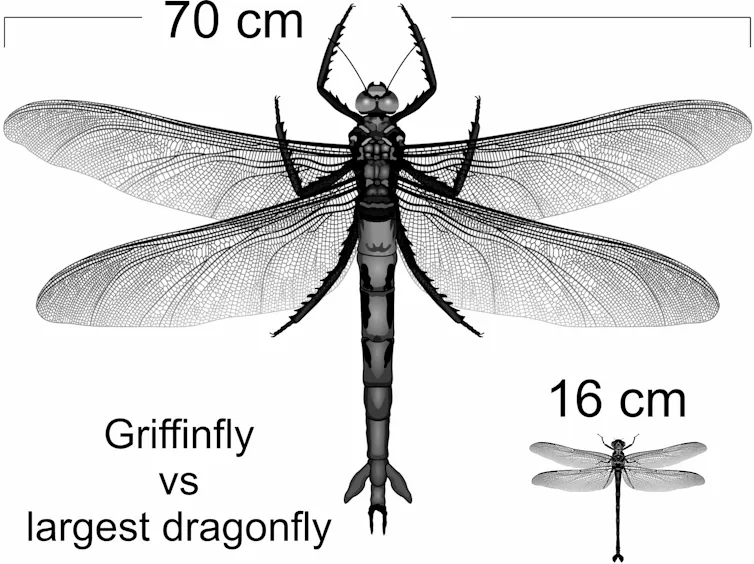
Illustration of a griffinfly with 70cm wingspan and a modern dragonfly with 16cm wingspan.
The extinct griffinfly (left) next to one of the largest living dragonflies, the giant petaltail (right). Estelle Mayhew / Aldrich Hezekiah

The idea that the structure and function of the insect tracheal system limits body size has prevailed for the past 30 years and appears in educational textbooks.

Our interest in the theory arose 15 years ago, when we looked at thin slices of the flight muscle of locusts. The tracheoles appearing between and within the muscle fibres were few and took up only about 1% of the area, compared with the mitochondria that were occupying about 20%.

New evidence

We initially thought all an insect had to do to increase its oxygen delivery would be to increase the number of tracheoles. After all, this is where oxygen is supplied to the mitochondria.

To be sure the locust was not exceptional and to properly understand the effect of body size, we measured 44 species of flying insects of different body masses and metabolic rates. The project required five years and 1,320 transmission electron micrographs.

But the results were essentially the same: the tracheoles occupied only about 1% of the cross-sectional area of the flight muscles regardless of body size. In contrast, the blood-filled capillaries in the flight and cardiac tissue of some birds and mammals occupy about 10% of the area.

Microscope images
Under the electron microscope, thin slices of insect muscle (left) and mammal muscle (right) show the tracheoles and capillaries in white. Antoinette Lensink and Edward Snelling

This shows there is plenty of scope to increase the number and volume of tracheoles without weakening the muscle. So the structure of the tracheal system is not an important constraint on body size.

Evidence from developing insects shows insects can grow more tracheoles in flight muscle in lower oxygen levels, and they pass this trait to their offspring. The conclusion is that the body size of flying insects has never been limited by the structure or function of their tracheal systems.

There is no physiological reason why insects the size of griffinflies could not fly in today’s atmosphere. And yet they don’t exist today.

The simpler reasons may be that larger animal species are more prone to extinction than smaller ones – and 300 million years ago, the griffinfly had no bird or mammal predators to watch out for.

Authors: Roger S. Seymour, Professor Emeritus of Physiology, Adelaide University

Read more https://theconversation.com/giant-dragonflies-once-roamed-earths-skies-new-research-upends-the-textbook-theory-of-why-they-went-extinct-278997

Road Signs: Understanding Their Role in Clear and Effective Signage

Effective signage and display hardware can help businesses communicate information, promote products and organise customer or visitor movement. Road...

Bottle Label Printing: Key Factors to Consider Before Your Next Packaging Run

Effective packaging begins with understanding the product, bottle material, artwork and production requirements when planning bottle label printing. H...

Planning a Long-Distance Move With Interstate Movers Melbourne

Moving between states involves more planning than a typical local relocation. Along with packing and transporting household belongings, you need to...

Understanding the Role of an I/O Controller in Industrial Automation

Modern industrial systems depend on accurate communication between sensors, machines and control systems. An I/O controller can help manage this commu...

How the Right Mining Hose Supports Demanding Operations

Mining environments place considerable demands on equipment used for material transfer, water management and processing. Hoses operating in these co...

Simple Ideas for Making Social Gatherings More Memorable

We have all been to those parties where everyone just stands around the kitchen island, staring at their phones, waiting for someone else to make a mo...

Outdoor Wall Lights: Improving Exterior Lighting Around Your Home

Lighting can influence how a room looks, feels and functions, so the right fitting should be selected according to both appearance and practical req...

Commercial Office Cleaning: Combining Routine Office Cleaning With Melbourne Service

Keeping a workplace clean requires a service that can accommodate everyday tasks as well as the particular needs of the business. Professional comme...

Caravan Sales in Queensland: How to Find the Right Caravan for Sale QLD

Caravan ownership is about more than having somewhere to sleep while travelling. For many Queenslanders, it is one of the best ways to explore regio...

What Sir Walter Buffalo Turf Actually Costs in 2026 (And Why Quotes Vary So Much)

Two quotes landed on a Hills District homeowner's kitchen table last spring for the exact same 80-square-metre backyard. One said $12 a metre. The o...

Nearly 1,300 NSW Hospital Beds Are Occupied By People Who Are Ready To Go Home

1,276 people in NSW hospitals have been medically cleared for discharge but remain in hospital because they're still waiting for NDIS or aged care sup...

National Survey Launched to Measure Operational Impacts of Federal NDIS Policy Reforms

The effects of recent NDIS reforms are beginning to move beyond policy papers and into day to day service delivery. A new national survey is asking ...

Beyond the Nappy Cake: Baby Shower Gifts That Get Used

What new Australian parents unwrap, keep, and quietly thank you for months later. Six weeks after my daughter was born, I did an audit of the baby sh...

Parent-Advocates Are Reshaping Frontline Disability Service Delivery

Parents have always been part of the disability sector. They advocate, coordinate services, challenge decisions and often become the person holding ev...

Vista Cruises Enters "Two-Flagship Era" as Vista Aurora Completes Inaugural Voyage

Vista Aurora Sets Sail along the Yangtze. (Photo courtesy of the company)YICHANG, China — August 5, 2026 — Vista Aurora, a high-end interprovinc...

A Digital Preparation Checklist For International Medical Conferences

An international medical conference compresses many responsibilities into a few days. A delegate may need to present research, move between venues, ...

The Growing Popularity of Lab Grown Diamonds in Sydney and Hong Kong

The diamond industry has changed significantly in recent years as more buyers seek ethical, affordable, and sustainable alternatives to mined diamon...

Modern AI SEO Agency vs Traditional SEO: What’s the Difference

Search engine optimisation has changed dramatically over the past few years. Search engines have become smarter, user behaviour has evolved, and bus...
















