

is this oil shock the wake-up call NZ needed?
- Written by: Murat Ungor, Senior Lecturer in Economics, University of Otago
In recent years, there has been no shortage of warnings about the fragility of New Zealand’s largely imported fuel supply.
Now, motorists are seeing the cost of that vulnerability at the pump. Across the country, petrol has surpassed $3.30 a litre on average. On Auckland’s Waiheke Island, locals protested after prices at a local station exceeded $4 a litre.
The catalyst, of course, is the US and Israel’s ongoing war on Iran. It has disrupted key supply chains and pushed Brent crude, the international benchmark for oil prices, over $100 a barrel.
There is no sign yet of Iran ending its effective closure of the Strait of Hormuz, a narrow waterway between Iran and Oman through which roughly 20% of all the world’s oil shipments flow.
New Zealand prime minister Christopher Luxon has called the crisis “one of the most significant oil shocks we’ve had in history”.
For his government, this moment should surely have prompted a hard look at the country’s deep dependence on imported fuels – and what sustainable alternatives there are to reduce it.
A small country, far from fuel
New Zealand is an island economy heavily dependent on imported fuel, and any sustained disruption ripples quickly through everyday costs.
The reason lies in both geography and infrastructure. Until 2022, the Marsden Point refinery supplied around 70% of the country’s refined fuel. Its closure meant New Zealand now relies entirely on imported petrol, diesel and jet fuel, sourced mainly from refineries in Singapore, South Korea and China.
Those refineries, in turn, depend on crude oil that travels through the Strait of Hormuz. In effect, New Zealand faces a double exposure: higher global prices and the risk of delayed supply.
The government says New Zealand currently holds around seven weeks of supply, in storage and on ships already bound for our shores.
Finance Minister Nicola Willis has acknowledged that buffer relies on “ships like this continuing to turn up.” It was designed to smooth over short disruptions, not absorb a sustained global crisis. Officials are already planning for scenarios lasting eight to twelve weeks.
Who gets hit first?
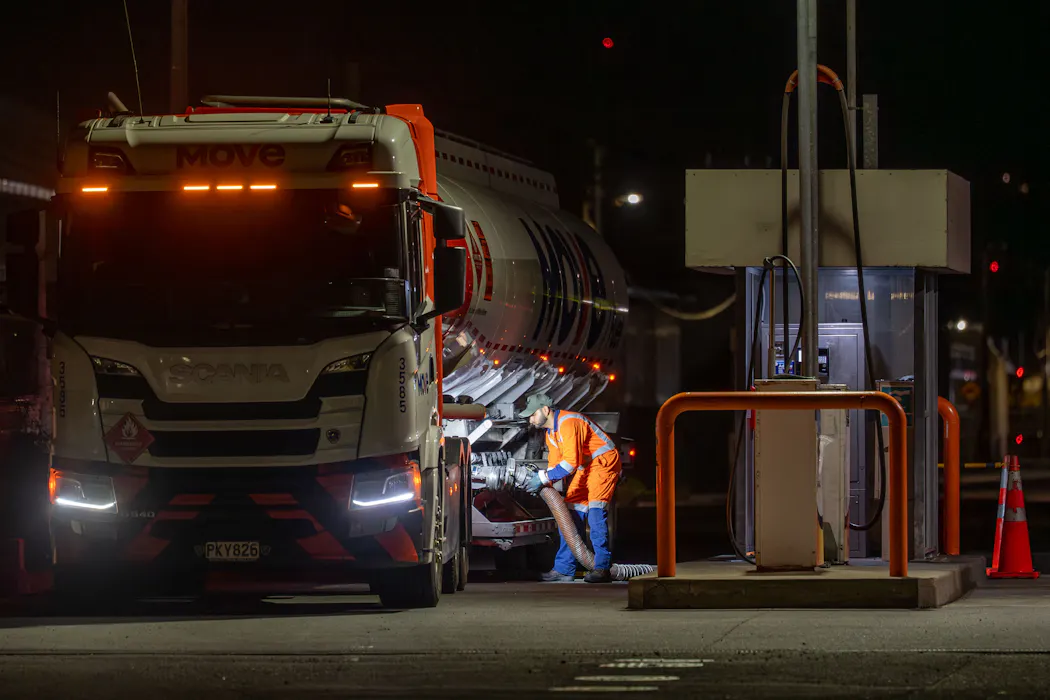
Diesel – the fuel that powers trucks, tractors, fishing boats and construction equipment – is the bigger economic problem. Its price has risen faster than petrol and its impact is wider.
As Luxon put it, diesel “powers up so much of our economy” and is “the key pacing item.” New Zealand’s economy moves on trucks. Almost everything its consumers buy at the supermarket, from the milk produced in the Waikato to the lettuce grown in Pukekohe, has been on the back of a diesel-guzzling truck.
In agriculture, the impact is a double blow: farmers need diesel to run tractors and milk tankers, and they depend heavily on fertilisers.
The Strait of Hormuz also carries significant volumes of liquefied natural gas and fertilisers. Higher fuel costs plus higher fertiliser costs squeeze farm margins from both sides.
Food prices follow. Fresh fruit and vegetables are particularly vulnerable: their short shelf life means there is no slack to absorb sudden freight cost increases. Treasury has modelled a scenario in which inflation hits 3.2% by June.
Aviation faces its own squeeze. Jet fuel is a specialised product with no domestic refining fallback. Air New Zealand has already suspended its earnings guidance and warned of fare hikes.
What can NZ actually do?
Price changes affect rich and poor differently. The government has targeted relief at those who need it most: around 143,000 working families with children will receive a $50-per-week boost through the in-work tax credit for as long as petrol stays above $3 a litre, at a total cost of up to $373 million.
Willis has explicitly ruled out broader handouts, warning of a vicious spiral of inflation. Luxon has drawn the same lesson from the pandemic, cautioning against too much spending. The government has also widened the pool of fuel suppliers by accepting imports meeting Australian specifications.
But this crisis also exposes a longer structural problem. New Zealand has one of the highest car ownership rates in the world – 815 light vehicles per 1,000 people in 2024.
Road transport consumes nearly 40% of all the energy used in the country, yet electricity accounts for less than 1% of transport energy use. That gap is the problem, but also the opportunity.
Electric vehicles, electric buses and electrified freight all reduce exposure to the next oil shock. As fuel prices rose, Auckland recorded 2.25 million public transport trips in a single week: a seven-year high. People make rational choices when price signals are strong enough.
But transition at scale takes time.
Electric vehicles make up roughly 3% of the light vehicle fleet, and electric heavy trucks remain a niche technology. Farming, fishing and air travel have no quick electric alternative. Even an accelerated shift would leave most of New Zealand dependent on petrol and diesel for many years.
Ultimately, New Zealand cannot control what happens in the Strait of Hormuz. But it can control how much we depend on it. The question is whether it starts now – or waits to find itself just as exposed when the next crisis hits.
Authors: Murat Ungor, Senior Lecturer in Economics, University of Otago


















