

FactCheck Q A: are South Australia's high electricity prices 'the consequence' of renewable energy policy?
- Written by: Dylan McConnell, Researcher at the Australian German Climate and Energy College, University of Melbourne
The Conversation fact-checks claims made on Q&A, broadcast Mondays on the ABC at 9.35pm. Thank you to everyone who sent us quotes for checking via Twitter using hashtags #FactCheck and #QandA, on Facebook or by email.
Excerpt from Q&A, March 19, 2018.Now, the consequence of [Jay Weatherill’s] policies was that South Australians faced the highest electricity charges, the highest retail electricity charges, in the country.
– Minister for Urban Infrastructure and Cities Paul Fletcher, speaking on Q&A, March 19, 2018
During an episode of Q&A, Minister for Urban Infrastructure and Cities Paul Fletcher said that South Australia has the “highest retail electricity charges in the country”. That statement in itself is correct.
But Fletcher went on to say that the high prices were “the consequence” of former SA Premier Jay Weatherill’s renewable energy policies, which included the introduction of a 50% renewable energy target, met in 2017.
Was Fletcher right?
Checking the source
In response to a request for sources and comment, a spokesperson for Fletcher pointed The Conversation to the Australian Energy Market Commission’s 2017 Residential Electricity Price Trends report, wholesale electricity price data from the Australian Energy Market Operator, and a 2017 Australian Competition and Consumer Commission report, which stated that:
… the combination of significant network investment over the past decade, recent increases to gas prices, more concentrated wholesale markets, and the transition from large scale synchronous generation to variable and intermittent renewable energy resources has had a more pronounced effect on retail prices and number of offers in South Australia than any other state in the National Electricity Market.
You can read the full response from Fletcher’s office here.
Verdict
Paul Fletcher was correct to say that South Australia has the highest retail electricity prices in Australia.
Current prices for the typical South Australian customer are 37.79 cents per kilowatt-hour (c/kWh). The Australian Capital Territory has the lowest retail electricity prices in Australia, at around 23.68 c/kWh.
But there are many factors that affect retail electricity prices. Increasing levels of renewable energy generation is just one.
Other factors include network costs, gas prices, changes in supply and demand dynamics and market competition issues.
Therefore, Fletcher’s assertion that South Australia’s high retail electricity prices are “the consequence” of former Premier Jay Weatherill’s renewable energy policies is incorrect.
Does South Australia have the highest retail electricity prices in the nation?
First, a quick terminology reminder. “Energy” is a broad term that includes sources such as petrol, diesel, gas and renewables, among other things. “Electricity” is a specific form of energy that can be produced from many different sources.
The “retail electricity price” is what you’ll typically see in your home electricity bill, and is usually expressed in cents per kilowatt-hour (c/kWh).
According the Australian Energy Market 2017 Residential Electricity Price Trends report, South Australia does indeed have the highest retail prices in the nation. Current prices for the typical South Australian customer are 37.79c/kWh.
The lowest retail electricity prices in the country are in the Australian Capital Territory, where the typical customer pays around 23.68c/kWh.
The retail electricity price includes the wholesale price of the electricity, the network costs (or the “poles and wires” that bring the electricity to your home), retailing costs, and levies related to “green schemes” (such as the renewable energy target or solar feed-in tariffs).
The chart below shows how the different components contributed the electricity price increase in South Australia between 2007-08 and 2015-16.
For many years the drivers for retail prices have been network costs – which have very little to do with renewables.
But over the past 18 months, there has also been a increase in wholesale electricity prices across the entire National Electricity Market – the interconnected power system that covers Queensland, New South Wales, the Australian Capital Territory, Victoria, South Australia and Tasmania.
A range of factors have contributed to this.
These include the increase in gas prices, and the tightening of the supply-demand balance.
The closures of South Australia’s Northern Power Station in 2016 and Victoria’s Hazelwood Power Station have contributed to a reduction in electricity supply (capacity).
The ACCC is also investigating “transfer pricing” – which is when a business that’s an energy generator as well as a retailer shifts costs from one part of its business to another.
Are the prices ‘the consequence’ of Weatherill’s renewable energy policy?
No. Even if wholesale prices become the main driver of retail prices, it’s not accurate to place the blame squarely on renewables.
Increased renewable energy generation may have contributed to decisions for some power plants to close. But so would other factors – such the A$400 million safety upgrade required for the Hazelwood power plant to have stayed open.
As mentioned above, other factors such as gas prices and competition issues have also contributed to increases in wholesale electricity prices. And as shown below, these are not confined to South Australia.
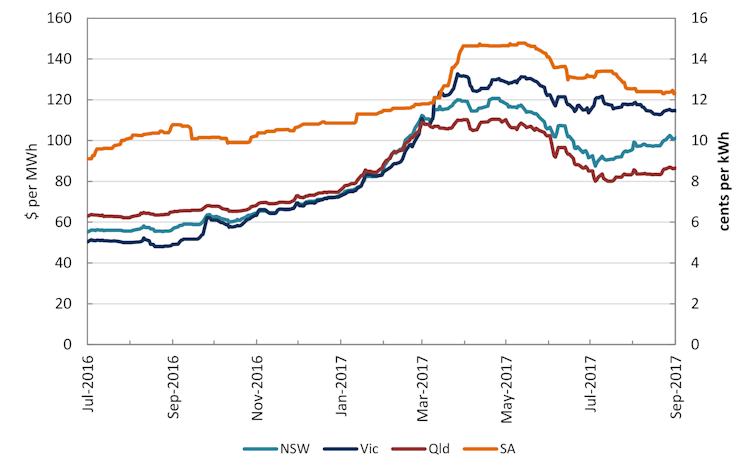 Electricity futures prices for 2017–18.
ACCC 2017, Retail Electricity Pricing
Inquiry, Preliminary report (page 56)
Electricity futures prices for 2017–18.
ACCC 2017, Retail Electricity Pricing
Inquiry, Preliminary report (page 56)
Gas prices are particularly important in the South Australian context, which is the most gas-dependent region in the National Electricity Market.
In addition, the South Australian market is the most concentrated in terms of competition.
So, Fletcher was not correct to say that South Australia’s high electricity prices are “the consequence” of Weatherill’s renewable energy policies.
Indeed, a large proportion of the existing renewable investment in South Australia has been financed as a result of the federal Renewable Energy Target, introduced by the Howard government, rather than state policy. – Dylan McConnell
Blind review
I agree with the verdict.
The price question is not contentious. South Australia has the highest retail electricity prices in Australia.
But no single factor or decision is responsible for the electricity prices we endure today.
The prices are the result of many different policies and pressures at every step of the electricity supply chain. – David Blowers
 The Conversation FactCheck is accredited by the International Fact-Checking Network.
The Conversation’s FactCheck unit was the first fact-checking team in Australia and one of the first worldwide to be accredited by the International Fact-Checking Network, an alliance of fact-checkers hosted at the Poynter Institute in the US. Read more here.
Have you seen a “fact” worth checking? The Conversation’s FactCheck asks academic experts to test claims and see how true they are. We then ask a second academic to review an anonymous copy of the article. You can request a check at checkit@theconversation.edu.au. Please include the statement you would like us to check, the date it was made, and a link if possible.
Authors: Dylan McConnell, Researcher at the Australian German Climate and Energy College, University of Melbourne


















