NZ may be winning the fight against the invasive yellow-legged hornet – but a crucial phase lies ahead
- Written by Phil Lester, Professor of Ecology and Entomology, Te Herenga Waka — Victoria University of Wellington
Six months on from the discovery of a yellow-legged hornet queen in Auckland there are encouraging signs New Zealand’s eradication effort is gaining ground.
Teams that have been searching intensively for the highly invasive predators haven’t turned up a new nest since last month.
This result suggests the country’s $12 million response programme – which has seen dozens of nests found and destroyed, alongside a huge public reporting effort – may be starting to get on top of the incursion.
From my perspective, having closely followed the response, there is good reason to be cautiously optimistic this serious threat to New Zealand and its vulnerable ecosystems can be stamped out before it gains a foothold.
Still, this progress comes at a critical moment, when any remaining hornet nests will shift into a new phase and rapidly seed a new generation.
At this time of year, worker numbers peak and colonies would normally begin producing new queens, known as gynes. These queens mate, then disperse and overwinter in sheltered sites, ready to establish new nests in spring.
From a biosecurity perspective, the goal is straightforward: find and destroy every remaining nest before new queens are produced. The coming weeks may determine whether that goal is achieved.
Why this tiny invader remains such a threat
The yellow-legged hornet (Vespa velutina) is an invasive predator native to Asia that has spread rapidly through parts of Europe over the past two decades. It is now widely regarded as one of the most damaging threats to honeybees and other pollinators.
Yellow-legged hornets specialise in hunting live prey.
They are particularly effective at targeting honey bees, often hovering at the entrance of hives and killing returning workers mid-flight. A single colony can consume tens of thousands of honey bees and other insects over a season.
The impact on beekeeping can be severe. Entire hives can collapse under sustained predation pressure. Even when colonies survive, bees [may stop foraging altogether out of fear],(https://link.springer.com/article/10.1007/s10340-018-1063-0), reducing pollination of crops and native plants.
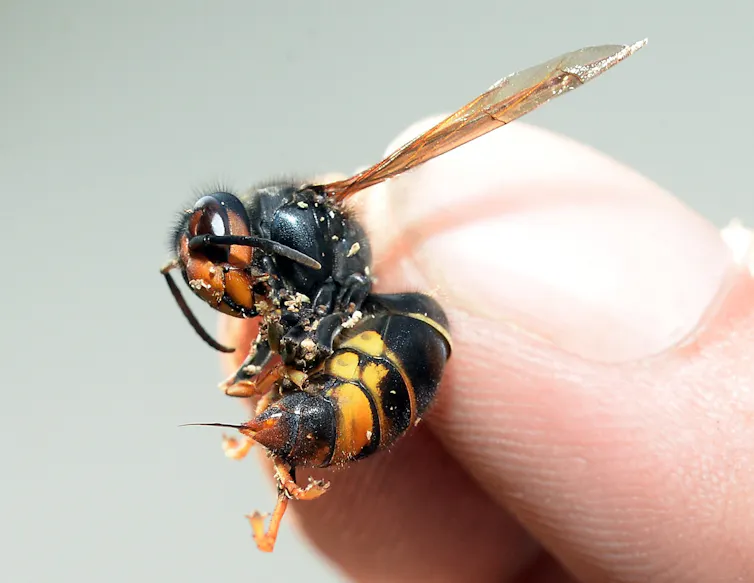
Hornets also pose a risk to people. While they are not typically aggressive away from their nests, they will defend them vigorously if disturbed. In Europe, stings have been linked to cases of anaphylaxis and, in some instances, death.
New Zealand’s incursion appears to be recent and geographically contained.
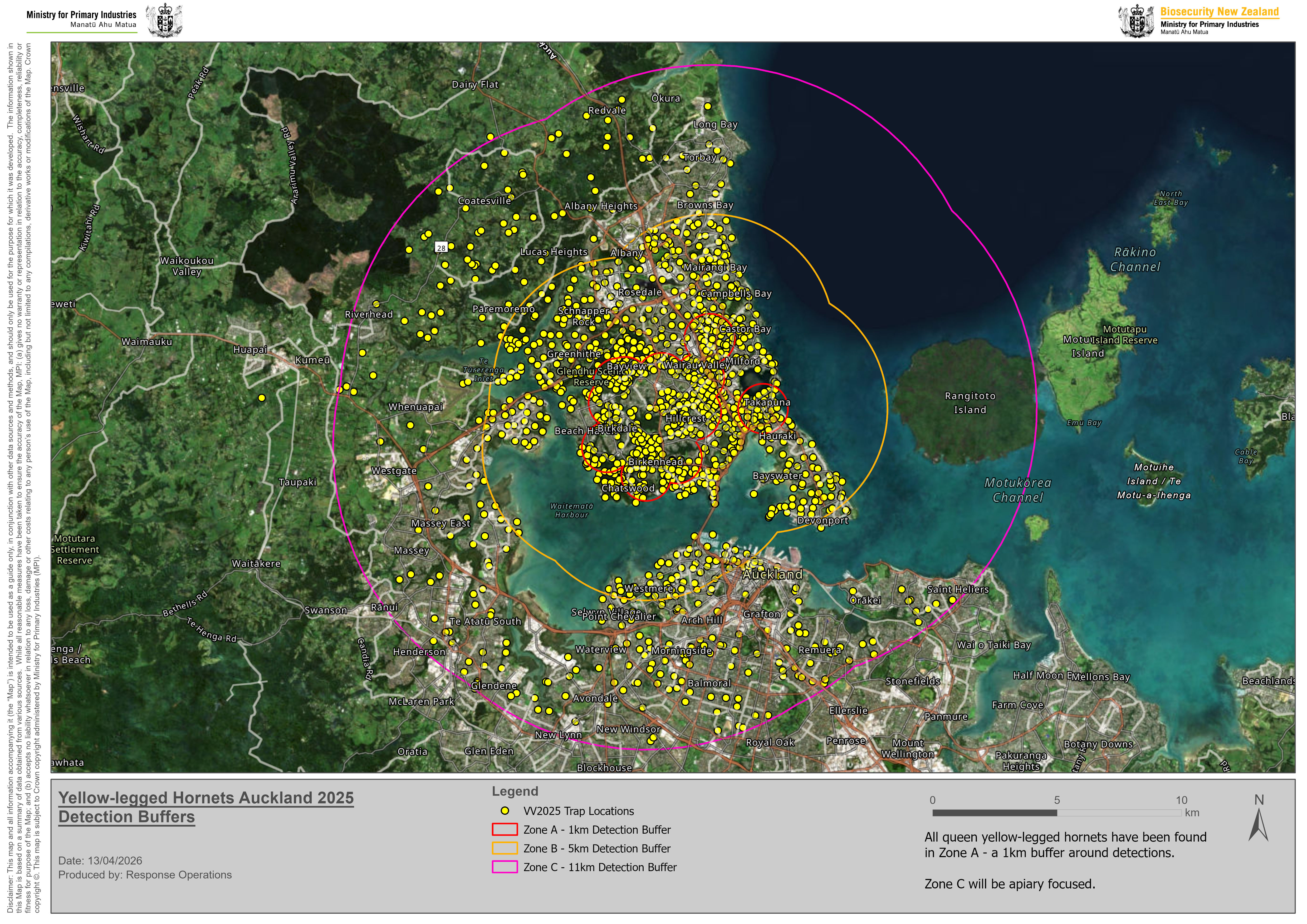
Since the first queens were detected in Auckland in October, all confirmed nests have been found within a relatively small area on the North Shore. Genetic analysis suggests they may have originated from a single introduction event, over the summer of 2024/25.
AI cameras and ‘Judas hornets’
Behind the 77 queens discovered to date – most of them linked to nests – lies a far larger response effort, measured in thousands of hours of fieldwork, thousands of public reports and a coordinated national push.
Each day, more than 50 people are on the ground hunting hornets. Beekeepers are also helping by monitoring more than 575 apiaries across the region. The wider public response has been impressive: the Ministry for Primary Industries has received more than 16,625 notifications so far.
Two experts visiting from the UK – where teams have been dealing with hornet incursions for years – have been advising on field tactics, tracking and nest detection.
Drawing on that experience, they say the New Zealand response stands out for its scale, coordination and smart use of technology. As Pete Davies, formerly of the UK’s Animal Plant and Health Agency, put it:
You’re throwing everything at it, using all the technology available and treating it with urgency. I remain optimistic that you’ll ultimately eradicate the hornet from New Zealand.
AI-enabled cameras are now being deployed at bait stations to distinguish yellow-legged hornets from wasps and other insects, allowing teams to monitor activity remotely and focus their efforts where it matters most.
Another key tool has been the clever use of so-called “Judas hornets”.
Captured workers are fitted with tiny radio transmitters and released, then tracked as they fly back to their nest – effectively leading search crews straight to hidden colonies that would otherwise be difficult to locate high in trees.
A toxic bait that attracts hornets and wasps, but not bees, has also been deployed. Other non-toxic bait stations have been set out across the search area and are being checked regularly.
For all of this momentum, however, the work is not yet over. Continued public support will be essential to locate any remaining hidden nests. Missing even one could undo this year’s progress and send the response back to square one next season.
If a suspect hornet is spotted, it should be photographed (from a safe distance) and reported. Where traps are in use, they should be checked regularly. Beekeepers are encouraged to monitor hive entrances closely for hornets “hawking” and killing bees.
Clear guidance on identifying yellow-legged hornets, making traps and submitting sightings is available through the Ministry for Primary Industries.
Authors: Phil Lester, Professor of Ecology and Entomology, Te Herenga Waka — Victoria University of Wellington