

researchers are discovering how they see, hear, feel – and even remember
- Written by Samarth Kulshrestha, Research Fellow in Molecular Biology, University of Canterbury
Plants are often seen as passive organisms, rooted in one place and largely unable to react to the world around them.
But a new field of research is challenging these assumptions and showing that plants are as sophisticated as animals in detecting and adjusting to environmental signals.
Plants can perceive light through specialised proteins, detect sound vibrations and respond to touch via mechano-sensitive channels, recognise chemical signals released by neighbouring plants, and even retain memories of past experiences through changes in their DNA.
My own research focuses on how plants detect the passage of time as part of their seasonal cycle, but that it merely one aspect of a major reconsideration of their sensory capacity – and the parallels with animal senses.
Plants can see colours
Anyone who has noticed a flower turning its head to track the sun knows plants can detect light. Like animals, plants sense light signals using specialised receptors, each for a different wavelength (or colour) of light.
Phytochromes detect red and far-red light and cryptochromes and phototropins respond to blue and ultraviolet light. These sensors transform light cues into molecular signals to coordinate a plant’s daily circadian rhythms.
Emerging research suggests trees can even identify the summer solstice, the longest day of the year. This cue may act as a seasonal switch, triggering a transition in key physiological processes such as leaf ageing and bud setting.
My research identified a specific gene, known as Early-Flowering-3, in European beech trees (Fagus sylvatica) which seems to control seasonal responses such as energy storage, changes in plant hormone signals and preparing for winter.
But light detection is only one sense plants use to perceive their world.

Tuning into their environment
Plants can also listen. Studies show they can detect vibrations caused by chewing insects or the buzz of pollinating bees, and they respond to the sound of flowing water by directing roots towards it.
Plants can also generate their own vibrations. When under stress, tobacco and tomato plants emit ultrasonic clicks that provide information about the plants’ condition, including the level of dehydration or injury. These clicks can be heard using a sound recorder.
Scientists also documented what happens when they play sounds to plants. They observed changes in the membranes of their cells and the chemical signalling along ion channels. While plants do not have nerves, these channels functions in a similar way, acting as tiny gateways to transmit information in and out of cells.
The exact receptors plants use to perceive sound remain unclear, but we are now investigating whether they sense vibrations through tiny hair-like structures on leaf surfaces.
Don’t touch me
Beyond vibrations, plants also respond directly to physical touch, often in striking ways.
Familiar examples include the touch-me-not plant (Mimosa pudica) or the Venus flytrap (Dionaea muscipula), which respond to touch by rapidly closing their leaves.
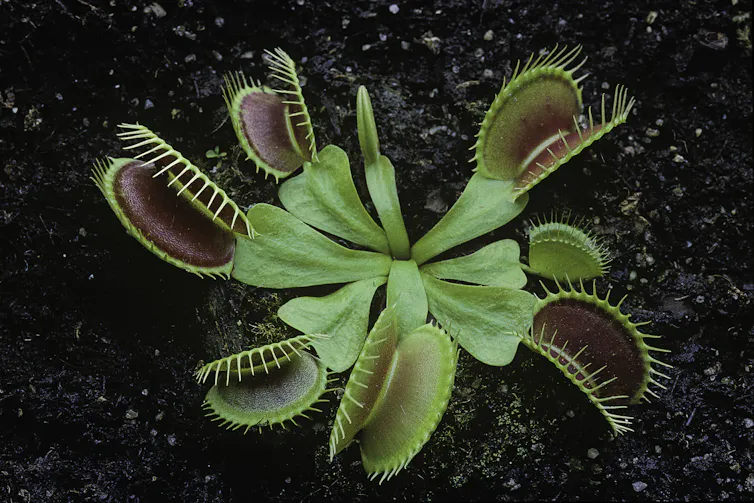
These examples illustrate plants’ ability to perceive and respond to mechanical stimuli. But beyond these rapid movements, plants also detect rain and damage caused by browsing herbivores. The latter prompts plants to activate defence responses such as the production of toxins or depositing lignin to make themselves less palatable.
Just like animals, plants contain specialised proteins that detect these physical forces. These mechanical sensing proteins convert physical stimuli into biochemical signals, often through calcium signalling.
Plants remember the past to decide the future
Changes in temperature provide a good example of plants remembering that winter has passed. Remembering cold temperatures helps them flower at the right time when spring arrives.
As observed in animals, these memories are stored through epigenetic mechanisms – chemical changes to DNA that don’t affect the genetic code.
Epigenetic changes alter the way genes are packaged and read, creating a molecular record of past conditions.
In New Zealand, for example, trees remember temperatures from previous summers to synchronise their reproduction across entire forests – a phenomenon known as masting.
Masting triggers widespread seed production – and subsequent pest outbreaks that can threaten native wildlife. Researchers revealed that removable markers generate temporary chemical tags that can switch genes off. This allows masting plants to carry information from one year to the next.
Together, these findings show that plants can see, hear, feel and remember in ways parallel to our own sensory systems. Far from being passive or unresponsive, plants respond to environmental clues in sophisticated and complex ways.
Rethinking plant life in this way challenges long-held ideas about intelligence, awareness and communication in the natural world.
Authors: Samarth Kulshrestha, Research Fellow in Molecular Biology, University of Canterbury

















