

After another hot summer, here are 6 ways to cool our cities in future
- Written by: Komali Yenneti, Honorary Academic Fellow, Australia India Institute, University of Melbourne
Australia is a “land of climate extremes”. This is especially true for our cities, which have become hubs of extreme summer temperatures. This past summer was the second-hottest on record for Australia, following the 2018-19 record, with average maximum temperatures more than 2°C above the long-term average.
Frequent and long heatwaves are having serious impacts on energy consumption, public health, labour productivity and the economy.
Read more: After a summer of extremes, here's what to expect this autumn
Even without global warming, cities already face a problem — the urban heat island effect, whereby inner urban areas are hotter than the surrounding rural areas. Urban heat islands are caused by factors such as pollution, energy consumption, industrial activities, large dark concrete buildings, asphalt roads and closely spaced structures.
Evidence from Australia’s major cities shows average temperatures are 2-10°C higher in highly urbanised areas than in their rural surroundings.
Read more: Urban growth, heat islands, humidity, climate change: the costs multiply in tropical cities
Governments and policymakers can use a variety of cooling strategies combined with community engagement, education and adaptation measures to cool Australian cities.
1. Green infrastructure
Green infrastructure includes parks, street trees, community gardens, green roofs and vertical gardens. In tropical and subtropical climate zones, like much of Australia, green infrastructure is a cost-effective cooling strategy.
Read more: Requiem or renewal? This is how a tropical city like Darwin can regain its cool
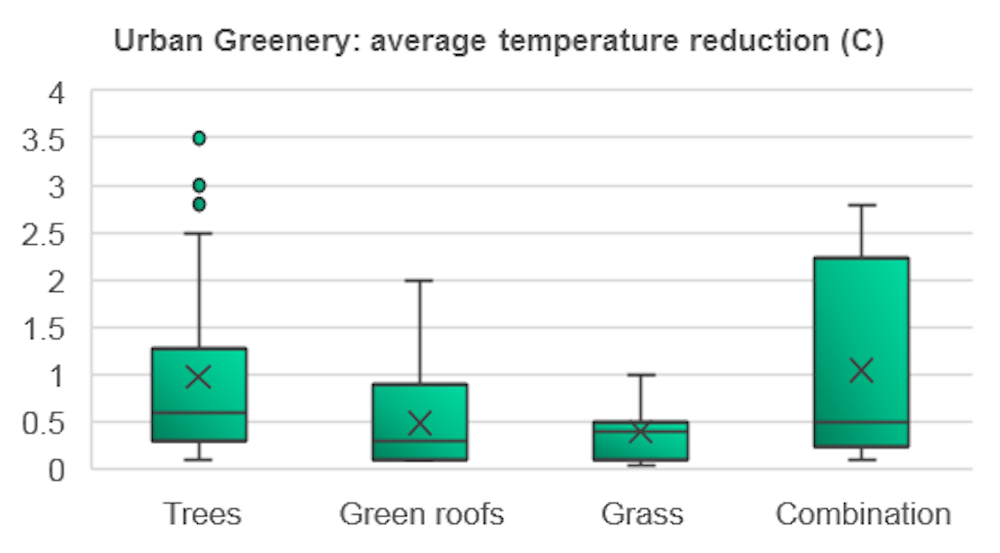
Evidence suggests a 10% increase in tree canopy cover can lower afternoon ambient temperatures by as much as 1-1.5C, as the chart below shows. Similarly, in parks with adequate irrigation ambient temperatures can be 1-1.5°C lower than nearby unvegetated or built-up areas.
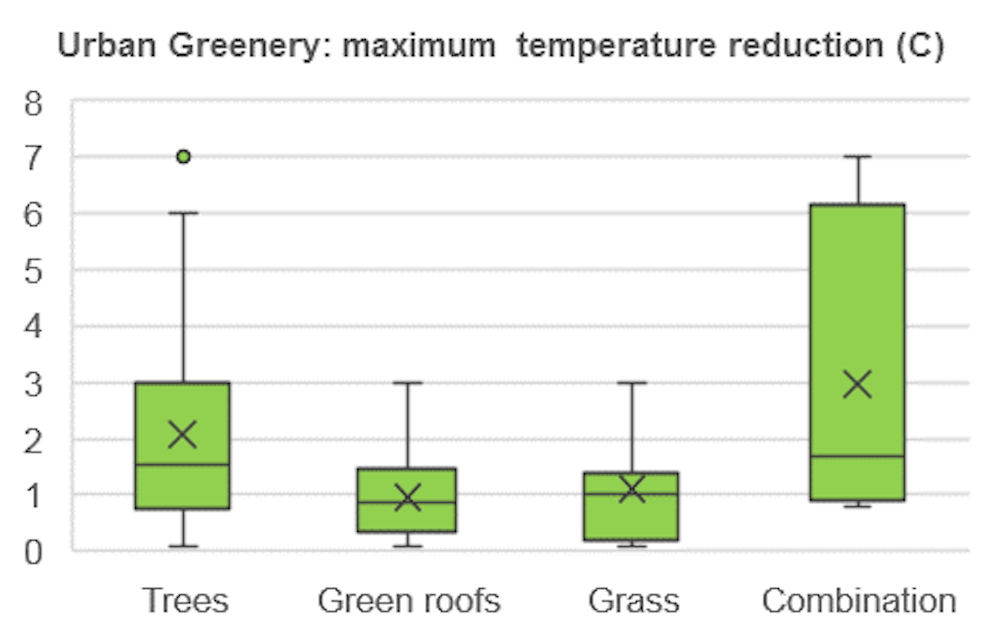 Maximum (above) and average (below) temperature reduction potential of different urban greenery techniques.
Komali Yenneti et al, Author provided
Maximum (above) and average (below) temperature reduction potential of different urban greenery techniques.
Komali Yenneti et al, Author provided
 We can increase street tree canopy cover by planting more shade trees on footpaths, lanes and street medians. Where there is little space for parks and street trees, green roofs and walls may be viable options.
Read more:
Here’s how green infrastructure can easily be added to the urban planning toolkit
2. Water-sensitive urban design
The use of water as a way to cool cities has been known for thousands of years. Water-based landscapes such as rivers, lakes, wetlands and bioswales can reduce urban ambient temperatures by 1-2°C. This is a result of water heat retention and evaporative cooling.
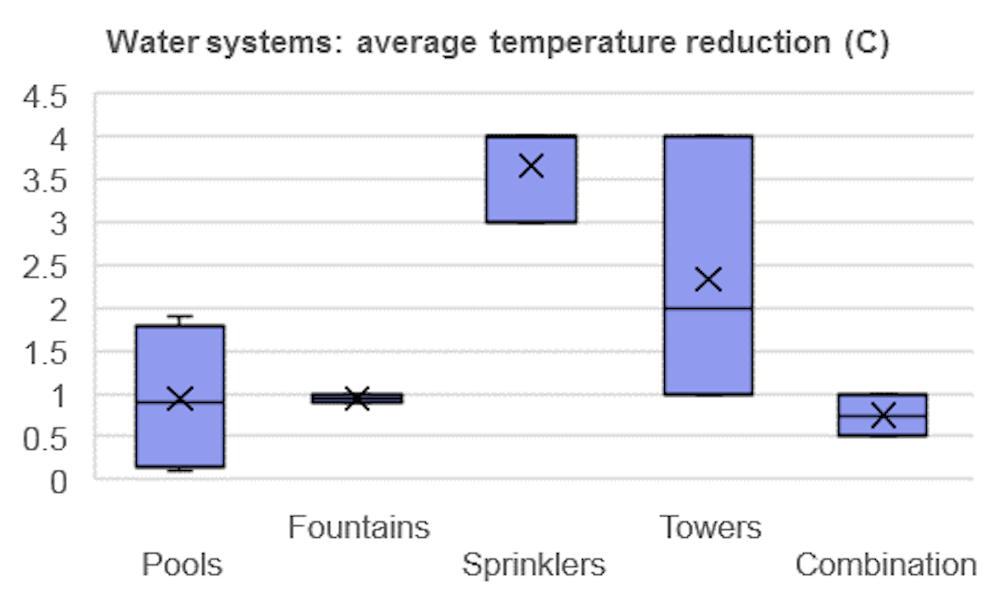
In addition to natural water bodies, various other water-based technologies are now available for both decorative and climatic reasons. Examples include passive water systems, like ponds, pools and fountains, and active or hybrid systems, such as evaporative wind towers and sprinklers. Active and passive systems can decrease ambient temperatures by 3-8°C, as the charts below show.
We can increase street tree canopy cover by planting more shade trees on footpaths, lanes and street medians. Where there is little space for parks and street trees, green roofs and walls may be viable options.
Read more:
Here’s how green infrastructure can easily be added to the urban planning toolkit
2. Water-sensitive urban design
The use of water as a way to cool cities has been known for thousands of years. Water-based landscapes such as rivers, lakes, wetlands and bioswales can reduce urban ambient temperatures by 1-2°C. This is a result of water heat retention and evaporative cooling.
In addition to natural water bodies, various other water-based technologies are now available for both decorative and climatic reasons. Examples include passive water systems, like ponds, pools and fountains, and active or hybrid systems, such as evaporative wind towers and sprinklers. Active and passive systems can decrease ambient temperatures by 3-8°C, as the charts below show.
 Maximum (above) and average (below) temperature reduction potential of different active and passive water systems.
Komali Yenneti et al, Author provided
Maximum (above) and average (below) temperature reduction potential of different active and passive water systems.
Komali Yenneti et al, Author provided
 Water-based systems are usually combined with green infrastructure to enhance urban cooling, improve air quality, aid in flood management and provide attractive public spaces.
Read more:
When the heat is on, we need city-wide plans to keep cool
3. Cool materials
Building materials are major contributors to the urban heat island effect. The use of cool materials on roofs, streets and pavements is an important cooling strategy. A cool surface material has low heat conductivity, low heat capacity, high solar reflectance and high permeability.
Evidence suggests that using cool materials for roofs and facades can reduce indoor temperature by 2-5°C, improve indoor comfort and cut energy use.
Water-based systems are usually combined with green infrastructure to enhance urban cooling, improve air quality, aid in flood management and provide attractive public spaces.
Read more:
When the heat is on, we need city-wide plans to keep cool
3. Cool materials
Building materials are major contributors to the urban heat island effect. The use of cool materials on roofs, streets and pavements is an important cooling strategy. A cool surface material has low heat conductivity, low heat capacity, high solar reflectance and high permeability.
Evidence suggests that using cool materials for roofs and facades can reduce indoor temperature by 2-5°C, improve indoor comfort and cut energy use.
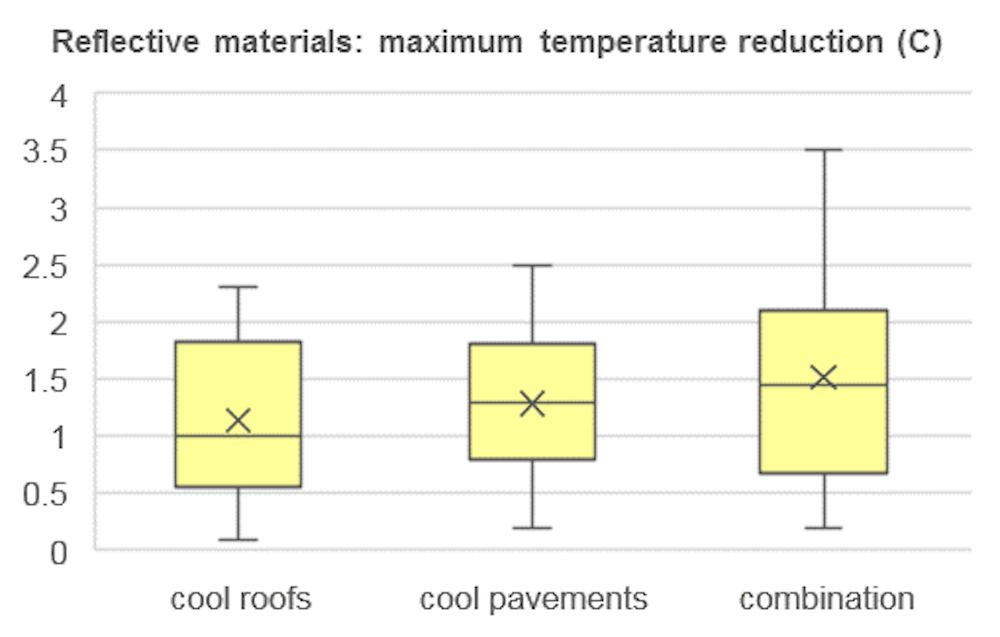 Maximum (above) and average (below) temperature reduction potential of different cool surfaces.
Komali Yenneti et al, Author provided
Maximum (above) and average (below) temperature reduction potential of different cool surfaces.
Komali Yenneti et al, Author provided
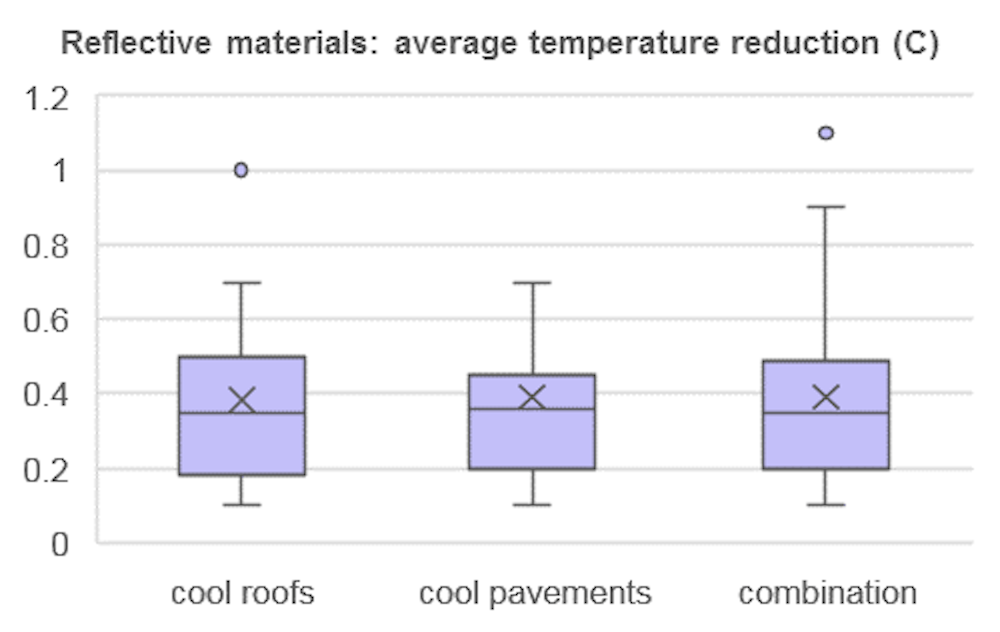 Cool materials commonly applied to buildings include white paints, elastomeric, acrylic or polyurethane coating, ethylene propylenediene tetrolymer membrane, chlorinated polyethylene, polyvinyl chloride, thermoplastic polyolefin, and chlorosulfonated polyethylene.
Lighter aggregates and binders in asphalt and concrete, permeable pavers made from foam concrete, permeable asphalt and resin concrete are standard cool pavement materials.
Read more:
Building cool cities for a hot future
4. Shading
Shading can decrease radiant temperature and greatly improve outdoor thermal comfort. Providing shading on streets, building entries and public venues using greenery, artificial structures or a combination of both can block solar radiation and increase outdoor thermal comfort. Examples of artificial structures include temporary shades, sunshades and shades using solar panels.
Read more:
In a heatwave, the leafy suburbs are even more advantaged
5. Combined cooling strategies
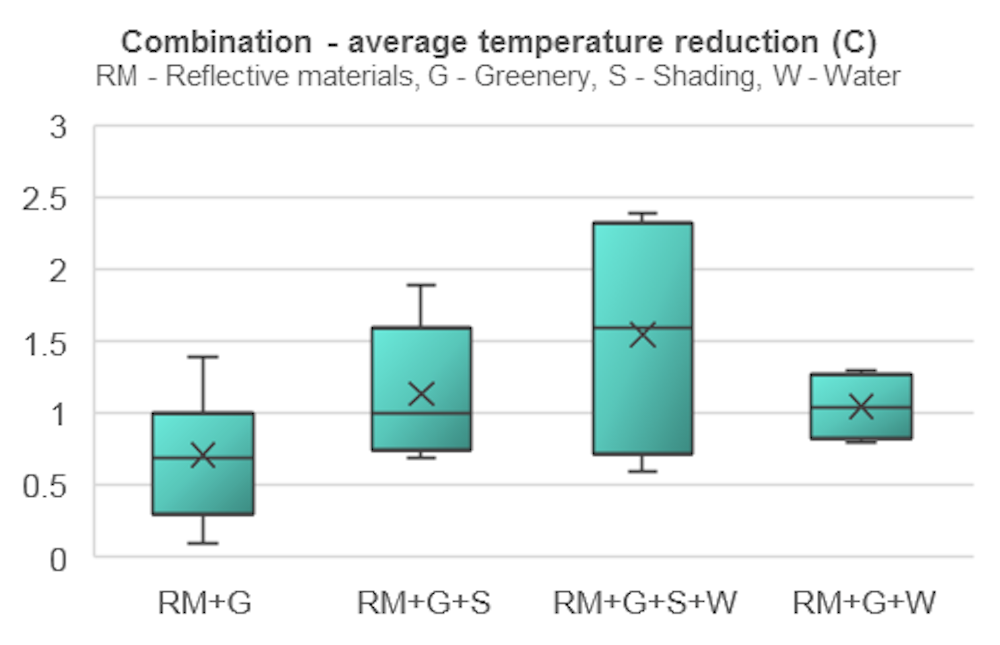
Performance analysis of various projects in Australia suggests the cooling potential of the combined use of the different strategies discussed above is much higher than the sum of the contributions of each individual technology, as the charts below show. The average maximum temperature reduction with just one technology is close to 1.5°C. When two or more technologies are used together the reduction exceeds 2.5°C.
Cool materials commonly applied to buildings include white paints, elastomeric, acrylic or polyurethane coating, ethylene propylenediene tetrolymer membrane, chlorinated polyethylene, polyvinyl chloride, thermoplastic polyolefin, and chlorosulfonated polyethylene.
Lighter aggregates and binders in asphalt and concrete, permeable pavers made from foam concrete, permeable asphalt and resin concrete are standard cool pavement materials.
Read more:
Building cool cities for a hot future
4. Shading
Shading can decrease radiant temperature and greatly improve outdoor thermal comfort. Providing shading on streets, building entries and public venues using greenery, artificial structures or a combination of both can block solar radiation and increase outdoor thermal comfort. Examples of artificial structures include temporary shades, sunshades and shades using solar panels.
Read more:
In a heatwave, the leafy suburbs are even more advantaged
5. Combined cooling strategies
Performance analysis of various projects in Australia suggests the cooling potential of the combined use of the different strategies discussed above is much higher than the sum of the contributions of each individual technology, as the charts below show. The average maximum temperature reduction with just one technology is close to 1.5°C. When two or more technologies are used together the reduction exceeds 2.5°C.
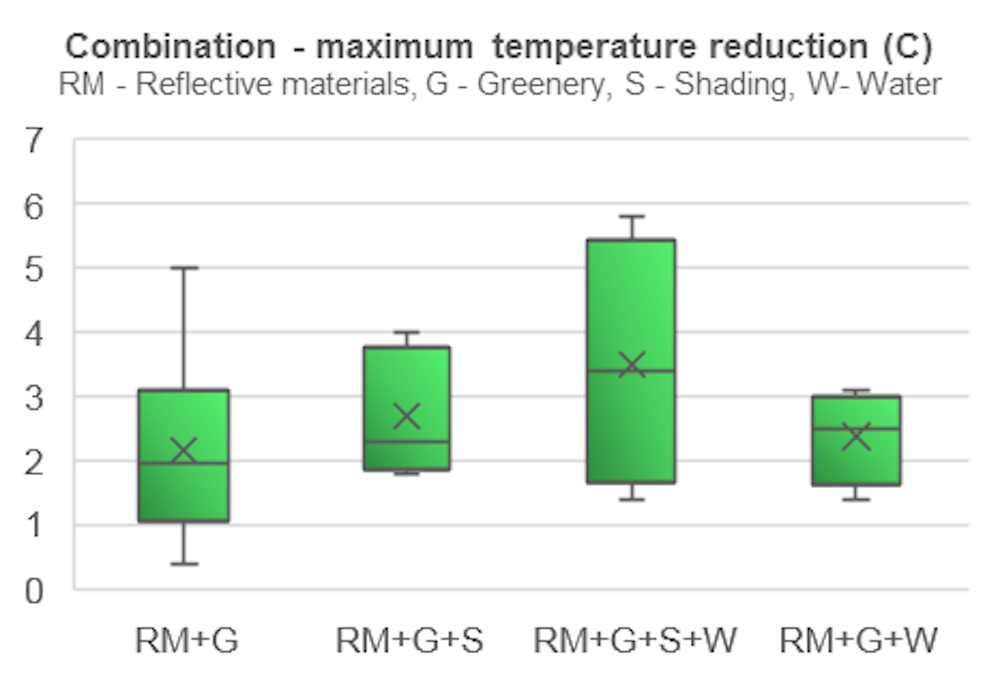 Maximum (above) and average (below) temperature reduction potential for a combination of technologies.
Komali Yenneti et al, Author provided
Maximum (above) and average (below) temperature reduction potential for a combination of technologies.
Komali Yenneti et al, Author provided
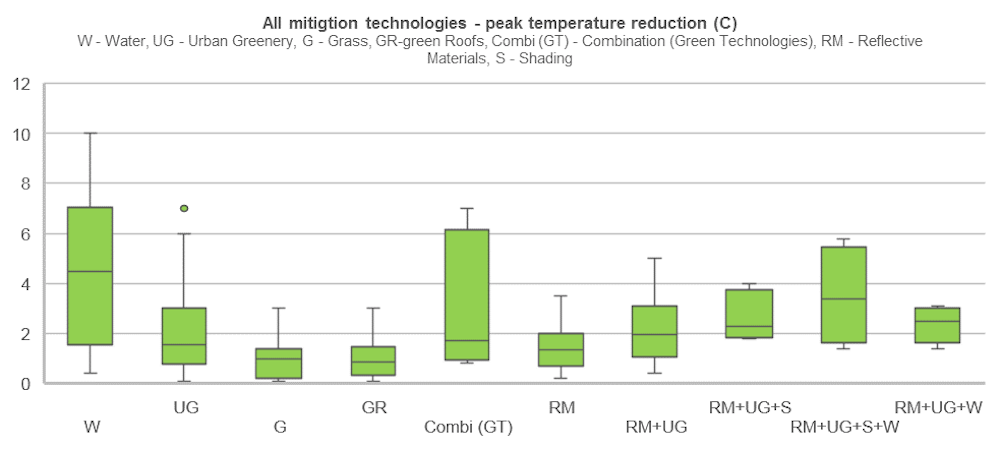
 The chart below shows the peak temperature reduction for all cooling strategies.
 Komali Yenneti et al, Author provided
6. Behaviour changes
People are significant contributors to urban heat through their use of air conditioning. The waste heat from air conditioners heats up surrounding outdoor spaces.
Projections show cooling demand in Australian cities may increase by up to 275% by 2050. Such a trend will have a great impact on urban climate, as well as increasing electricity use. If this is powered by fossil fuels, it will add billions of tons of carbon pollution.
Climate-responsive building design and adaptive design techniques in existing buildings can minimise occupants’ demand for cooling energy by reducing indoor and outdoor temperatures.
Read more:
We have the blueprint for liveable, low-carbon cities. We just need to use it
Cities must take a holistic, long-term approach
Local governments can prepare for and respond to heat events through emergency response plans. However, emergency responses alone cannot address other challenges of urban heat, including human vulnerability, energy disruptions and the economic costs of lower workplace productivity and infrastructure failures.
Long-term cooling strategies are needed to keep city residents, buildings and communities cool and save energy, health and economic costs.
Komali Yenneti et al, Author provided
6. Behaviour changes
People are significant contributors to urban heat through their use of air conditioning. The waste heat from air conditioners heats up surrounding outdoor spaces.
Projections show cooling demand in Australian cities may increase by up to 275% by 2050. Such a trend will have a great impact on urban climate, as well as increasing electricity use. If this is powered by fossil fuels, it will add billions of tons of carbon pollution.
Climate-responsive building design and adaptive design techniques in existing buildings can minimise occupants’ demand for cooling energy by reducing indoor and outdoor temperatures.
Read more:
We have the blueprint for liveable, low-carbon cities. We just need to use it
Cities must take a holistic, long-term approach
Local governments can prepare for and respond to heat events through emergency response plans. However, emergency responses alone cannot address other challenges of urban heat, including human vulnerability, energy disruptions and the economic costs of lower workplace productivity and infrastructure failures.
Long-term cooling strategies are needed to keep city residents, buildings and communities cool and save energy, health and economic costs.
Authors: Komali Yenneti, Honorary Academic Fellow, Australia India Institute, University of Melbourne


















