

Pretend play is a magical part of childhood. New research suggests it can also help mental health
- Written by: Fotini Vasilopoulos, Postdoctoral Researcher, Matilda Centre for Research in Mental Health and Substance Use, University of Sydney
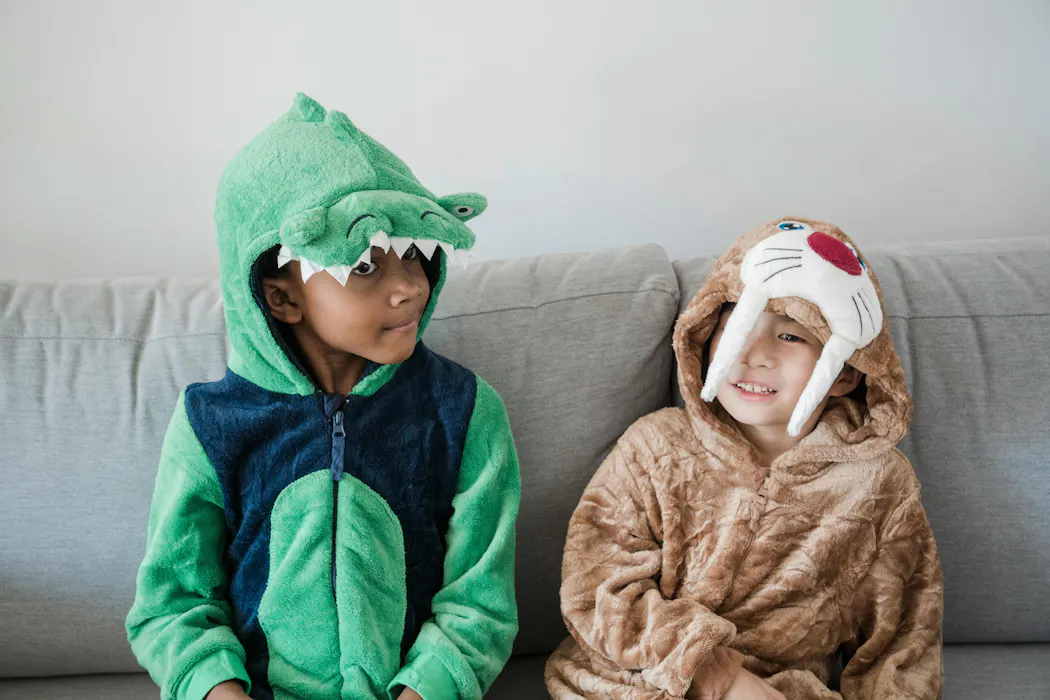
Pretend play is a significant and often magical part of childhood.
Children have huge imaginations and use these to turn rocks into spaceships, tables into forts or pens into fairies. They might pretend to be “mum” or to “cook dinner”. Or they may invent their own characters, worlds and concepts that have no bearing on anything adults are able to come up with.
The ability to pretend play generally first emerges at 15-18 months. By about 20 months children start to imitate life around them. By the time they are four or five the play is complex and involves interacting with others and acting out characters.
But apart from being a part of development, are there other benefits? Our study suggests pretend play can also help mental health.
Our research
According to the World Health Organization, around one in seven children and adolescents are affected by mental health conditions. Most interventions target problems after they emerge, rarely addressing the developmental foundations that could prevent them.
In our study, we analysed data from more than 1,400 Australian children taking part in the Longitudinal Study of Australian Children.
Their pretend play ability was assessed by early childhood educators over a one-year period, when children were aged between two and three. This related to how well a child was able to:
do simple pretend play like feeding a doll or stuffed animal
pretend one object is a substitute for something else, like using a towel as a blanket or a box for a house
do peer pretend play like using materials to role-play in costumes and playing house.
Mental health outcomes were then measured using parent and educator reports on emotional and behavioural difficulties, submitted when participants were aged between four and five and again between the ages of six and seven.
What we found
We found stronger pretend play ability among two and three-year olds was associated with fewer emotional and behavioural difficulties at four-five and six-seven years of age. Some of these difficulties could include having many worries or often having temper tantrums.
The findings held even after accounting for participants’ socioeconomic background, the mother’s mental health, language ability and the security of their relationship with their parents.
Why is this so?
Emotional regulation – the ability to manage and respond to emotions – has been linked to mental health in childhood and adolescence.
It has been suggested that if a child is better at pretend play, they will have better emotional regulation because pretend play allows one to practice this skill.
But when we examined this link, we did not find an association between pretend play, emotional regulation and mental health outcomes later on. This suggests other, less understood developmental processes may be involved.
So in our study, we suggest something called “embodied cognition” could explain the link between pretend play and mental wellbeing.
Embodied cognition is the idea that thinking isn’t something that happens only in your head. Your body and the way it moves through the world are also involved in thinking.
For example, when children learn to count with their fingers, the physical action is part of how the mathematical concept takes shape in their minds.
Similarly, playing, imagination and acting things out aren’t just fun. They are helping children learn how to think, feel and respond to their environment. This in turn is possibly what is leading to better mental health.
But more investigation is needed before we can be certain.
How can parents encourage pretend play?
In the meantime, there are several things you can do to encourage pretend play in your child.
Let play unfold for its own sake, rather than turning it into a “teaching moment”. If a child makes a mistake while counting or naming things during play, the priority is to keep the play going rather than interrupting to correct them.
Follow the child’s lead when joining in, much like a game of tennis. Waiting for the child to “serve” first, helps keep play child‑led, though gentle prompts can help if a child is unsure how to begin.
Respond to children’s play with simple observations or open‑ended comments instead of instructions. Describing what is happening in the play, or wondering aloud what might happen next, can enrich play without directing it. For example, “what could that leaf do?” Rather than, “that leaf can be the house for the pig”.
Step “inside the play” rather than directing it from the sidelines. Adults can ask children what role they would like them to take on, or suggest being a low-power character, such as a confused visitor or a forgetful customer.
Keep in mind, play doesn’t need to be complicated or instructional. It just needs to encourage children’s imaginations. And as our study suggests, it can also protect their mental health in the process.
Lucinda Grummitt, Sasha Bailey, Louise Birrell, Iroise Dumontheil, Gill Francis, Eliza Oliver, Olivia Karaolis, Robyn Ewing, Michael Anderson, Maree Teesson and Emma L. Barrett were also authors of the research study discussed in this piece.
Authors: Fotini Vasilopoulos, Postdoctoral Researcher, Matilda Centre for Research in Mental Health and Substance Use, University of Sydney


















