

A new nuclear arms race is accelerating. There’s only one way to stop it
- Written by Tilman Ruff, Honorary Principal Fellow, School of Population and Global Health, The University of Melbourne
This week in New York, diplomats from almost every nation will convene for a four-week review of the Treaty on the Non-Proliferation of Nuclear Weapons (NPT), the most comprehensive nuclear arms agreement in the world.
The stakes could hardly be higher.
Russia, Israel and the United States, all nuclear-armed, are conducting illegal wars of aggression against countries without nuclear weapons. Nuclear-armed India and Pakistan engaged in conflict last year across their disputed border, raising the spectre of nuclear escalation.
In February, the last remaining agreement constraining Russian and US nuclear weapons lapsed, with nothing to replace it. The two countries account for nearly 90% of the world’s nuclear weapons.
And all nine nuclear-armed states are investing vast sums in modernising their arsenals with more capable and dangerous weapons. Deployed nuclear weapons and those on high alert, ready to be launched within minutes, are also rising.
All these developments have brought the Doomsday Clock, which assesses how close the world is to existential catastrophe, closer to midnight than it has ever been since 1947.

What is the NPT?
The NPT is considered a cornerstone of international law in relation to nuclear weapons and disarmament. It has the widest membership of any arms control agreement, with 190 states. These include five countries that manufactured and exploded nuclear weapons before 1967 – China, France, Russia, the United Kingdom and the United States. All other members do not have nuclear weapons.
North Korea is the only state to have joined the NPT and then renounced it. India, Israel and Pakistan, all nuclear-armed, along with South Sudan, are the only countries that have never joined.
The NPT is essentially a bargain struck in the late 1960s between the states that had nuclear weapons and those that did not. The first five nuclear-armed states – also permanent members of the UN Security Council with veto rights – committed to end the nuclear arms race and eliminate their arsenals.
In exchange, states without nuclear weapons agreed to forego acquiring them, with the sweetener of assistance in developing peaceful uses of nuclear technology.
The International Atomic Energy Agency (IAEA) was established to ensure non-nuclear states did not acquire weapons. However, the treaty did not establish any timeframes, defined processes, or verification or enforcement mechanisms for nuclear-armed nations to disarm.
The NPT entered into legal force in 1970, initially for 25 years. It was hoped the task of nuclear disarmament would be accomplished by then.
When this was clearly not the case in 1995, the treaty was indefinitely extended, thereby removing an important source of pressure on nuclear-armed states to fulfil their side of the bargain. Since then, there have been reviews every five years to debate implementation of the treaty.
Rarely consensus
These conferences, however, have been fraught.
In 2015, for example, Canada, the UK and US blocked adoption of a painstakingly negotiated text at the behest of Israel, a non-member of the treaty. And in 2022, Russia blocked adoption of the final text, mainly due to references to the Zaporizhzhia nuclear power plant in Ukraine, which it attacked and occupied.
Since 1995, only two review conferences have produced an agreed outcome document.
In 2000, the members agreed to 13 practical steps to progress nuclear disarmament, but these remain almost completely unimplemented. And in 2010, the members agreed to a 64-point action plan, but implementation has been variable and weak, particularly for the 22 actions relating to disarmament.
The NPT has been moderately effective, though, in discouraging additional states from acquiring nuclear weapons. A number of countries, such as Canada, Germany, Sweden, Switzerland, South Korea and Australia, gave up nuclear weapons programs or ambitions after joining.
But when it comes to disarmament, the treaty has failed dismally.
The head of this year’s conference, Do Hung Viet, has stressed the risk of failing to find consensus again at this year’s review.
It may not put an end to the NPT itself but […] it may hollow out the NPT. We may lose the credibility of the NPT itself.
Two main challenges ahead
In the current dysfunctional international environment, expectations for this year’s conference are low.
Nuclear-armed states have not only failed to disarm, they are growing, modernising and threatening to use their arsenals in an accelerating arms race. And two recent developments are likely to cast further shadows over the debate.
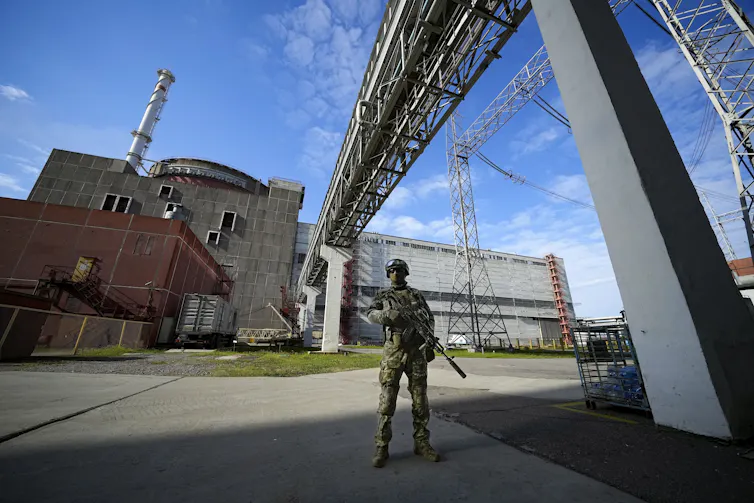
The first is Russia’s unprecedented weaponisation of nuclear facilities in Ukraine, including operating nuclear power plants with huge quantities of radioactive materials in the reactor cores and in spent fuel ponds. Russian forces have engaged in a number of reckless actions, including:
- attacking and damaging the facilities
- interfering with their operation and terrorising staff
- using some as military bases
- and jeopardising the power and water supplies critical to the essential cooling of reactors and spent fuel.
These actions risk a radiological disaster extending far beyond Ukraine’s borders.
A major failing of the last review conference in 2022 was that no measures were passed to protect nuclear facilities from attack.
The second major issue confronting this year’s review: the US–Israeli attacks on Iran’s nuclear facilities.
Both countries have cited Iran’s imminent acquisition of nuclear weapons as a pretext for their attacks, despite the fact US intelligence officials and the head of the IAEA said this wasn’t the case.
The might-is-right attacks by the US and Israel raise profound questions for the world’s non-nuclear nations in the value of adhering to the NPT. Why should they comply with the treaty’s stringent requirements when nuclear-armed states can use illegal force against them, at their will?
Non-proliferation cannot be secured by war. In fact, for the surviving members of Iran’s regime (and leaders of other nations), the war likely reinforces the opposite lesson: preventing military aggression is best assured by having nuclear weapons.
The risk of other states now following the North Korean model – leaving the NPT and developing an initially clandestine nuclear weapons program – is much higher.
In the nuclear age, security is either shared or non-existent. The only safe and sustainable future is predicated on eliminating nuclear weapons. This can only be achieved through cooperation, negotiation and international law, backed up by equitable verification.
Authors: Tilman Ruff, Honorary Principal Fellow, School of Population and Global Health, The University of Melbourne

















