

Why did Indian lawmakers vote against ensuring more women in parliament?
- Written by: Mandar Oak, Associate Professor, School of Economics, Adelaide University
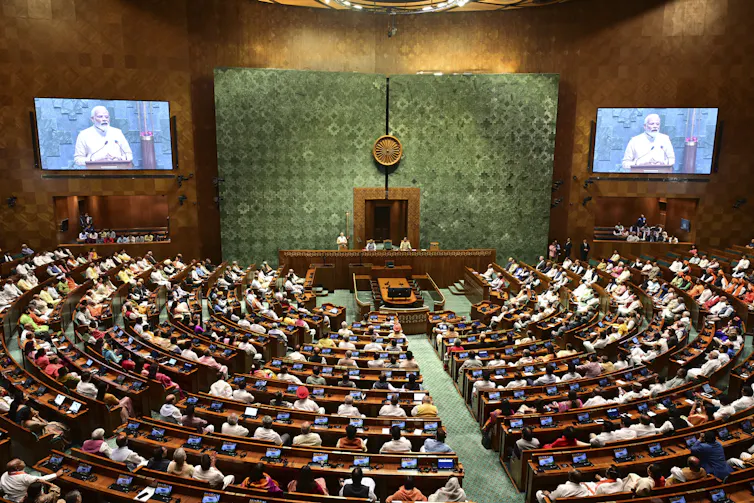
Indian Prime Minister Narendra Modi suffered a rare defeat last week after a bill to reserve one-third of seats in the lower house of parliament for women failed to get enough support.
The bill was paired with another piece of legislation that would have set in motion the process of redrawing India’s electoral map, increasing the size of the lower house from the current 543 seats to as many as 850.
Women currently comprise about 14% of the Lok Sabha (the lower house). The Inter-Parliamentary Union, a global organisation of national parliaments, ranks India 147th in the world in terms of women’s representation.
The idea of reserving seats for women in parliament has enjoyed broad support across Indian politics, but its implementation has always met with problems.
This time, Modi’s Bharatiya Janata Party (BJP) tried to fast-track the bill while bundling it with the other bill to redraw parliamentary districts based on population – and the opposition baulked. It claimed the former was a Trojan horse to smuggle in the latter.
Why is redistricting so problematic?
That redistricting process, known as delimitation, was originally intended to ensure each citizen’s vote carried roughly equal weight. However, it has been a highly charged political issue.
Opponents claimed delimitation can lead to gerrymandering, giving advantages to BJP candidates over religious minorities. Critics also said the process could unfairly affect the distribution of parliamentary seats among states.
India has not fully redistributed Lok Sabha seats among states since 2001, partly because doing so would penalise states in southern India with lower fertility rates.
Delimitation based on current population figures would grant more seats to India’s more populous northern and central states, while reducing those in the south.
This reallocation would benefit the BJP since its political base lies in the Hindi-speaking northern-central region. For Modi, therefore, delimitation is not merely a constitutional exercise, it is a process that could help strengthen his party’s hold on power in the upcoming 2029 elections.
Why did the government introduce the bills?
The first reason is political credit. The Modi government has long tried to project itself as the driver of large, historic reforms.
And women voters have become central to Indian politics. Across the country, parties increasingly compete for their votes through welfare schemes, cash transfers, cooking gas subsidies, housing programs and other policies.
For the BJP, the push to guarantee parliamentary seats for women carried a powerful political message: the government is not merely delivering welfare to women, but offering them a direct share in political power.
The second reason was strategic. The bills were designed to test whether the opposition could remain united under pressure.
Women’s representation is a politically difficult issue to oppose. Had even a small number of opposition parties broken ranks, or abstained from the vote, the government might have cleared the constitutional threshold to pass the measures.
The third reason is that failure, too, can be politically useful.
If the bills passed, Modi’s government would gain credit for implementing two long-overdue reforms in one masterstroke. If they failed, the opposition could be blamed for blocking women’s empowerment.
In addressing the nation on television soon after the defeat, Modi did precisely that. He accused the opposition Congress party of being an “anti-reform party” that spread lies and confusion.
The opposition, however, stayed united. It called out the government for fusing a popular reform with a politically loaded institutional process that would have given the BJP an electoral advantage.
Where do things go from here?
For the past decade, the BJP’s command over India’s parliament allowed it to set the legislative agenda with confidence. It was able to push through contentious measures with its overwhelming majority and political momentum, while the opposition remained divided.
This defeat shows even a small opposition can still impose limits on a powerful prime minister.
At the same time, the opposition should not mistake this win as the last word on delimitation. It has, at most, postponed the confrontation.
Once the current census is completed early next year, delimitation will return to the political agenda, and the parliamentary arithmetic may look different by then.
Women’s representation gives the opposition an opening. It could call the BJP’s bluff now by tabling a bill for immediate implementation of the 33% quota to see if Modi will support it. The opposition parties could also voluntarily reserve a third of their own candidates for women.
Such a move would force the BJP either to follow suit or risk being exposed on the women’s representation issue ahead of the 2029 elections. It might also yield the opposition electoral dividends, strengthening its hand for the delimitation battle that will follow in the next parliament.
Authors: Mandar Oak, Associate Professor, School of Economics, Adelaide University


















