

Francesca Albanese’s When the World Sleeps humanises Palestinian lives
- Written by Martin Kear, Lecturer, Department of Government and International Relations, University of Sydney
Francesca Albanese, an Italian lawyer and scholar, is the United Nations’ Special Rapporteur on the Occupied Palestinian Territories, comprising the West Bank, Gaza Strip and East Jerusalem. Her job is to report to the UN on the human rights situation in these territories.
Since its inception in 1993, the role of rapporteur has been controversial and at times adversarial. Previous appointees were regularly castigated by Israeli governments and pro-Israel lobby groups for their perceived biases against Israel.
The same is true for Albanese. Since she assumed her position in May 2022, she has been an outspoken and persistent critic of Israel’s occupation and especially its war on Gaza. She has argued that Israel’s actions amount to genocide.
As punishment for her efforts to expose persistent Israeli breaches of international humanitarian law, the US Department of Treasury has classified Albanese as a “specially designated national”. This prevents any US citizen and corporation from engaging with her. All of her US assets have been frozen.
Albanese is the first UN official to be sanctioned by the US Treasury – a fate she shares with Vladimir Putin, Bashar al-Assad, the late Ayatollah Ali Khamenei, and the recently deposed president of Venezuela, Nicolás Maduro.
Review: When the World Sleeps: Stories, Words, and Wounds of Palestine – Francesca Albanese (Hardie Grant)
It is from this perspective that Albanese writes her latest book, When the World Sleeps. She seeks to give a voice and character to Palestinians and their struggle for justice and dignity in the face of Israel’s nearly 60-year occupation, which, even before Hamas’ devastating attack in October 2023, had been criticised as a form of apartheid.
When the World Sleeps presents ten stories that aim to “grapple with the past and present of Palestine”. For readers unfamiliar with the exigencies of the Israel-Palestine conflict, these stories will make for uncomfortable and confronting reading.
According to Albanese, they are accounts from either “the ground-zero of genocide” or from those “forced to watch the atrocities unfold from afar.” Her assessment of what is happening to Palestinians, not just post-2023, but since 1948, will be viewed by some readers and commentators as controversial, even heretical.
It challenges the dominant perception of the conflict, continually perpetuated by western governments. The perception of the balance of power between Israelis and Palestinians, she writes, has been distorted to a point where the rights of Israelis to live in peace and security significantly outweigh any similar rights for Palestinians.

Key themes
When the World Sleeps presents invaluable eyewitness accounts of Palestinian life under Israeli occupation. It has three key themes.
The first is that Palestinians are human beings who should be accorded dignity and equality, and whose suffering at the hands of Israeli occupation should not be seen as the unavoidable byproduct of combating terrorism.
The second is that Israeli leaders should be held accountable for any breaches of international humanitarian law.
Finally, Albanese argues that justice for the victims and accountability for perpetrators of these crimes should be pursued with impartiality.
She begins her exposé of Palestinian life by telling the story of the death of six-year-old Hind Rajab, whose family was killed in Gaza by Israeli artillery fire in January 2024. She uses the vignette as a window into life as a Palestinian child under Israeli occupation.
Albanese highlights Palestinian children’s humanity and “the authentic miracle” of their life, vitality, and tenderness, in a setting where “energy and hope seemed to persist despite adversity”. She juxtaposes the experiences of her own children with that of Palestinian children, highlighting their starkly different lives.
Palestinians, she observes, live in a “state of permanent war, being separated from all the other Palestinians in the world, not being able to travel, or even dream about the simplest things in life”.
Jerusalem and the West Bank
The next two chapters reflect on Palestinian life in Jerusalem, seen first through the eyes of Abu Hassan, a tour guide in Jerusalem, then through the eyes of a bookstore owner named George.
Jerusalem is central to the lives of both Palestinians and Israelis. It is the third-holiest city in Islam, home to the al-Aqsa mosque, and the holiest city in Judaism, with its remains of the Second Temple.
The city was divided by the first Arab-Israeli War (1948-49), with Israel controlling West Jerusalem and Jordan controlling East Jerusalem. It was unified in 1967, when Israel captured East Jerusalem during the Six Day War.
For Palestinians, East Jerusalem is a central part of any Palestinian state, so much so that there cannot be a Palestine without East Jerusalem. Jerusalem is once again a divided city, because of Israel’s separation wall, which aims to cleanse space in Jerusalem of any non-Jewish presence.

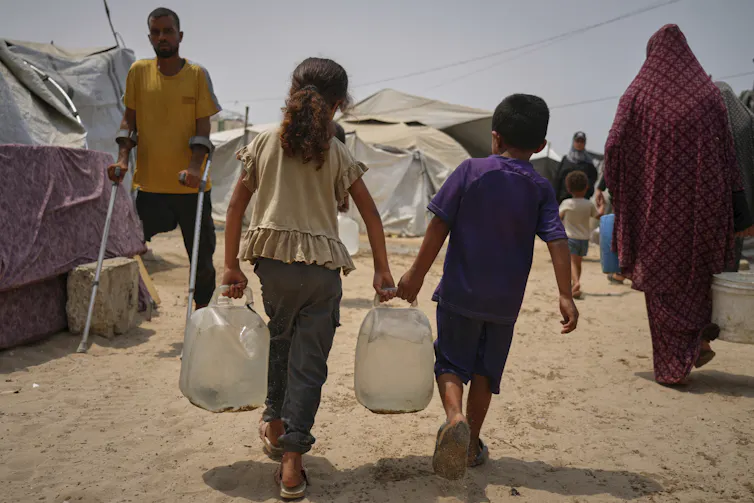 Palestinian children haul jerrycans of water collected from a distribution point in Gaza City, August 12, 2025.
Jehad Alshrafi/AAP
The limits of international law
In a chapter titled Ingrid, Albanese deals with the controversial subject of whether Israel’s occupation can be classified as “apartheid”. Ingrid is Dutch, a long-time Palestinian researcher, and co-founder of the Boycott, Diversify, and Sanction (BDS) movement.
Through this window, Albanese explores various international legal opinions from the International Court of Justice and human rights organisations, such as Amnesty International and Human Rights Watch. These have provided research and legal arguments that Israel’s occupation is apartheid and therefore a crime against humanity.
“It is not just a question of discrimination,” Albanese argues,
but of the denial of fundamental rights, of the separation of people on racial and territorial grounds, and of the use of coercive measures to keep the oppressed group isolated and subordinate.
The chapter brings to life how Israel’s occupation exposes the limits of international law when there is no diplomatic appetite to bring perpetrators to justice.
As well as exploring the permissive diplomatic environment that allows Israel’s occupation to continue unimpeded, Albanese touches on the more controversial topic of resistance in the form of boycotts and sanctions, but also more violent forms.
Perhaps most important is Albanese’s hypothetical question: “What would I do if I was a Palestinian living under occupation?”
Albanese’s exploration of Palestinian life in While the World Sleeps is her way of expressing a form of resistance to the Israeli occupation. She does this by juxtaposing the occupation’s inhumanity with Palestinians’ humanity. As she notes in her conclusion, “if you want to achieve change, first of all you have to be change, and that you cannot change anything if you do not change yourself.”
While the World Sleeps is, in part, Albanese’s attempt to be at peace with her increasingly complex life as a highly visible, vocal, and thus controversial advocate for Palestinian humanity and an equitable peace.
What comes through in her storytelling is not just the dignity of the Palestinians, but their samud – their determination to persevere in the face of adversity. The stories humanise them by bringing their experiences to life, and express Albanese’s fear that when the world sleeps the genocide of Palestinians will continue.
Authors: Martin Kear, Lecturer, Department of Government and International Relations, University of Sydney
Palestinian children haul jerrycans of water collected from a distribution point in Gaza City, August 12, 2025.
Jehad Alshrafi/AAP
The limits of international law
In a chapter titled Ingrid, Albanese deals with the controversial subject of whether Israel’s occupation can be classified as “apartheid”. Ingrid is Dutch, a long-time Palestinian researcher, and co-founder of the Boycott, Diversify, and Sanction (BDS) movement.
Through this window, Albanese explores various international legal opinions from the International Court of Justice and human rights organisations, such as Amnesty International and Human Rights Watch. These have provided research and legal arguments that Israel’s occupation is apartheid and therefore a crime against humanity.
“It is not just a question of discrimination,” Albanese argues,
but of the denial of fundamental rights, of the separation of people on racial and territorial grounds, and of the use of coercive measures to keep the oppressed group isolated and subordinate.
The chapter brings to life how Israel’s occupation exposes the limits of international law when there is no diplomatic appetite to bring perpetrators to justice.
As well as exploring the permissive diplomatic environment that allows Israel’s occupation to continue unimpeded, Albanese touches on the more controversial topic of resistance in the form of boycotts and sanctions, but also more violent forms.
Perhaps most important is Albanese’s hypothetical question: “What would I do if I was a Palestinian living under occupation?”
Albanese’s exploration of Palestinian life in While the World Sleeps is her way of expressing a form of resistance to the Israeli occupation. She does this by juxtaposing the occupation’s inhumanity with Palestinians’ humanity. As she notes in her conclusion, “if you want to achieve change, first of all you have to be change, and that you cannot change anything if you do not change yourself.”
While the World Sleeps is, in part, Albanese’s attempt to be at peace with her increasingly complex life as a highly visible, vocal, and thus controversial advocate for Palestinian humanity and an equitable peace.
What comes through in her storytelling is not just the dignity of the Palestinians, but their samud – their determination to persevere in the face of adversity. The stories humanise them by bringing their experiences to life, and express Albanese’s fear that when the world sleeps the genocide of Palestinians will continue.
Authors: Martin Kear, Lecturer, Department of Government and International Relations, University of Sydney 
















