

Google AI


Modern Australian

Romy Ash’s novel imagines the next pandemic as an eerily beautiful mushroom disease

  • Written by: Jane Rawson, PhD Candidate, Creative Writing, University of Tasmania

Do you remember the very early days of the pandemic, before the freedom rallies, before even the vaccinations, when we were spraying boxes of muesli bars with Glen-20 in case that was how the germs were getting to us?

In those days, there was a feeling these lockdowns could perhaps save us from all the things wrong with the world. Emissions were way down. People were creating spontaneous collective musical experiences on the balconies of apartments. The canals of Venice ran clear. Maybe all it took was a deadly virus to make us change?

In the end, everything actually got worse and has continued to get worse. But that spirit is what animates Romy Ash’s eco-fiction novel, Mantle: the idea that a pathogen might make us wake up to ourselves; make us stop, think and change course.

What if we abandoned the idea of our separateness from nature? What if we embraced our porousness – “our bodies are hosts; we’re always living communally” – and treated ourselves as ecosystems, rather than individuals?
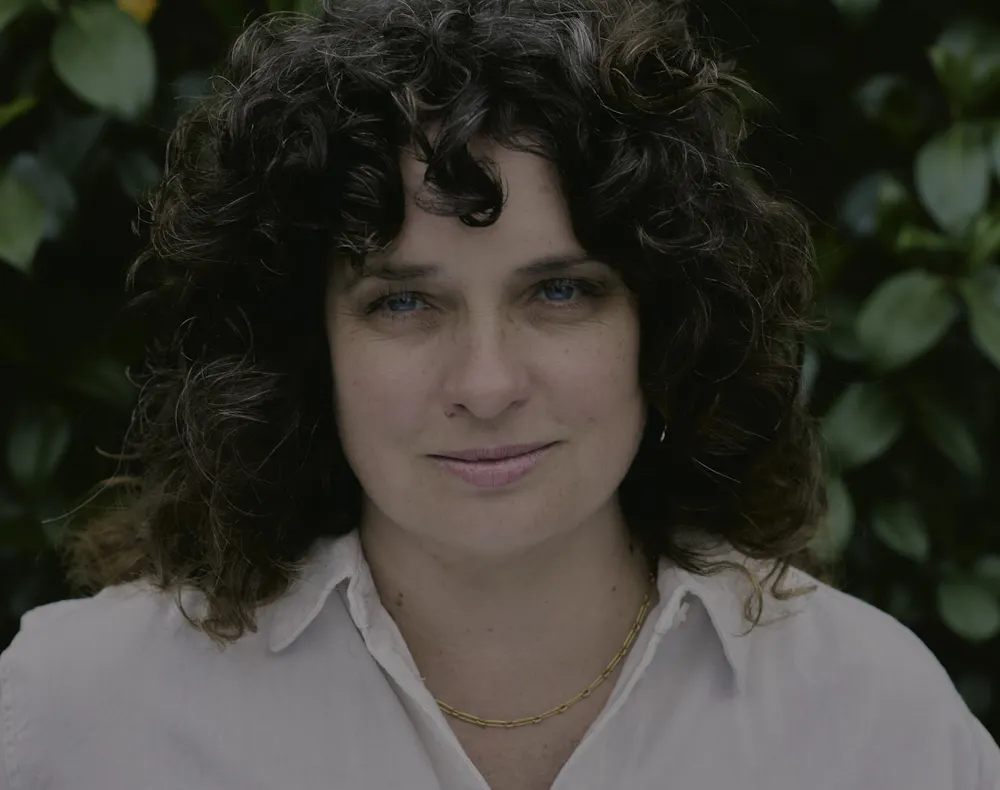
Romy Ash’s novel imagines the next pandemic as an eerily beautiful mushroom disease
Romy Ash’s Mantle explores the idea that a pathogen might make us wake up to ourselves – and change course. Lauren Bamford/Ultimo

Bad – but beautiful

When she published her first novel, Floundering, in 2012, 31-year-old Ash was touted as the next big thing, with photo spreads in Women’s Weekly and a swag of prizes, including shortlistings for the Miles Franklin, Commonwealth Book Prize and Prime Minister’s Literary Awards. This second novel brings depth, humour and wryness, gained in the life she’s lived in between.

Ursula, her main protagonist, is 50, single and childless. She and her mother, Delores, are the last remnants of their family. Ursula works as an academic in Melbourne, but she’s taken a break to spend a little time with her mother, who lives alone in a self-built home where “the windows are actually shower screens”, in the far south of Lutruwita/Tasmania. It overlooks the salmon farms made infamous by Richard Flanagan’s Toxic.

Ursula has come because she needs some quiet time to work on a geology paper, but she discovers her mother is dying and the paper is quickly forgotten. Are the growths in Delores’ lungs cancer?

Delores is independent, fractious, deeply embedded in the intricacies of small-town Tasmanian life. She has a landline phone and a composting toilet. She “bought here because it was the cheapest place to buy land, and this was the cheapest block”.

As death approaches, Delores declines any treatment and focuses instead on making sure Ursula has all the information she needs: the Corolla is serviced at the BMW mechanic with the mossy cars out front, the best lemons come “from the driveway with one goat” and “there is a list of businesses in town that are not be frequented under any circumstances”.

Ash’s understanding and representation of life in the southern reaches of the Huon Valley, particularly for a writer from “the mainland”, is exquisitely accurate: “Small slight, large grievance, long held. This is the fabric of the town.”

book cover - mushroom pattern
Delores leaves Ursula with a house full of hoarded junk and a rash, which turns out to be widespread among the locals – and entirely untreatable. In the throes of grief, Ursula hooks up with Toby, a diver at the salmon farms. She wakes the next morning to find their bodies connected by fine, sticky threads, “pale, translucent, a soft earthy white”, in the places where their skin was touching. It’s a new fungal pandemic. The borders close. News trickles in from the mainland. Whatever it is, it’s bad. But at the same time, it’s also beautiful: as they spend night after night together and wake each morning, ever more stuck, Ursula finds herself dreaming Toby’s dreams, learning new skills, losing her fear of the deep ocean. Then her body starts to fruit. No easy binaries Mantle is set in a near future, just far enough from now that Ursula can “stare out into the night, hoping for the flash of a swift parrot, even in the dark; even knowing they are extinct”. Unlike many contemporary eco-fiction novels, Mantle has no easy villains (not even, really, the salmon farms). It doesn’t let the reader feel self-righteous about their own environmental stance. Ash takes a nuanced, exploratory approach to conservation ethics and to our individual roles in the broader crisis of extinction, wildlife depletion and climate change. She introduces us to an old fisherman, Ernie, who has been breeding and planting endangered giant kelp; Ursula laughingly calls him a greenie. ‘I wouldn’t sit next to a greenie at the pub,’ he continues, ‘but I know giant kelp is a bloody nursery, and I know its disappearance is one reason why we aren’t pulling any lobster out of the sea.’‘I’m a greenie,’ I say. ‘It’s that and the salmon farms.’‘You’re not a greenie; you’re a city slicker.’I laugh. ‘Latte drinker,’ I say. Delores’ best friend Joc tells Ursula: I don’t eat meat. I do no harm. This is my philosophy. Those men who know the ocean is going to hold them, they’ve got a dive bag with a knife in it, they’ve got a spear gun, but they are also appreciating the wonder. Ash rejects the easy binaries that can come with seeing “the environment” theoretically, and investigates the ethics that develop among people who live among, and off, other animals. She recognises the complexities that occur when a place has high unemployment and low education, and where the best jobs can be found at the salmon farms; where being a “greenie” is a privilege attached to class. Next big thing Ursula is middle-aged, grumpy, horny, an expert in her field, scared of the ocean – and not, in any way, a nature lover or an outdoors type. She is far from your typical eco-fiction narrator, and her perspective welcomes in all kinds of readers. The novel is also replete with food, because while Ursula stops thinking about her profession – mudstone geography – almost as soon as the book begins, she never stops thinking about the joys of cooking and eating. Ash is a former food blogger and columnist for The Guardian: Mantle is crying out for an accompanying recipe collection (albeit one that’s mushroom-heavy). This is a novel that explores connection, porousness, the possibilities offered by permeability. “It asks for a numb heart, the patriarchy,” says Joc. Mantle asks, what if we could ask for the opposite; what if we could let ourselves feel? Authors: Jane Rawson, PhD Candidate, Creative Writing, University of Tasmania

Read more https://theconversation.com/romy-ashs-novel-imagines-the-next-pandemic-as-an-eerily-beautiful-mushroom-disease-281017

What to Do When an Older Car Is No Longer Worth Keeping in Melbourne

Ever looked at another repair quote and wondered whether your old car is still worth the trouble? It is a common turning point for Melbourne motoris...

Your Baby's First Year: A Local Guide to Feeding, Sleep, and When to Get Extra Support

Ask ten parents in a Brisbane mothers' group how their baby is feeding or sleeping, and expect ten different answers.  Someone's baby sleeps throug...

Kitchen and Laundry Makeover Ideas That Don't Require a Full Renovation

Full kitchen renos are expensive — and most people don't actually need one.  They need the kitchen to stop looking like it's stuck in 2009, or they...

How Technology Is Reshaping the Modern Australian Commercial Kitchen

The commercial kitchen has always been shaped by technology. Refrigeration changed how ingredients could be stored, modern ventilation transformed k...

The Number on a Roller Blind Fabric That Nobody Explains

Somewhere in the fabric book, next to the colour name, there is a percentage. Three per cent. Five per cent. Ten per cent. Nobody explains it, most c...

What’s Trending in Men’s Jewellery This Father’s Day!

Finding a Father’s Day gift that feels personal, stylish and genuinely wearable is not always easy. While socks and novelty mugs have traditionally ...

Road Signs: Understanding Their Role in Clear and Effective Signage

Effective signage and display hardware can help businesses communicate information, promote products and organise customer or visitor movement. Road...

Bottle Label Printing: Key Factors to Consider Before Your Next Packaging Run

Effective packaging begins with understanding the product, bottle material, artwork and production requirements when planning bottle label printing. H...

Planning a Long-Distance Move With Interstate Movers Melbourne

Moving between states involves more planning than a typical local relocation. Along with packing and transporting household belongings, you need to...

Understanding the Role of an I/O Controller in Industrial Automation

Modern industrial systems depend on accurate communication between sensors, machines and control systems. An I/O controller can help manage this commu...

How the Right Mining Hose Supports Demanding Operations

Mining environments place considerable demands on equipment used for material transfer, water management and processing. Hoses operating in these co...

Simple Ideas for Making Social Gatherings More Memorable

We have all been to those parties where everyone just stands around the kitchen island, staring at their phones, waiting for someone else to make a mo...

Outdoor Wall Lights: Improving Exterior Lighting Around Your Home

Lighting can influence how a room looks, feels and functions, so the right fitting should be selected according to both appearance and practical req...

Commercial Office Cleaning: Combining Routine Office Cleaning With Melbourne Service

Keeping a workplace clean requires a service that can accommodate everyday tasks as well as the particular needs of the business. Professional comme...

Caravan Sales in Queensland: How to Find the Right Caravan for Sale QLD

Caravan ownership is about more than having somewhere to sleep while travelling. For many Queenslanders, it is one of the best ways to explore regio...

What Sir Walter Buffalo Turf Actually Costs in 2026 (And Why Quotes Vary So Much)

Two quotes landed on a Hills District homeowner's kitchen table last spring for the exact same 80-square-metre backyard. One said $12 a metre. The o...

Nearly 1,300 NSW Hospital Beds Are Occupied By People Who Are Ready To Go Home

1,276 people in NSW hospitals have been medically cleared for discharge but remain in hospital because they're still waiting for NDIS or aged care sup...

National Survey Launched to Measure Operational Impacts of Federal NDIS Policy Reforms

The effects of recent NDIS reforms are beginning to move beyond policy papers and into day to day service delivery. A new national survey is asking ...
















