

Like solar, most of the first home battery subsidies went to the wealthy. We need a fairer approach
- Written by Thomas Longden, Senior Researcher, Urban Transformations Research Centre, Western Sydney University
Australia is in the grip of a record-breaking battery rush.
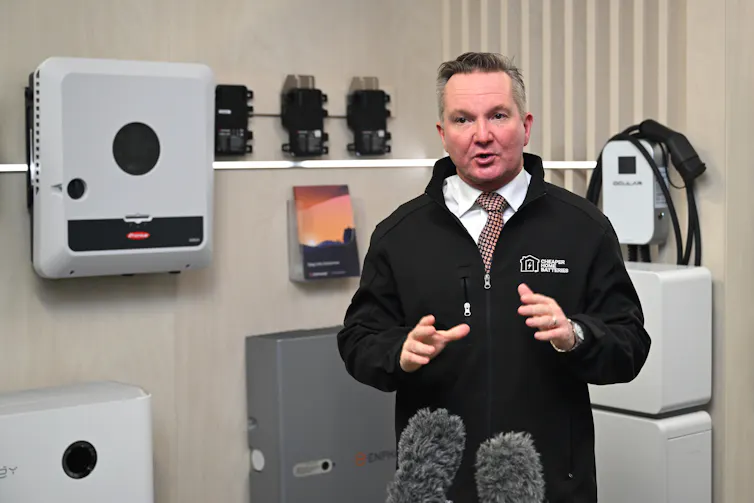
Last week Energy Minister Chris Bowen announced that more than 380,000 home batteries have been installed since July last year. That’s over 100,000 more than the total installed between 2020 and mid-2025. The reason for the rush: government subsidies, which cut the upfront cost by about 30%.
While the federal government has described the Cheaper Home Batteries program as an “unprecedented success”, it has also been criticised for unfairly allowing wealthier households to reap the benefits.
Our working paper, released this week but not yet peer reviewed, shows a disproportionate increase in the installation of batteries and rooftop solar in wealthier postcodes.
The program has now been redesigned, with two major revisions that took effect this month. The upfront subsidy now available will be lower than previously advised across all battery sizes. The subsidy will also differ based on the size of battery installed.
Will this be enough to better target the scheme? That’s not clear. We found similar issues occurred when rooftop solar subsidies were changed in 2011. These should be a cautionary example of policies that entrench energy inequality. They show a need to move away from first-come, first-secured schemes.
Wealthy households were first for subsidies
We looked at the number of batteries installed between July 2025 and March 2026 across all Australian postcodes.
Compared with a middle socio-economic group, there have been 912 more batteries installed in the richest major city postcodes with high solar installations.
This corresponds with 3.6% more households installing a battery and an additional 36 megawatt-hours of capacity in each of these more wealthy postcodes, compared with the middle socio-economic group.
Our research shows households that could move quickly have been able to secure a higher subsidy before changes to the program came into effect at the start of May 2026. For the period between December 2025 and March 2026, battery installations are estimated to have increased by ten per month in more prosperous postcodes. But this is likely to be an underestimate, with data still to be released and revised by the Clean Energy Regulator.
We found many of these fast movers also locked in a larger subsidy by installing a bigger battery. There had been a 4.5 kilowatt-hour (kWh) to 9.5kWh increase in the average capacity of batteries installed since December 2025.
Impact on rooftop solar
Because households must have solar installed to get a battery subsidy, there has also been an increase in solar installations.
We found there was a doubling of rooftop solar capacity installed in more prosperous postcodes, compared with the 12 months before the Cheaper Home Batteries program was announced.
Repeating mistakes of the past
In 2011, a similar inequitable pattern occurred for rooftop solar – households in more wealthy postcodes were able to lock in a high upfront subsidy or a higher feed-in tariff.
Households in South Australia and Queensland that got rooftop solar installed before policy changes in 2011 still receive a 40–44 cent/kWh feed-in tariff, and will continue to do so until mid-2028. Most solar households receive much less: 10c/kWh or lower.
Our research, which focuses on revisions to both household solar and battery programs, shows we have repeated the mistakes of the past.
Taking equity seriously
Household technology subsidies that use first-come, first-secured financial support are likely to favour households with greater financial resources and a greater tolerance of financial risk.
Australia’s battery subsidy is set to decrease each year, no matter how many batteries are installed. The subsidy does not vary by postcode, wealth or income.
But future household programs could be designed differently, with the aim of more equitable support during the early stages of adoption.
For example, a Californian solar scheme reduced its subsidy based on how many batteries had already been installed. And while research shows savvy households anticipated the changes and installed more rooftop solar in the months before subsidies decreased, it provides an example of what could be done.
Australia’s battery program could have set subsidies based on how many batteries had been installed in each postcode. Greater allocations could also be provided to higher-priority areas.
This means higher subsidies would be distributed more evenly across the country and not centred in major cities. It would also reserve more funding for lower-income households in areas where battery installations have not kept up.
How to avoid a two-speed energy transition
The home battery rush is a cautionary example of policy design that has entrenched inequality through first-come, first-secured subsidies. We need to do more to ensure everyone is part of the energy transition.
Our findings raise questions about the aims of household solar and battery subsidy programs. Does equity across socioeconomic groups matter? Should we have a more targeted approach? Should we prioritise areas with weaker or more remote sections of the grid?
When announcing the revisions to the Cheaper Home Batteries program, Bowen noted the previous success of rooftop solar across Australia. He said: “We want to match that success with home batteries to cut bills for everyone, for good.”
We are still a long way from an equitable transition, where people from all walks of life have access to rooftop solar and home batteries.
Authors: Thomas Longden, Senior Researcher, Urban Transformations Research Centre, Western Sydney University

















