

Why the race to save these cherished penguins just became more urgent
- Written by Jemma Geoghegan, Professor and Webster Family Chair in Viral Pathogenesis, University of Otago
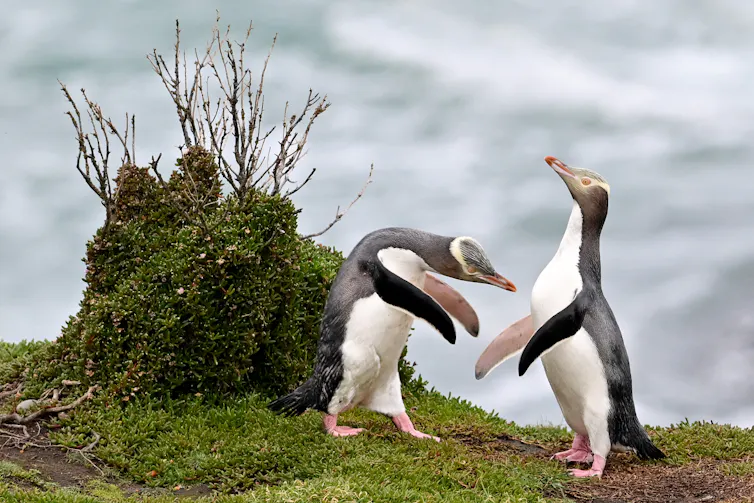
The hoiho, also known as takaraka or yellow-eyed penguin, holds a special place in Aotearoa New Zealand’s natural identity.
Shy and solitary, with its distinctive yellow headband and pale eyes, it is one of the world’s rarest penguins and among the country’s most recognisable wildlife species.
For Ngāi Tahu, the hoiho is a taonga species closely tied to the health of the ocean and coastal ecosystems. The bird’s image appears on New Zealand’s $5 note alongside Sir Edmund Hillary, while its decline has become one of the country’s most urgent conservation stories.
That story has taken a new turn, with a just-published genomic analysis revealing the hoiho is not a single population, but three deeply distinct subspecies. Without immediate intervention, one of those subspecies could vanish within decades.
When one becomes three
Today, fewer than 115 hoiho breeding pairs remain on mainland New Zealand and Rakiura/Stewart Island.
Our research, supported by Genomics Aotearoa, shows these mainland birds are genetically isolated from subantarctic populations and have been evolving independently for thousands of years.
For decades, yellow-eyed penguins were broadly managed as two groups: mainland birds and subantarctic birds from the Auckland and Campbell Islands.
But by sequencing the genomes of 249 penguins from across their range, we discovered there are actually three distinct lineages with no migration between them. The mainland birds diverged from the southern populations between 5,000 and 16,000 years ago, long before humans arrived in New Zealand.
In partnership with Ngāi Tahu, we propose recognising three subspecies:
- hoiho murihiku: mainland and Rakiura hoiho
- hoiho motu maha: Auckland Islands hoiho
- hoiho motu ihupuku: Campbell Island hoiho
Recognising these three subspecies changes how we think about their conservation.
Rather than being interchangeable populations, these groups should now be considered distinct evolutionary lineages, each the result of thousands of years of adaptation to different environments.
Deadly disease driving decline
The mainland subspecies is already in crisis. Since 2019, chicks have been dying from a devastating disease known as respiratory distress syndrome, which causes severe breathing difficulties, lung damage and high mortality in young birds.
Previous work identified a likely viral cause: a newly discovered gyrovirus circulating in yellow-eyed penguins. Intriguingly, the virus is present across all regions, while severe disease appears concentrated in mainland birds.
Our analyses suggest there may be a genetic reason why. We identified certain immune and respiratory genes associated with disease susceptibility, including genes involved in antiviral immune responses.
This does not mean the disease risk is purely genetic. Habitat degradation, climate stress, fisheries bycatch, malnutrition and environmental change are all contributing to declining survival.
But it suggests mainland birds may be especially vulnerable to the virus because of their unique evolutionary history and shrinking population size.
The genomic warning signs are already visible. Mainland birds have lower genetic diversity and higher inbreeding than southern populations.
Yellow-eyed penguins have long been considered endangered, but our findings suggest extinction of the mainland subspecies is an even greater loss than previously thought.
The population has been declining for decades due to warming oceans, changing food availability, fisheries interactions, introduced predators and disease. Chick survival is now extremely poor, with fewer than 20% surviving to adulthood.
Without urgent action, extinction of the northern subspecies within a decade is now a realistic scenario. And because these penguins are genetically distinct, losing them means losing thousands of years of unique evolution.
How hoiho might be saved
Our findings have major implications for conservation management.
One possibility often discussed in endangered species recovery is “genetic rescue” – introducing individuals from other populations to increase genetic diversity.
But our results show the three hoiho subspecies are genetically very different, raising concerns about unintended consequences such as disrupting local adaptations.
That means conservation efforts may not be able to rely on future translocations between subspecies as a simple backup plan. Instead, preventing extinction of the mainland lineage must become the immediate priority.
That includes stronger fisheries protections to reduce bycatch, improved predator and habitat management, ongoing disease surveillance and research, greater investment in chick survival and rehabilitation, and stronger action to address marine ecosystem degradation and climate impacts.
Hoiho are also a taonga species for Māori and a major part of southern New Zealand’s wildlife identity. Their disappearance would be an ecological, cultural and economic loss all at once.
For many New Zealanders, yellow-eyed penguins feel like a permanent part of the landscape – a species that will always be there.
But genomics is telling us something sobering: the mainland hoiho is rapidly running out of time.
Authors: Jemma Geoghegan, Professor and Webster Family Chair in Viral Pathogenesis, University of Otago

















