

Australia has had ‘game-changer’ budgets before. How does Chalmers’ stack up?
- Written by David Lee, Associate Professor of History, UNSW Sydney
Of the many budgets delivered since the Second World War, four stand out as having ushered in or consolidated significant economic reform.
These were Ben Chifley’s in 1942, Bill Hayden’s in 1975, Paul Keating’s in 1989 and Peter Costello’s in 1996.
Joe Hockey’s 2014 budget tried to bring about lasting reform, but its failure tended to make later governments timid.
So, how did those budgets change Australia, and how does this year’s effort compare?
Ben Chifley’s 1942 budget
Chifley’s budget was a reforming budget in three main ways.
First, it facilitated Australia’s step-up to total war in the Pacific, following Japan’s attacks on Pearl Harbor and Darwin. Military spending rose to about 34% of gross domestic product (GDP).
Second, it embedded the Commonwealth takeover of income taxation, removing the states’ power to tax personal income.
Third, it established the modern welfare state by introducing the National Welfare Fund to compensate for higher wartime income taxes for everyone. This fund was intended to pay for future social services, such as unemployment benefits, widows pensions and child endowment.

Chifley’s budget paved the way for later governments to strive to maintain full employment through “Keynesian” techniques of monetary and fiscal management.
Budgetary management from the 1940s to the 1960s was assisted by a system of fixed exchange rates, including for the Australian dollar, that prioritised domestic stability. This system had been established by the Bretton Woods conference of 1944.
Bill Hayden’s 1975 budget
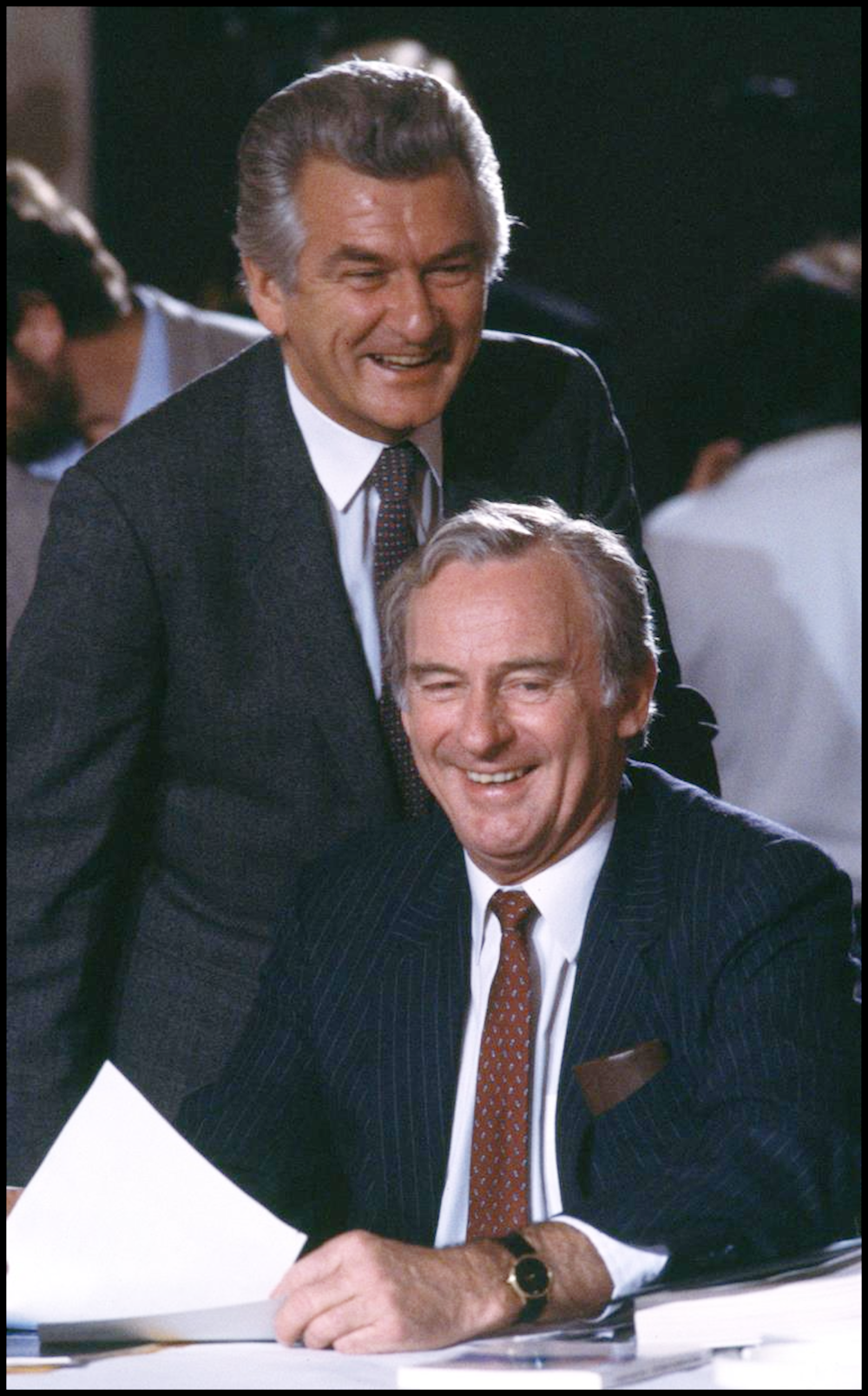
Hayden’s 1975 budget took place after the collapse of the Bretton Woods system in 1971 when the system of fixed exchange rates broke down.
Two years later, the spike in the global price of oil led to “stagflation” (simultaneously high unemployment and inflation). In 1975, the rate of inflation was about 17% and unemployment had jumped from 2% in the early 1970s to 5%.
Hayden’s budget is remembered for introducing Australia’s first universal healthcare system, Medibank, which lives on today as Medicare. More importantly, Hayden’s budget set Australia on the path to long-term reform by starting the shift from traditional Keynesian policies.
Breaking away from decades of economic orthodoxy, Hayden declared:
Today, it is inflation itself which is the central policy problem – more inflation simply leads to more unemployment.
His budget halved the growth in government expenditure and called for restraint in wages growth to prevent further economic instability.
Paul Keating’s 1989 budget
As treasurer, Keating’s most significant budget is generally regarded as the 1989 budget. His aim was to consolidate the economic reforms of the previous decade.
Paul Keating said his 1989 budget was “bringing home the bacon”.These included floating the Australian dollar and deregulating the financial system, laying the seeds for compulsory superannuation, reducing tariffs and liberalising trade, and introducing taxation reform.
The 1989 budget was the one Keating predicted would “bring home the bacon” insofar as all the economic reforms engineered by himself and Prime Minister Bob Hawke would pay dividends.
Although the budget cuts contributed to a recession in the early 1990s, it was the Keating budget most emblematic of the transformational economic policy reforms of the 1980s and 1990s.
Peter Costello’s 1996 budget
 Peter Costello put through ten budget surpluses.
Alan Porritt/AAP
Peter Costello put through ten budget surpluses.
Alan Porritt/AAP
Costello delivered 12 consecutive budgets from 1996 to 2007. His most important budget was arguably his first. It addressed a $9 billion deficit by introducing tough spending cuts and foreshadowing asset sales and thus laying the foundation for ten surpluses.
Prime Minister John Howard would call this budget “the most important of all budgets” delivered during his almost 12 years in government, as well as “the best and bravest in 25 years”.
Economist Warwick McKibbin persuasively argues that the introduction of the Goods and Services Tax (GST) in 2000 was made easier by tough spending cuts and the elimination of federal government debt in Howard’s first term.
Joe Hockey’s 2014 budget
 Joe Hockey speaks to the media after the 2014 budget.
Lukas Coch/AAP
Joe Hockey speaks to the media after the 2014 budget.
Lukas Coch/AAP
Another budget which sought but failed to establish a reformist path was Hockey’s 2014 budget.
Its key objective was to repair the budget by eliminating a $37.9 billion deficit. It proposed drastic cuts to health, education and social services.
The budget was, however, criticised as one of “broken promises”. Intense political opposition in the Senate resulted in many of its key changes being blocked or modified. Its most lasting legacy was to make later governments wary of introducing major reform.
Was Jim Chalmers’s 2026 budget a real reforming budget?
Chalmers’ fifth budget was developed amid serious global volatility. The war in the Middle East has produced an energy shock and fuel crisis even more severe than that of the 1970s. Internationally, the political and economic order established after WWII is fracturing.
Domestically, the neoliberal policies (shifting economic power from public institutions to markets) followed over the last 50 years are failing to offer solutions to serious economic problems.
These include lower productivity growth, high cost-of-living pressures, a housing affordability crisis, long-term fiscal unsustainability and climate and environmental risk.
Chalmers’ budget includes some bold reforms to negative gearing, capital gains and trusts.
But, compared with earlier reformist budgets, the 2026 budget is better characterised as incrementally reformist. Chalmers’ taxation reforms are less fundamental than the Howard-era GST reform. And they are less transformative than the economic reforms of the 1980s.
A real reformist budget after 2026 might be one that tackles more fundamental tax reform including to resource taxation and possibly a carbon tax; and a return to the public housing policies of the Chifley years, when the government provided long-term, low-interest loans to the states to build public rental housing.
Authors: David Lee, Associate Professor of History, UNSW Sydney

















