

If more of us work from home after coronavirus we'll need to rethink city planning
- Written by: John L Hopkins, Innovation Fellow, Swinburne University of Technology
We have seen an unprecedented rise in the number of people working from home as directed by governments and employers around the world to help stop the spread of COVID-19.
If, as some expect, people are likely to work from home more often after the pandemic, what will this mean for infrastructure planning? Will cities still need all the multibillion-dollar road, public transport, telecommunications and energy projects, including some already in the pipeline?
Read more: Flexible working, the neglected congestion-busting solution for our cities
World’s largest work-from-home experiment
Remote working was steadily on the rise well before COVID-19. But the pandemic suddenly escalated the trend into the “world’s largest work-from-home experiment”. Many people who have had to embrace remote working during the pandemic might not want to return to the office every day once restrictions are lifted.
They might have found some work tasks are actually easier to do at home. Or they (and their employers) might have discovered things that weren’t thought possible to do from home are possible. They might then question why they had to go into the workplace so often in the first place.
But what impact will this have on our cities? After all, many aspects of our cities were designed with commuting, not working from home, in mind.
Read more: Coronavirus could spark a revolution in working from home. Are we ready?
Stress test for NBN and energy networks
From a telecommunications perspective, the huge increase in people working from home challenges the ways in which our existing networks were designed.
Data from Aussie Broadband show evening peak broadband use has increased 25% during the shutdown. Additional daytime increases are expected due to home schooling with term 2 starting.
Research by the then federal Department of Communications in 2018 estimated the average Australian household would need a maximum download speed of 49Mbps during peak-use times by 2026. If more people work from home after COVID-19, the size and times of peak use might need to be recalculated.
Another factor not modelled by the government research was the potential impact of an increase in uploads. This is a typical requirement for people working from home, as they now send large files via their suburban home networks, rather than their office networks in the city.
Read more: Coronavirus: telcos are picking up where the NBN is failing. Here's what it means for you
Recent research by Octopus Energy in the UK has found domestic energy use patterns have also changed since COVID-19. With more people working from home, domestic energy use in the middle of the day is noticeably higher. Some 30% of customers use an average of 1.5kWh more electricity between 9am and 5pm.
Conversely, data from the US show electricity use in city centres and industrial areas has declined over the same period.
Less commuting means less congestion
Closer to home, new data from HERE Technologies illustrate just how much traffic congestion has eased.
Thursday afternoons from 5-5.15pm are normally the worst time of the week for traffic congestion in Melbourne. Last week the city’s roads recorded the sort of free-flowing traffic usually seen at 9.30am on a Sunday. Just 1.8% of Melbourne’s major roads were congested, a fraction of the usual 19.8% at that time.
All of Australia’s major cities are experiencing similar reductions. Transurban has reported traffic is down 43% on the Melbourne airport toll road, 29% on its Sydney roads and 27% in Queensland.
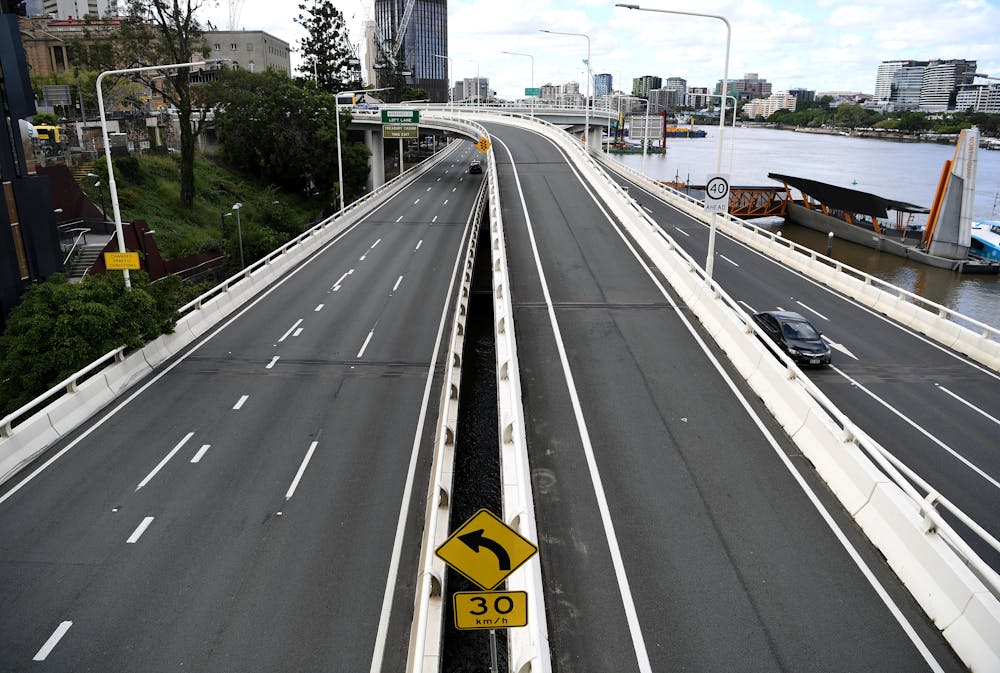 Morning peak-hour traffic has vanished in Brisbane and other Australian cities under the COVID-19 restrictions.
Dan Peled/AAP
Morning peak-hour traffic has vanished in Brisbane and other Australian cities under the COVID-19 restrictions.
Dan Peled/AAP
Passengers are also staying away from public transport in droves. For example, South Australian government statistics for Adelaide show passenger numbers have slumped by 69% for buses, by 74% for trains and by 77% for trams, compared with this time last year.
Read more: For public transport to keep running, operators must find ways to outlast coronavirus
What does this mean for infrastructure planning?
With these trends in mind, future investment in roads, public transport, energy and telecommunications will need to consider the likelihood of more people working from home.
Prior to COVID-19, Melbourne research found 64% of city workers regularly worked from home, but usually only one day a week, even though 50% of their work could be done anywhere. While the changes we are now seeing are a result of extreme circumstances, it is not inconceivable that, on average, everybody could continue to work from home one extra day per week after the pandemic. Even this would have significant implications for long-term urban planning.
The most recent Australian Census data show 9.2 million people typically commute to work each day. If people worked from home an average of one extra day per week, this would take 1.8 million commuters off the roads and public transport each day.
Many road and public transport projects will be based on forecasts of continuing increases in commuter numbers. If, instead, people work from home more often, this could call into question the need for those projects.
Areas outside city centres would also require more attention, as working from home creates a need for more evenly distributed networks of services for the likes of energy and telecommunications. Interestingly, such a trend could support long-term decentralisation plans, like those outlined in Melbourne’s Metropolitan Planning Strategy. And if such change encourages more people to live away from the big cities, it also could help to make housing more affordable.
Read more: Fancy an e-change? How people are escaping city congestion and living costs by working remotely
Authors: John L Hopkins, Innovation Fellow, Swinburne University of Technology


















