

Allianz Commercial: AI and cloud computing drive global construction boom for data centers
- Global spending on data centers is expected to reach several trillion US dollars by 2030 with the US and China as main drivers of growth.
- The surging demand for data centers has created a building boom, with costs for some construction projects exceeding $20 billion, say Allianz Commercial experts.
- Rapid expansion is heightening exposures and introducing new risks for companies and insurers.
SINGAPORE - Media OutReach Newswire - 6 November 2025 - The unseen forces of AI and cloud computing are never out of the news, yet behind the headlines lies a story of growth and innovation as tangible as bricks and mortar. The heavy computing power required by AI workloads, and the growing global demand for AI technologies, has seen a building boom take place around the world as developers scramble to build the facilities required to meet these needs. According to market research, up to $7 trillion will be spent on data centers by 2030 – a huge sum driven largely by technology companies in the US and China, while Europe lags a few paces behind. The tech industry's big three, Amazon, Microsoft and Google Cloud, accounted for almost two-thirds of global cloud revenue in Q2 2025. Combined with Chinese companies such as Alibaba and Tencent, their capital expenditure budgets for 2025 reach hundreds of billions of US dollars, much of it geared towards the industrial scale infrastructure and dependable energy sources that high-performance AI and cloud computing now demands.
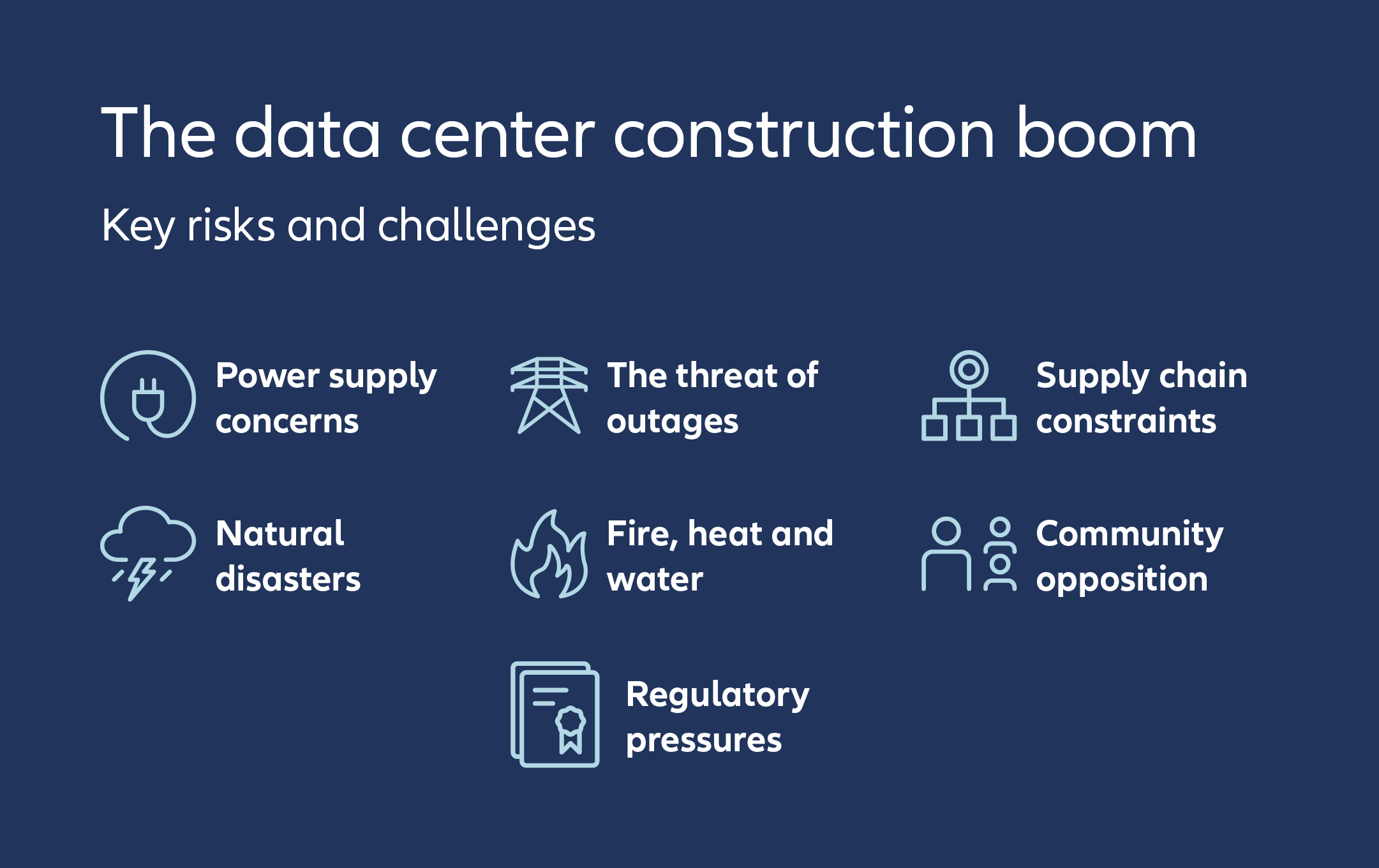
The latest Allianz Commercial report, The Data Center Construction Boom, explores the extent of this global buildout and also questions whether the building bonanza can last. Despite the ongoing expansion, several factors could limit future growth, including the surging costs of construction. These have escalated dramatically from $200-$300 million, to projects exceeding $20 billion. According to Allianz Commercial construction experts, average-sized facilities now cost between $500 million and $2 billion. Along with higher construction prices, the complex nature of data center construction and operation requires specialized insurance coverage for risks such as power supply concerns, faulty workmanship, fire or natural catastrophes.
"Construction projects as complex and extensive as data centers require significant time and resources. Typically, they require project-specific policies given their size and their unique risk profile that demands specialized insurance," says Darren Tasker, Head of Construction, Americas, at Allianz Commercial.
Data centers are fueling the construction industry
A global buildout is underway to construct the infrastructure needed to support the digital economy. The US will be the largest market for data centers, covering about two thirds of the total global data center power demand with 81 gigawatts (GW) by 2028, while China's data center market is building out equally aggressively. Greater Beijing alone now accounts for roughly 10% of global hyperscale capacity. Europe is trailing behind the two superpowers but is experiencing a 43% annual increase in pipeline activity, with London and Dublin as the largest markets (each with over 1GW capacity), followed by Amsterdam, Frankfurt, Paris, and Milan.
"The bigger data centers have a huge footprint. The scale of a $20bn+ facility can involve tens of thousands of workers on site at peak times, with significant equipment and building supplies moving in and out," says Chris Fancher, US Head of Construction Property at Allianz Commercial. "Timings can be tight. This requires expert coordination, as any missteps or faulty workmanship can lead to potential losses or costly delays."
Data centers combine great processing power with unique risk profile
Building a data center is a complex, multi-disciplinary undertaking, which presents a multitude of risks. One of the main issues is the soaring power demand that threatens to outpace grid capacity and infrastructure. The electricity demand from data centers worldwide is set to more than double by 2030, to around 945Twh. This is slightly more than the consumption of the whole of Japan today, with its population of 124 million. To avoid power issues, which are the main source of impactful outages with 45%, data center operators are increasingly seeking to reduce their reliance on the grid by generating their own power on site, including renewables, gas, and even potentially small nuclear reactors.
Fire, heat and water are also significant risks for data centers, potentially leading to severe property damage or business interruption losses. Lithium-ion batteries are increasingly being used in server racks in data halls. The fire risk associated with these batteries is well documented, particularly in relation to electric vehicles and charging infrastructure. Large data centers can consume up to 19 million liters of water a day, equivalent to the water use of a town with a population of up to 50,000. Increasing cooling requirements will drive up water and electricity demand, while rising global temperatures pose a growing risk to the resilience of over half the world's top data center hubs. This has altered the risk profile of data centers and contributed to the increase in construction and insurance costs.
Risk management crucial with strong growth expected in Asia
The Asia Pacific region accounts for approximately 30% of global data center capacity and is expected to grow at a compound annual growth rate of 21% from 2024 to 2028, a faster pace compared to more developed markets. The region consists of multiple markets, each with distinct drivers and market conditions. China, Japan, and India account for 60% of the total installed capacity in the region, while markets like India, Malaysia, and Indonesia are expected to lead the next wave of growth.
Christian Sandric, Regional Managing Director of Allianz Commercial Asia, says, "As the demand for data centers in the region surges, it is crucial that parties fully understand the risks involved during construction and operation. Beyond the main risks such as power supply, rising construction costs and supply constraints, fire, and cooling requirements, parties also need to consider aspects such as cyberattacks, and impact on the surrounding environment, ecosystem, and infrastructure. For example, cooling systems may discharge heated water back into local water bodies, and this can raise temperatures and affect aquatic ecosystems.
"These complex and extensive risks call for specialist insurance and expert risk-management guidance, and clients need to work with an experienced team of underwriters who knows the business and can support the project from beginning to end, including multi-year coverage and policy extensions as needed."
Hashtag: #Allianz #AllianzCommercial
https://commercial.allianz.com/
https://www.linkedin.com/company/allianz-commercial
The issuer is solely responsible for the content of this announcement.
About Allianz Commercial
Allianz Commercial is the center of expertise and global line of Allianz Group for insuring mid-sized businesses, large enterprises and specialist risks. Among our customers are the world's largest consumer brands, financial institutions and industry players, the global aviation and shipping industry as well as family-owned and medium enterprises which are the backbone of the economy. We also cover unique risks such as offshore wind parks, infrastructure projects or film productions. Powered by the employees, financial strength, and network of the world's #1 insurance brand, we work together to help our customers prepare for what's ahead: They trust us in providing a wide range of traditional and alternative risk transfer solutions, outstanding risk consulting and Multinational services as well as seamless claims handling. Allianz Commercial brings together the large corporate insurance business of Allianz Global Corporate & Specialty (AGCS) and the commercial insurance business of national Allianz Property & Casualty entities serving mid-sized companies. We are present in over 200 countries and territories either through our own teams or the Allianz Group network and partners. In 2024, the integrated business of Allianz Commercial generated around €18 billion in gross premium globally. https://commercial.allianz.com/

















