

PolyU research unveils mechanoelectrical perception in sea urchin spines, empowering next-generation biomimetic sensors
HONG KONG SAR - Media OutReach Newswire - 5 March 2026 - Sea urchin spines are not only for defence—they also act as natural sensors. A research team led by Prof.
WANG Zuankai, Associate Vice President (Research and Innovation), Dean of Graduate School, Kuok Group Professor in Nature-Inspired Engineering and Chair Professor of the Department of Mechanical Engineering of The Hong Kong Polytechnic University (PolyU), together with scholars from City University of Hong Kong (CityU) and Huazhong University of Science and Technology (HUST), has discovered the mechanoelectrical perception in sea urchin spines, originating in their gradient porous structure, that allows the spines to instantly detect water flow. Using 3D printing, the team has replicated this structure and developed a bionic metamaterial sensor, which holds promise for breakthroughs in sensing technology. This innovation will drive the advancement of deep-sea technology such as marine monitoring and underwater infrastructure management, and can be extended to other emerging fields like brain-computer interfacing and aerospace.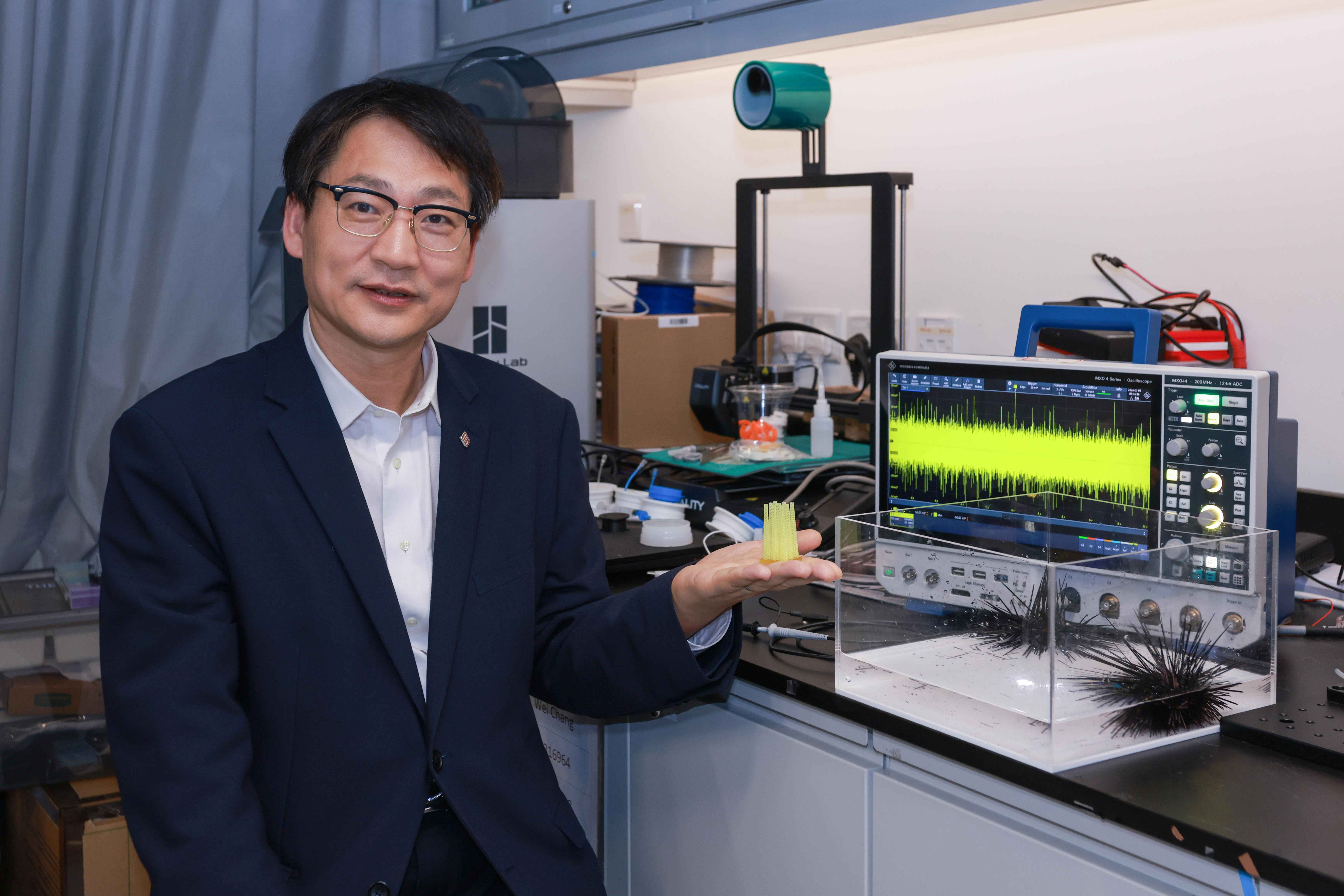
A research team led by Prof. Wang Zuankai, Associate Vice President (Research and Innovation), Dean of Graduate School, Kuok Group Professor in Nature-Inspired Engineering and Chair Professor of the Department of Mechanical Engineering of PolyU, has discovered the mechanoelectrical perception in sea urchin spines. It originates in the spines’ gradient porous structure that generates electrical signals when water flows through it. The team used 3D printing technology to replicate the structure and develop a novel bionic metamaterial sensor.
The research team found that, in the long-spined sea urchin (Diadema setosum), when a seawater droplet strikes the tip of a spine, the spine rotates rapidly within a second. Electrical measurements revealed that the droplet simulation produced a voltage of about 100 millivolts inside the spine; when the spine is immersed in water, water flow stimulation triggers a voltage of several tens of millivolts. This mechanoelectrical perception was observed even in dead spines, indicating that the mechanism is unrelated to biological cells.
This response originates from the stereom structure of the spine—the porous internal skeleton composed of pores with varying sizes and distributions. These pores exhibit a gradual gradient along the spine from the base to the tip: larger pores and lower solid density at the base, and smaller pores and higher solid density at the tip, forming a bicontinuous gradient porous structure. As water flows through the porous structure, solid-liquid interfacial interaction occurs and the flow exerts shear force on the electric double layer, inducing the separation and redistribution of interfacial charge, which generates a voltage difference. The gradient structure intensifies the interaction between water flow and pore surfaces, resulting in a stronger voltage difference and enhancing the spine's sensing capabilities.
Inspired by these findings, the researchers used vat photopolymerisation 3D printing to create artificial samples from polymer and ceramic materials that resemble the spine's stereom. Experiments showed that the spine-mimicking design produce a voltage output about three times higher and an amplitude about eight times greater than non-gradient designs under water flow stimulation, demonstrating that the key to the mechanoelectrical perception lies in the structure rather than the material. They also constructed a bionic 3D metamaterial mechanoreceptor that is designed in a 3 × 3 array with each unit made of gradient porous material. This mechanoreceptor can record electrical signals in real time underwater and precisely locate the position of water flow impact, without the need for additional electricity.
The research team points out that the gradient porous structure in sea urchin spines enhances signal transmission, thereby improving the precision and sensitivity of the mechanoreceptor. By replicating this structure in different materials, it is possible to extend its application beyond water flow sensing to various types of signals, including those measuring pressure, vibration and electromagnetic waves. This will inspire sensing technologies in multiple fields, such as in relation to its use in brain-computer interfaces to enhance the sensing of brainwaves and neural signals, with tremendous application potential.
Prof. Wang Zuankai said, "Compared to traditional mechanoreceptors, our design excels in manufacturability, structural design flexibility, material versatility, geometric and performance control, and real-time underwater self-sensing. Leveraging gradients of porous materials and 3D printing technologies, we aspire to produce more nature-inspired metamaterial sensors with a range of materials, pore sizes and surface features that support potential applications in many fields."
At the forefront of nature-inspired science and engineering research, Prof. Wang's team has also invented various new materials, including lotus leaf-inspired self-cleaning surfaces capable of rapid water repellency, Araucaria leaves-inspired surfaces that enable self-propelled liquid transport, and anti-icing structures that achieve spontaneous ejection of freezing droplets by replicating the biological mechanism of spore shooting in fungi. He envisions that their research will open up new avenues for the development of nature-inspired materials.
"For natural porous materials, mechanical properties such as strength may not be the primary function, but rather a by-product of complex biomineralisation. Uncovering previously unknown mechanisms that lie beyond a material's traditionally recognised function helps us to more comprehensively understand and fully utilise these natural resources. This is crucial for advancing biomimetic research," he added.
This joint research was co-led by Prof. LU Jian from CityU, and Prof. YAN Chunze and Prof. SU Bin from HUST. The study findings have been published in the international journal Nature.
Hashtag: #PolyU #MarineEnvironment #NatureInspiredEngineering #SensingTechnology #DeepSeaTechnology #Brain-ComputerInterface #Nature #HongKong
The issuer is solely responsible for the content of this announcement.

















