Modern Australian
The Times

This budget, amid talk of deficits, consider the lessons we ought to have learned

  • Written by Steven Hail, Adjunct Associate Professor, Torrens University Australia

This budget, amid talk of deficits, consider the lessons we ought to have learned

A decade ago, and years before Treasurer Josh Frydenberg promised a budget that was “back in the black”, Prime Minister Julia Gillard promised the same thing.

At that time, in the lead-up to the 2012 budget, unemployment was higher than it is today, and inflation and wages growth were so low (1.6% and 2.3%, respectively) as to provide no impediment whatsoever to cutting unemployment further.

Yet Gillard was resolute in her determination to bring in a budget surplus, by which she meant a budget that spent less than it took in.

She titled her speech to Western Australia’s Chamber Of Commerce and Industry and Chamber Of Minerals And Energy “In the Black

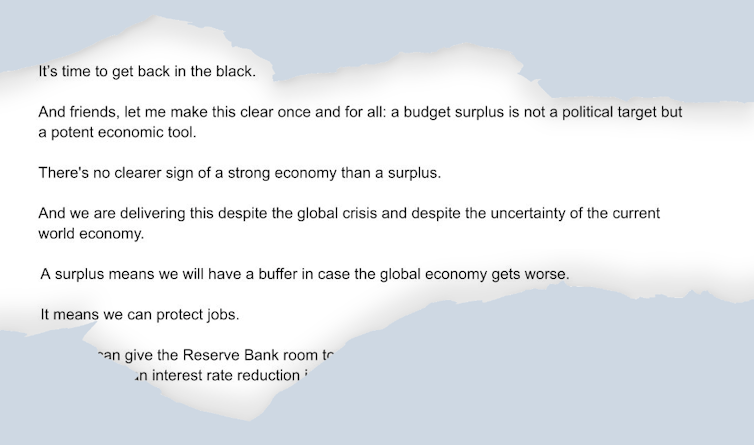
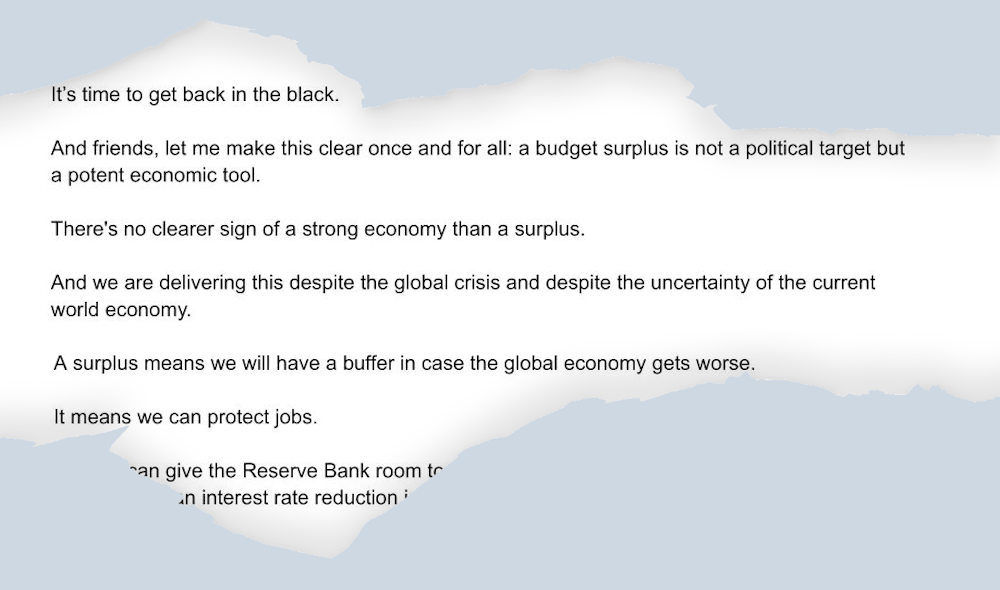
In the Black, Prime Minister Julia Gillard, April 19 2012. There was “no clearer sign of a strong economy than a surplus”. It would “protect jobs”, provide a “buffer in case the global economy gets worse”, and allow the Reserve Bank to cut rates, “knowing that an interest rate reduction is good for families and business”. Indeed, she added: …let me make this clear once and for all: a budget surplus is not a political target but a potent economic tool. I sometimes wonder whether she remembers this claim. I nearly asked her once, crossing North Terrace in Adelaide, but I chickened out. As with Gillard, so with Abbott Gillard never did get her budget surplus, and she and Kevin Rudd were followed as prime minister by Tony Abbott, who talked of a “budget emergency” that only a run of surpluses could fix. While in opposition, his finance spokesman Barnaby Joyce had gone as far as to suggest that the debt run up by years of budget deficits (spending more than the government took in) was “getting to a point where we can’t repay it”. Read more: Please, no more questions about how to pay off the COVID debt That was too much even for Abbott, who dumped Joyce as finance spokesman a month later. Neither Abbott nor his successors Malcolm Turnbull and Scott Morrison ever did get a surplus, although Morrison came close in 2018-19. The deficits and the way they were financed meant net debt continued to rise and rise. But the government didn’t run out of cash. And when the pandemic struck, borrowing (and having the Reserve Bank create) hundred of billions to support businesses and their employees turned out not to be a problem. So why did Gillard, Abbott, Turnbull, and for a while Morrison and Frydenberg, have their hearts so set on ultimately unachievable surpluses? It might be because they didn’t understand how Australia’s money system works. More charitably, it might be because, while they did understand how Australia’s system works, they found it convenient not to pass that knowledge on. They have been perpetuating the “government as households” metaphor, which ignores the role of the government as a currency issuer as well as a currency user. In cooperation with its wholly owned central bank, Australia’s government produces Australian dollars. It can’t run out of them. Budget money can’t run out The government has good reasons for collecting taxes (to suppress spending that might accelerate inflation) and good reasons for borrowing by issuing bonds (to temporarily withdraw money from the economy). But these don’t include a need to fund its spending. In truth, every dollar the government spends is a new dollar; every dollar it collects in taxes is a dollar destroyed. Every bond it sells does nothing more than change dollars into transferable savings accounts at the Reserve Bank. David Andolfatto, an economist who is vice president of the US Federal Reserve Bank of St Louis, puts it this way: …it seems more accurate to view the national debt less as form of debt, and more as a form of money in circulation. What this means is that Gillard was nearly right. She just needed to dump the word “surplus”. The budget is indeed a potent economic tool. Too much spending without offsetting tax will indeed push up inflation. Not enough spending will keep people out of work and risk a recession. But how much spending is needed relative to tax depends on the economy. In 2020 and 2021 a willingness to push out much more money than was taken in supported an economy that would otherwise have crashed, and helped bring about two of the most rapid recoveries from recessions and downturns in history. Horses for courses What budgets should do depends on how things are, and if we haven’t learned this by now, we should have. And what else have we learned? That complex global supply chains can be efficient but not necessarily resilient. Which means a transition away from petrol towards renewables may have benefits beyond the purely environmental. That preventative health, health care and aged care are more important than we might have thought. We have have also learned about the limits to the powers of the Reserve Bank. While governments talked of surpluses, we continued to obsess about central banks using official interest rates to control inflation. When it tried to push up inflation, it couldn’t, until recently. It might be that just as interest rate cuts were not the best way to stimulate inflation before the pandemic, interest rate hikes are not the best way to suppress inflation afterwards. Higher interest rates impose costs on businesses. And they actually increase some incomes, including those of savers and high earners who own products linked to treasury bonds. When high interest rates can suppress inflation, they are likely to do it by triggering a slide in asset prices, including the price of housing assets, which, with household debt high, ought to give policy-makers pause for thought. Taxing more and reining in government spending might do it better. Read more: Memories. In 1961 Labor promised to boost the deficit to fight unemployment. The promise won In any event, withdrawing money from the economy might not be the right thing to do at a time when when high prices are being driven by global events rather than spending at home. There’s a lot we should have learned in the past decade, much of it set out in modern monetary theory – something the budget papers are likely to acknowledge quietly, if at all. Authors: Steven Hail, Adjunct Associate Professor, Torrens University Australia

Read more https://theconversation.com/this-budget-amid-talk-of-deficits-consider-the-lessons-we-ought-to-have-learned-179310

Chatswood Tutoring And Its Role In Academic Achievement

Academic success often requires more than classroom attendance alone. Students face increasing expectations as they progress through school, particu...

Why Laser Hair Removal Treatments Continue Growing In Popularity

Managing unwanted hair can become time-consuming and frustrating for many people, especially when shaving, waxing, and other temporary methods requi...

Choosing the Right Devices for a Flexible Workplace

For IT leaders managing large fleets, the device layer is where workforce productivity and security policy meet. The shift towards flexible and hybrid...

How Business Advisory Services Help Companies Achieve Sustainable Growth

Every business owner aims to build a profitable and sustainable organisation. While dedication, innovation, and hard work are important, achieving l...

Why Body Contouring Has Become A Popular Cosmetic Treatment

Many people maintain healthy lifestyles through regular exercise and balanced eating habits but still struggle with stubborn areas of fat that are dif...

How to Choose the Right POS Hardware for Your Business in Australia

A lot of Australian business owners spend weeks researching POS software but buy hardware almost as an afterthought. That's a mistake. The wrong har...

Why Material Handling Hose Is Critical for Industrial Efficiency

A high-performance material handling hose is an essential component in industries that transport abrasive, dry, or bulk materials on a daily basis...

How to Choose the Right Lawyer in Melbourne for Your Situation

Choosing legal support can feel difficult, especially when the stakes are personal or business-related. The right lawyer in Melbourne should underst...

Hoteliers Look to Clever Value Adds to Increase Revenue

The Australian hospitality industry is still in recovery mode after a notoriously rough patch in recent years. While there has been a post-COVID tra...

Moving to Queensland? Here’s How to Prep Your Car for the Big Move North

There’s no sign of the northern migration slowing down, with thousands of southerners fleeing from chaotic lifestyles and cooler climates for a brig...

Diesel Shortage to Impact Trades and Contractors

Strait of Hormuz blockage affecting all major parts of trades and construction Trades and construction across residential, commercial and industria...

Why Holiday Home Owners Turn to Rental Management Agents

The Allure — and the Reality — of Renting Out Your Property Owning a holiday home is a dream for many Australians. Whether it's a beachside sha...

Why Finding Reliable Doctors In Bundoora Is Important For Long-Term Health

Access to quality healthcare plays an important role in maintaining overall wellbeing and managing health concerns early. Trusted Doctors in Bundoor...

Understanding the Different Types of Car Services: Minor vs Major

When it comes to car maintenance, one of the most important things every vehicle owner should understand is the difference between a minor and a maj...

How Superannuation and TPD Insurance Work Together

Superannuation is an essential part of financial planning in Australia. It is designed to provide individuals with income during retirement, helping...

Tiny Towns funding granted for Mt Hotham and Mt Buller upgrades

Alpine Resorts Victoria (ARV) has welcomed funding support from the Victorian Government’s  Tiny Towns Fund, with both Mt Hotham and Mt Buller se...

Locksmith Services: Why Professional Security Solutions Matter More Than Ever

Security is a critical concern for homeowners, businesses, and vehicle owners alike. Whether it involves protecting a property, replacing damaged lo...

Why Tooth Fillings Are Important For Protecting Damaged Teeth

Cavities and minor tooth damage are common dental problems that can worsen if left untreated. Professional tooth fillings help restore damaged teeth, ...