

As coronavirus restrictions ease, here's how you can navigate public transport as safely as possible
- Written by: Hassan Vally, Associate Professor, La Trobe University
As coronavirus restrictions continue to ease, one of the key challenges we face is how to deal with people moving around a lot more.
In particular, as more of us start to head back to school and the office in the coming weeks and months, more of us will be getting on buses, trains and trams.
So what is public transport going to look like as we relax restrictions, and how can we navigate this safely?
Read more: To limit coronavirus risks on public transport, here's what we can learn from efforts overseas
Workplaces can help
Victorian premier Daniel Andrews has emphasised working from home will be one of the last measures the state will ease.
But even when restrictions are relaxed, do we all need to go into the office as much as we used to?
Working from home has become the “new normal” for many of us, and we’ve learnt a lot about how to do this successfully. Employers have adjusted too, with some indicating they will encourage increased remote working moving forward.
So one of the obvious things we can do to reduce the numbers of people using public transport is to continue to work from home where possible.
Read more: If more of us work from home after coronavirus we'll need to rethink city planning
Another option is for workplaces to implement flexible start times. If we can reduce the numbers of people using public transport during peak times, this will make a significant difference in reducing crowding.
Public transport providers and governments
State governments have introduced additional cleaning practices on public transport networks. These will continue, and may even be increased, as more people return to public transport.
Although increased cleaning is important, physical distancing remains the key to safely moving large numbers of people again. Governments will need to consider some changes to ensure people can keep a safe distance from others on their commute.
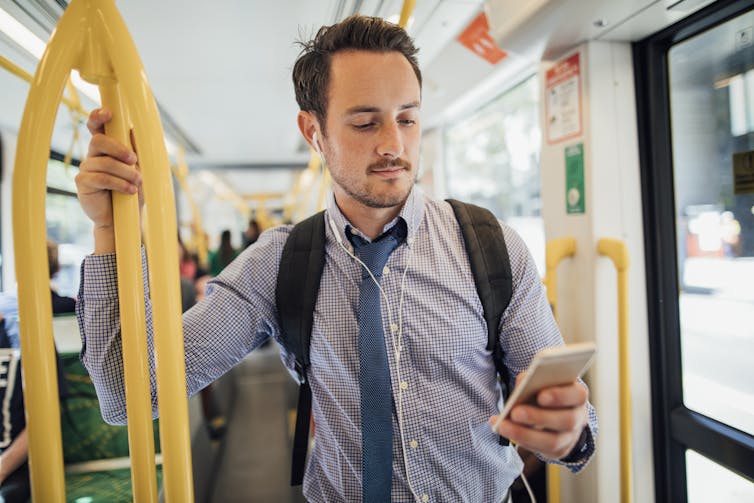 Many people touch the same surfaces on public transport.
Shutterstock
Many people touch the same surfaces on public transport.
Shutterstock
As we’ve seen with the easing of restrictions, different states will take different approaches.
For example, New South Wales has imposed limits on how many people can board a bus or train. A maximum of 32 people are allowed in a train carriage (normally one carriage holds 123 passengers), while buses are limited to 12 passengers (capacity is normally 63).
Further, markings on the seats and floors of buses and trains indicate where people can sit and stand.
Marshals are also being stationed around the public transport network to ensure commuters are following the rules.
In a similar move, the South Australian government revealed they will remove seats from Adelaide trains.
Read more: Coronavirus recovery: public transport is key to avoid repeating old and unsustainable mistakes
In contrast, Queensland is not imposing any passenger limits, instead asking commuters to use their common sense. The government says there is plenty of room on public transport in Queensland at present, and the risk of virus transmission is low given the small number of active cases.
Similarly, Victoria has not imposed passenger limits. But the government has indicated commuters will be able to access information about which public transport services are the least crowded to assist travel planning.
Some states have flagged extra services may be needed to avoid overcrowding, though the extent to which this will be possible is dependent on resources.
In addition to extra services, NSW has indicated it will boost car parking and enhance access for cyclists and pedestrians.
What can you do?
The main responsibility around keeping virus transmission suppressed as we relax restrictions rests with us as individuals to behave sensibly and responsibly.
The same principles apply when we use public transport as when we navigate all public spaces.
Maintaining physical distance from others and washing our hands regularly are possibly even more important when we’re using public transport, given we potentially come into contact with a lot of people in an enclosed space.
We know SARS-CoV-2, the virus that causes COVID-19, is more likely to spread indoors than outdoors. We also know prolonged contact with someone infected with the virus increases the risk of transmission, as compared to a passing encounter.
So public transport commutes have the potential to pose a significant risk of virus transmission, especially if you’re sitting next to an infected person on a long journey.
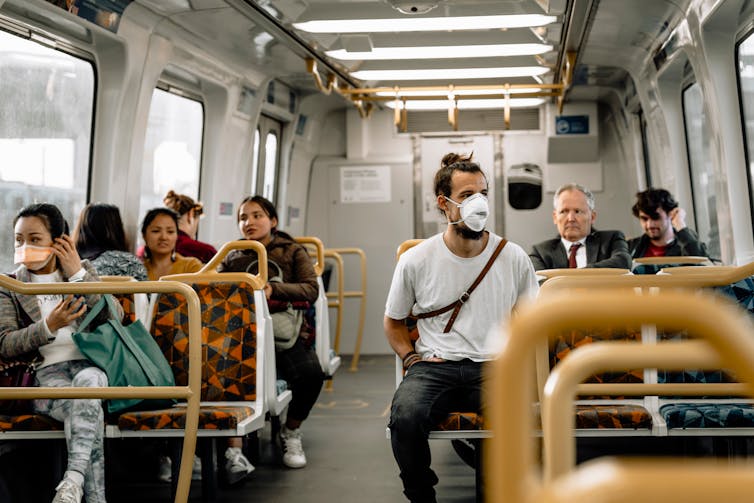 Masks are a hot topic.
Shutterstock
Masks are a hot topic.
Shutterstock
Taking hand sanitiser when you use public transport is a good idea so you can clean your hands while travelling. You may be touching contaminated surfaces, for example the bars and handles for balance.
In addition, washing your hands thoroughly with soap as soon as you arrive at your destination should become a part of your routine.
Importantly, if you’re sick you should not be leaving the house, let alone taking public transport or going to work.
What about masks?
Wearing a mask on public transport is an issue of personal preference.
But if you choose to wear a mask, it’s important to understand a couple of things.
First, masks need to be put on and taken off correctly so you don’t inadvertently infect yourself in the process.
And while masks potentially offer some additional protection to you and others, it’s still critical to follow physical distancing and other hygiene measures.
Read more: Who's most affected on public transport in the time of coronavirus?
Authors: Hassan Vally, Associate Professor, La Trobe University


















