Mining companies are required to return quarried sites to their 'natural character'. But is that enough?
- Written by Shaun Rosier, Practice-based PhD Researcher in Landscape Architecture, Te Herenga Waka — Victoria University of Wellington
New Zealand has more than 1,100 registered quarries. Some of these mined sites are small, rural operations, but a significant number are large and complex, and within a city’s urban boundaries.
As part of the resource consent application for a mining project, quarry operators are usually issued with a quarry management plan, which outlines what needs to happen to the landscape once mining has finished.
Most local government bodies require quarry operators to do little more than smooth the altered landscape, redistribute topsoil across these slopes, plant some new vegetation, and manage any onsite waterways to prevent surface erosion.
But restoring the ecology of an extracted site isn’t enough any more.
My research at the Horokiwi Quarry in Wellington explores how design-led remediation projects can restore the ecology of a mined landscape as well as creating new public landscapes that can be used for recreation.
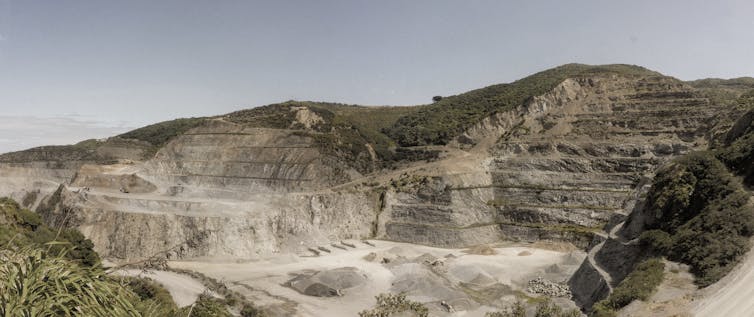 The southern half of the Horokiwi Quarry has been reshaped and the massive bench to the left entirely removed.
Author provided
The southern half of the Horokiwi Quarry has been reshaped and the massive bench to the left entirely removed.
Author provided
Conditions of remediation
Quarry management plans currently pay attention to returning the topography of a mined site to a “natural” condition during the remediation. Quarries and mines extract material from the earth, and by necessity alter the surface dramatically.
Read more: Afterlife of the mine: lessons in how towns remake challenging sites
Often a large amount of material has to be removed first to access the desired aggregate material or rare mineral. Once remediation begins, this material is spread across the site to create a natural appearance, suitable for revegetation. The landscape is smoothed over, pits filled in, and topsoil distributed.
Likewise, the revegetation strategy remains relatively simple. Most remediation projects rely on spraying a seed-fertiliser-mulch mix over these freshly contoured slopes. In difficult conditions, this is often paired with manual planting to establish cover for pioneer species.
These strategies typically use regionally specific plants, ideally sourcing the seed stock from the area to help establish a robust and appropriate ecology.
Read more: The uranium mine in the heart of Kakadu needs a better clean up plan
Nature and culture
These processes are all used to restore a site back to a “natural character”, but what this means is left undefined. The Resource Management Act (RMA), under which mining resource consent applications have to be made, says miners have:
…a duty to avoid, remedy or mitigate any adverse effect on the environment arising from an activity.
While the RMA does not define this natural character condition that is to be preserved or restored, it provides some guidance in the New Zealand Coastal Policy Statement.
Here, natural character is determined to be underpinned by natural processes, elements and patterns. But as some planners and designers have made clear, this is still an unclear position.
It relies on a problematic distinction between nature and culture, where nature is something different and unaltered from humans. Or, as US environmental historian William Cronon writes:
The place where we are is the place where nature is not.
Problematic results
Most remedial works are successful from a biological point of view, leading to full or partial restoration of ecological processes. For example, the limestone quarry at Cape Foulwind has been relatively successful in its biophysical remediation. But the site is close to local communities and on a major tourist route, and could play a bigger role as a public space.
On the other hand, the remediation of the Mikonui Valley mine, on conservation land on the West Coast, has arguably been a failure, described as a “moonscape” by conservationists. The company paid a bond to the Department of Conservation to allow it to mine on public land, but it has not remediated the land to an acceptable degree, and likely never will.
Behind this is the larger issue that remediation was only seriously considered at the end of the extraction process. Doing so left little room for other design options.
Read more: Mining powers modern life, but can leave scarred lands and polluted waters behind
Another approach to remediation
Recent research has called for a different approach, especially for quarries and mines within urban areas where landscape architects are involved throughout the entire extraction process.
Using their knowledge and skill sets could bring the extracted landscape significantly closer to a desirable outcome. It would also allow for new spaces, including parks, housing, recreation or ecological reserves.
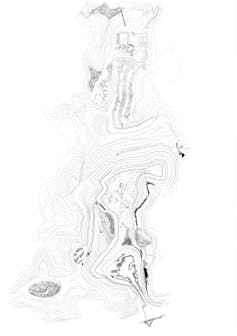 A proposal for the remediation of the Horokiwi Quarry would turn it into a regional park, connected to the surrounding suburbs and the cities of Wellington and Lower Hutt.
Author provided
A proposal for the remediation of the Horokiwi Quarry would turn it into a regional park, connected to the surrounding suburbs and the cities of Wellington and Lower Hutt.
Author provided
This is an important shift for urban quarry sites. Establishing a design process that works in parallel with the extraction process would allow sites such as the Horokiwi Quarry to play a role in the public life of a city.
This large aggregate quarry has a remaining lifespan of 20-30 years, and presents an ideal case to develop remediation techniques that can bring the most out of this landscape.
The design proposal builds on the experience of a landscape of extreme scale and mass. Facilities such as sports fields, gathering spaces, relaxation and a mix of pathways all feed off the experience of the landscape.
At the same time, new ecological sites are established where appropriate to create a different relationship between visitors and the landscape.
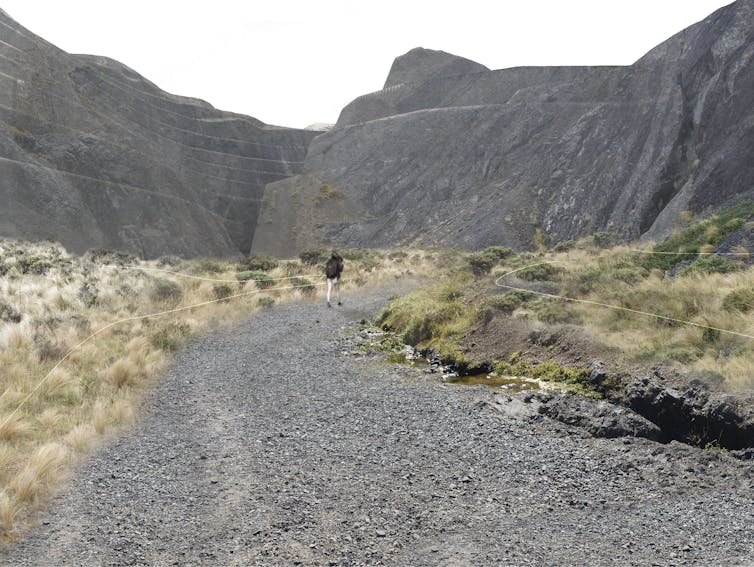 Pathways are designed to give visitors a sense of the scale of the quarried site.
Author provided
Pathways are designed to give visitors a sense of the scale of the quarried site.
Author provided
Turning post-extraction landscapes such as the Horokiwi Quarry into public spaces confronts us with their scale and otherworldliness. It can change how we relate to the environment.
We have to remediate these sites in a way that moves us to recognise our relationship with extraction and consumption. This might not be pretty, but it is necessary.
Authors: Shaun Rosier, Practice-based PhD Researcher in Landscape Architecture, Te Herenga Waka — Victoria University of Wellington