Feeling pressured to buy Christmas presents? Read this (and think twice before buying candles)
- Written by Gary Mortimer, Professor of Marketing and Consumer Behaviour, Queensland University of Technology
Christmas marks a peak in consumerism across the West. Despite the COVID downturn, this Christmas the spending frenzy is unlikely to be dampened.
One consumer sentiment survey showed about 12% of people expect to spend more this Christmas than in previous years. About one-third expected to spend less – a similar result to previous years. And retailers are also feeling optimistic: more than one in three expect Christmas sales to exceed 2019 by more than 5%.
All this festive spending creates significant waste, particularly in the form of unwanted gifts.
So before you finish your Christmas shopping, it’s worth considering why we feel forced to spend big on gifts during the silly season, and whether there are better, greener alternatives.
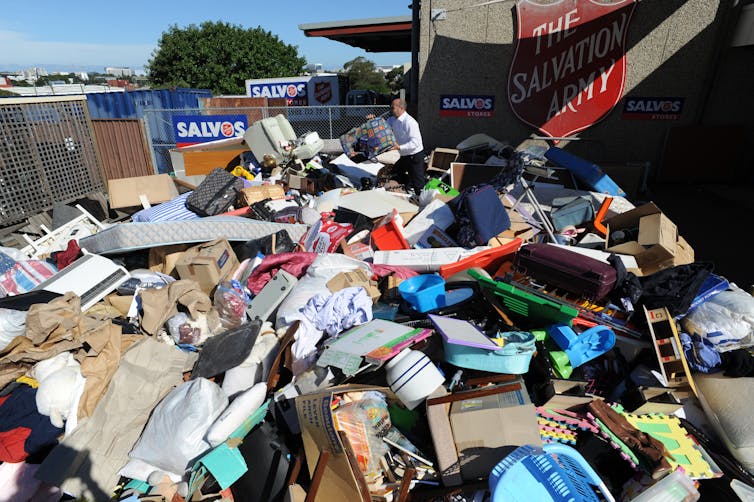 Unwanted Christmas presents can pile up in landfill and at charity stores.
AAP
Unwanted Christmas presents can pile up in landfill and at charity stores.
AAP
Really, you shouldn’t have
Research by ING found A$400 million worth of unwanted presents were gifted in Christmas 2018, comprising about 10 million items.
Topping the list were novelty items (51%), candles (40%), pamper products (40%), pyjamas or slippers (35%) and underwear or socks (32%).
Charity groups are inundated with unwanted goods directly after Christmas. Not all of these are resold – charities reportedly send about 60,000 tonnes of unwanted items to landfill every year.
This waste comes at a huge cost, not only to household budgets but also to the environment. Recent research on the topic is hard to come by, but in 2007 researchers from the Stockholm Environment Institute examined consumption over the festive season, and found 80kg of carbon dioxide per person could be saved if unwanted gifts were not purchased.
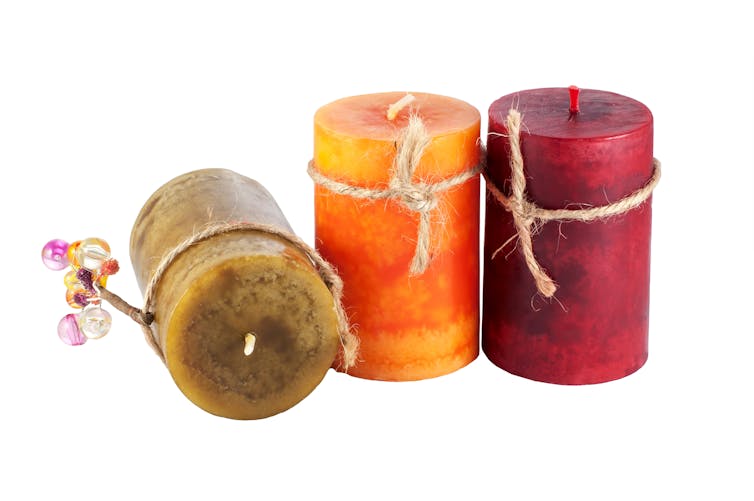 Some people don’t like receiving candles at Christmas.
Shutterstock
Some people don’t like receiving candles at Christmas.
Shutterstock
Why do we feel obliged to buy?
Gift-giving is a complex emotional process. And it’s not necessarily always a positive experience: a 2016 survey found 43% of Australian shoppers felt forced to spend money at Christmas.
Research suggests Christmas gift-giving is less about altruism, and becoming more about social pressure to reciprocate – the expectation that when we receive a gift, we will give one in return. And reciprocity does not necessarily bring happiness. One study dating back to 1990 found those who gave an obligatory gift had negative feelings about the act afterwards.
In particular, some respondents felt their freedom to choose a gift was curtailed by perceived obligations – that they had to reciprocate with a gift of similar type, price or brand. This triggered psychological “reactance” – the unpleasant arousal people experience when their free behaviours are threatened.
Read more: How to choose the right Christmas gift: tips from psychological research
Gift-giving can be a way of showing appreciation, but you don’t necessarily need to spend up big. Research shows while gift-givers might expect a gift to be appreciated more if it was expensive, recipients reported no such association.
Or you could spend nothing at all, by regifting an unwanted present. In some circles of contemporary society, regifting is frowned upon. Respondents in one study went so far as to describe regifters as lazy, thoughtless and disrespectful.
However in some cultures, regifting is considered normal. For example, a classic 1922 ethnographic study describes a ritual followed by people of the Massim archipelago in Papua New Guinea. Called Kula, it involves people travelling to a nearby island and presenting residents with shells and necklaces. The recipients would keep the gifts for a time, then pass them to others, and on it went.
To these islanders, keeping gifts destroyed the value created by the act of giving, while regifting maintained it.
 Regifting is a sustainable option to dealing with unwanted gifts.
Shutterstock
Regifting is a sustainable option to dealing with unwanted gifts.
Shutterstock
5 ways to have a green Christmas
There are lots of ways to give a gift without hurting the planet. And since the COVID-19 pandemic forced many activities online, the options are even greater. Here are a five options:
1. Virtual and digital gifts: these range from electronic gift vouchers that allow the receiver to buy what they really want, to subscriptions to streaming services, audiobooks and even virtual bouquets.
Due to COVID, virtual travel, which began for many as a temporary measure, may now be around to stay. Or you could gift a virtual Christmas event such as cooking classes, cocktail-making experiences and virtual craft workshops.
2. Give an experience: Experiences are events such as concerts, jet boating, spa treatments or a romantic evening cruise. Research shows experiential gifts contribute more to consumer happiness than material purchases.
Giving experiential gifts also strengthens social connections between givers and recipients.
Read more: Virtual reality has been boosted by coronavirus – here's how to avoid it leading us to dystopia
3. Regift: Regifting, if done thoughtfully, can be a great way to avoid unwanted presents ending up in landfill.
The practice is actually quite common. One consumer survey shows when people receive unwanted gifts, 25% give them to someone else. And on websites such as Gumtree, you can even buy other people’s unwanted gifts. At the time of writing, products for sale included an unworn Maurice Lacroix men’s watch, an electric drum kit and a new Samsung smart TV.
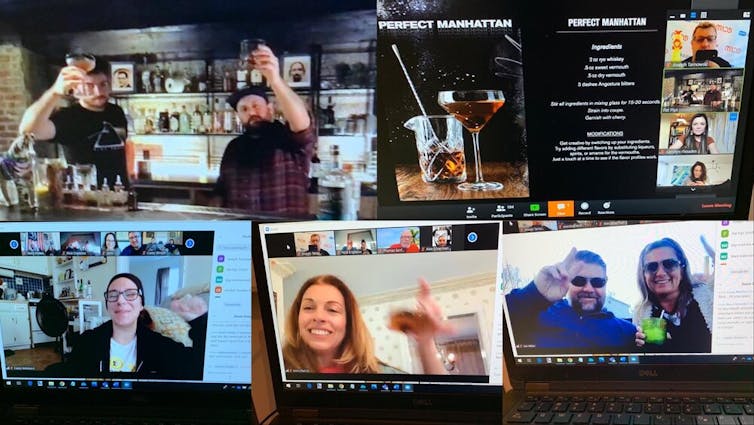 Virtual cocktail making classes, such as these offered by Melbourne bar Laylow, are a green gift option.
Laylow
Virtual cocktail making classes, such as these offered by Melbourne bar Laylow, are a green gift option.
Laylow
4. Go handmade: Handmade gifts are unique and help forge a connection between the giver and the receiver. And even when you purchase the handmade gift rather than make it yourself, research shows recipients usually perceive that the gift symbolically contains “love”.
Etsy has become the global marketplace for handmade gifts and vintage treasures. But keep in mind that if you order a handmade gift from the other side of the world, transporting it will generate carbon emissions.
5. Upcycle: Upcycling prolongs the life of old objects by creatively reshaping them into new products. For example, an old jar might become a hanging plant pot, or a reclaimed door might be repurposed as a table top.
Research has found when people are told about the past identity or “story” of an upcycled product, the person feels “special” and demand for the product increases.
Read more: Your Christmas shopping could harm or help the planet. Which will it be?
Authors: Gary Mortimer, Professor of Marketing and Consumer Behaviour, Queensland University of Technology