

We've discovered a new rule of nature. It explains why animals' pointy parts grow the way they do
- Written by Alistair Evans, Associate Professor, Monash University
Discoveries of new overarching rules or “laws” in nature are very rare.
Surprisingly, my colleagues and I have found a new rule of biological growth that explains unexpected similarities in sharp structures found across the tree of life — in teeth, horns, claws, beaks, animal shells, and even the thorns and prickles of plants.
The discovery could help us look forward in evolution to predict how animals, including humans, and their many parts are likely to evolve. Our findings are published today in the open access journal BMC Biology.
The power of laws
Some patterns are very common in nature, such as logarithmic spirals that follow the golden ratio. These patterns appear because of the very simple processes that generate them. For example, a logarithmic spiral is produced when a spiral grows faster on one side than the other.
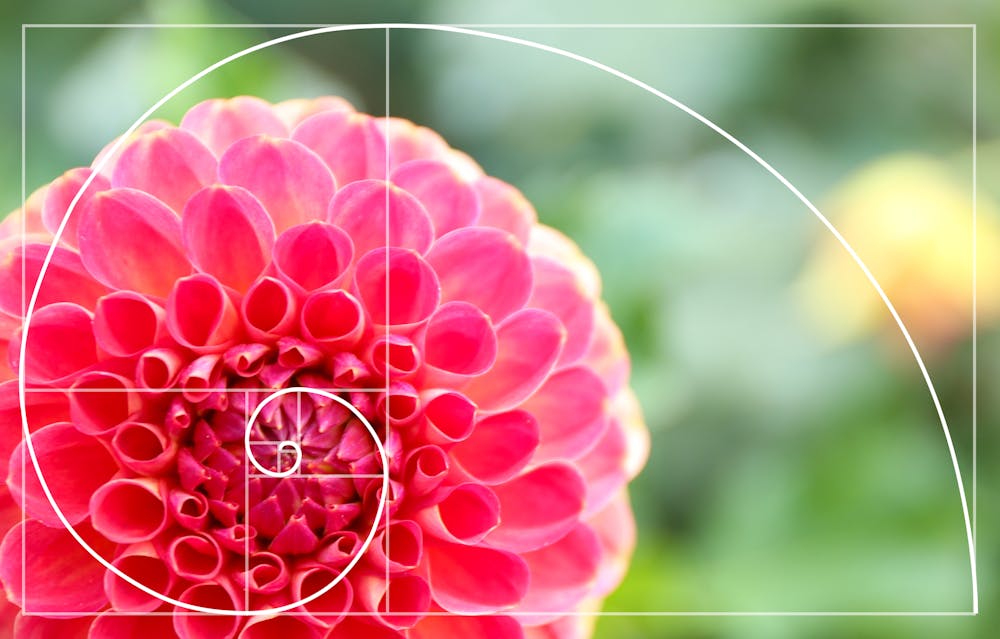 Logarithmic spirals follow the ‘golden ratio’ (~1.618). This mathematical ratio can predict patterns across nature, including in shells and plants.
Shutterstock
Logarithmic spirals follow the ‘golden ratio’ (~1.618). This mathematical ratio can predict patterns across nature, including in shells and plants.
Shutterstock
We can describe such patterns as following rules of growth. These rules help us understand why animals and plants are the shapes they are.
In my research I am fascinated by patterns in nature. And for many years I have searched for a pattern in how teeth grow. By looking at hundreds of teeth and measuring how they get wider as they get longer, my team and I identified a simple mathematical formula that underpins tooth shape.
This is a “power law”, in which there’s a straight-line relationship between a tooth’s width and length when you take a logarithm of these measurements. Power laws are also found in the sizes of earthquakes, extinction rates of animals and movements of the stock market.
Read more: The Golden Mean: a great discovery or natural phenomenon?
Thorns, horns and hooves
We named the new power law the “power cascade”, as it describes how the surface of a tooth cascades down while following a specific pattern. We looked at teeth from huge sharks, Tyrannosaurus rex, mammoths and humans, and saw the power cascade pattern in all of them.
Amazingly, the rule also works for claws, hooves, horns, spider fangs, snail shells, antlers, and the beaks of mammals, birds and dinosaurs. We even observed it in the horns of a Triceratops skeleton to be displayed at Melbourne Museum.
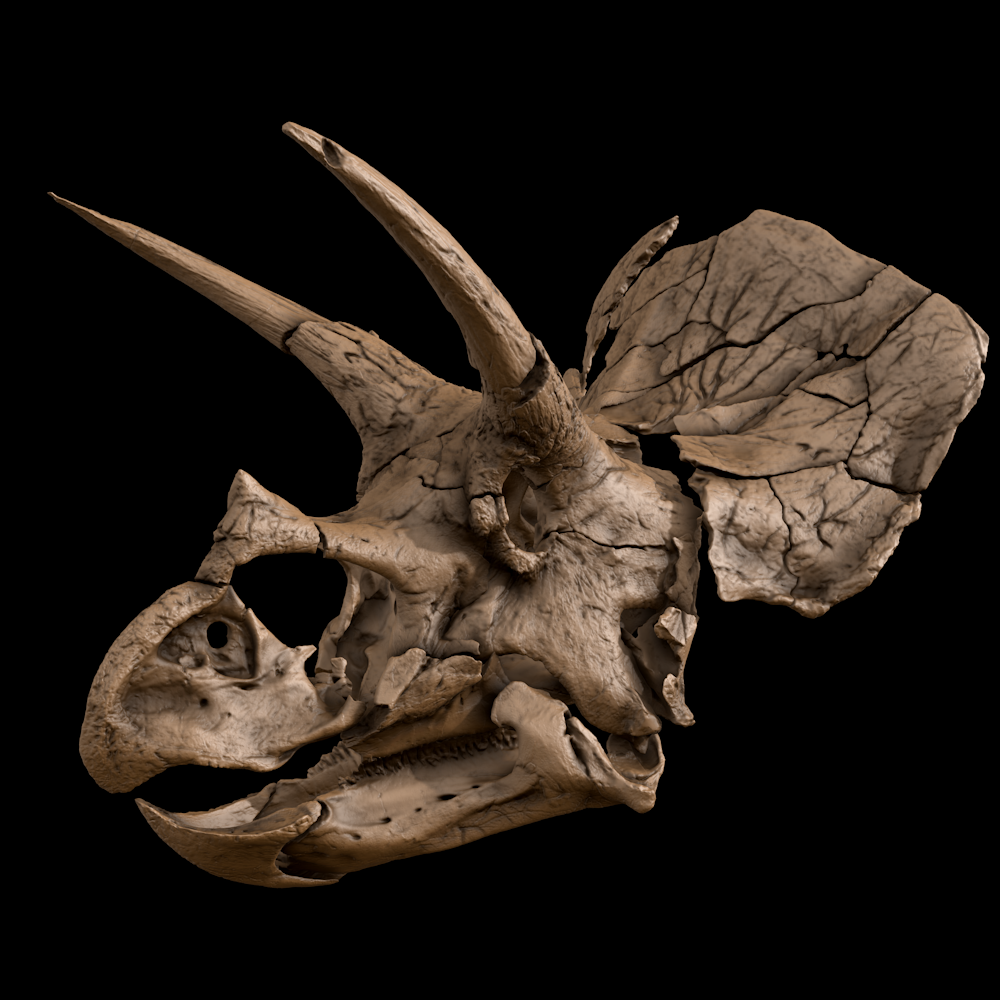 The skull of the Museums Victoria Triceratops shows the power cascade model in its three horns and beak.
Museums Victoria, Author provided (No reuse)
The skull of the Museums Victoria Triceratops shows the power cascade model in its three horns and beak.
Museums Victoria, Author provided (No reuse)
Perhaps these structures have a common shape because many of them carry out the same job. For instance, a sharp dinosaur tooth is useful for puncturing the flesh of prey, as is a sharp claw.
Nonetheless, we still find the power cascade pattern in physical traits that aren’t for piercing and have different shapes overall, such as shells and backward-facing horns.
The power cascade can simulate the growth of animal teeth, including sabre-toothed cats, Tyrannosaurs and giant sharks.Is it really a law of nature?
While I first noticed the power cascade about ten years ago using a technique I’d developed to measure 3D shapes, the long road to its discovery began much earlier.
The pattern builds on an idea first put forward in 1659 by Sir Christopher Wren, a polymath anatomist, physicist, mathematician and the architect of St Paul’s Cathedral in London.
Wren considered a snail shell may be a cone twisted around a logarithmic spiral. We now know shells and other shapes such as teeth and horns follow the power cascade shape, called a “power cone”.
The power cascade then seems to be the missing piece of a 350-year-old puzzle of how animals grow. But despite how common it is, can we really deem it a “law” of nature?
It was reasonably common for previous generations of biologists to refer to strong patterns (including the logarithmic spiral) as biological laws.
Biologists these days are very hesitant to use this term as it implies an unbreakable rule, such as the law of gravity. However, we can show there are very simple processes of growth which produce the power cascade pattern.
Therefore, when animals and plants grow in this way they will inevitably produce the power cascade shape, just as is the case with logarithmic spirals.
Certainly this rule can be bent, as seen by grooved snake fangs. But given the immense variety of animal parts it works for and the many shapes it makes, there’s a strong case to be made for classifying it as a power law of nature.
Future research will be able to confirm this.
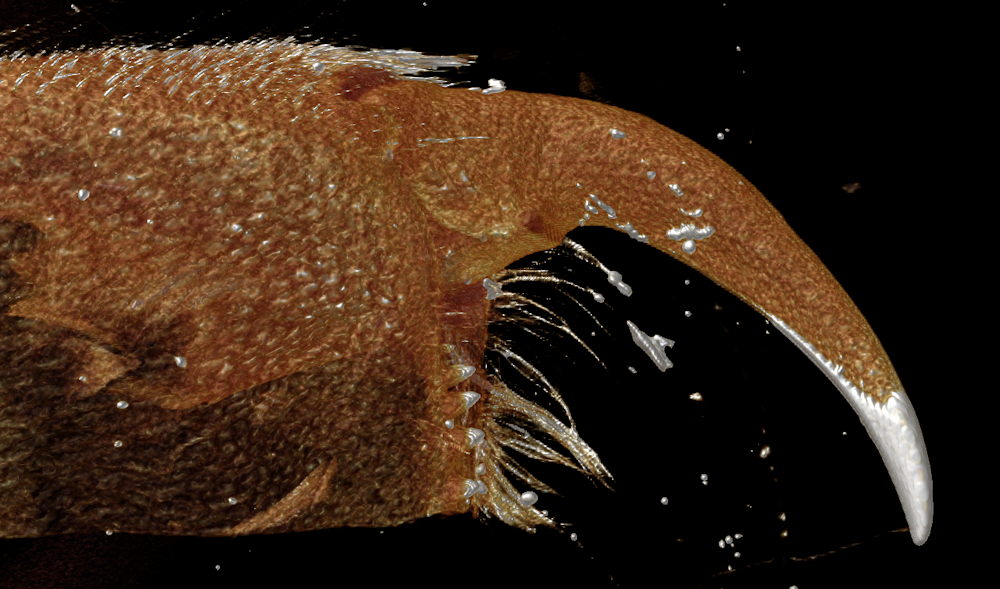 The power cascade rule is seen across diverse forms of life. This venomous spider fang is one example.
Alistair Evans, Author provided (No reuse)
The power cascade rule is seen across diverse forms of life. This venomous spider fang is one example.
Alistair Evans, Author provided (No reuse)
Predicting evolution (and life-like dragons)
What can we do with this newly discovered rule? Well, to start it can help us think about the likely course of evolution.
The evolution of animals is usually thought to include a lot of “random” factors. This makes it difficult to know exactly what animals will end up looking like many millennia from now.
That said, the power cascade is perhaps the simplest way for a pointed structure to form when an animal is growing as an embryo or juvenile. Thus, we’d expect this shape to be very common both now and in the future — and we know the former to be true.
We can even apply the power cascade to imagine what shapes the teeth, horns and claws of mythical creatures might look like if they followed rules in nature. In other words, we can now design dragons in Game of Thrones and fantastic beasts in Harry Potter to look as realistic as possible.
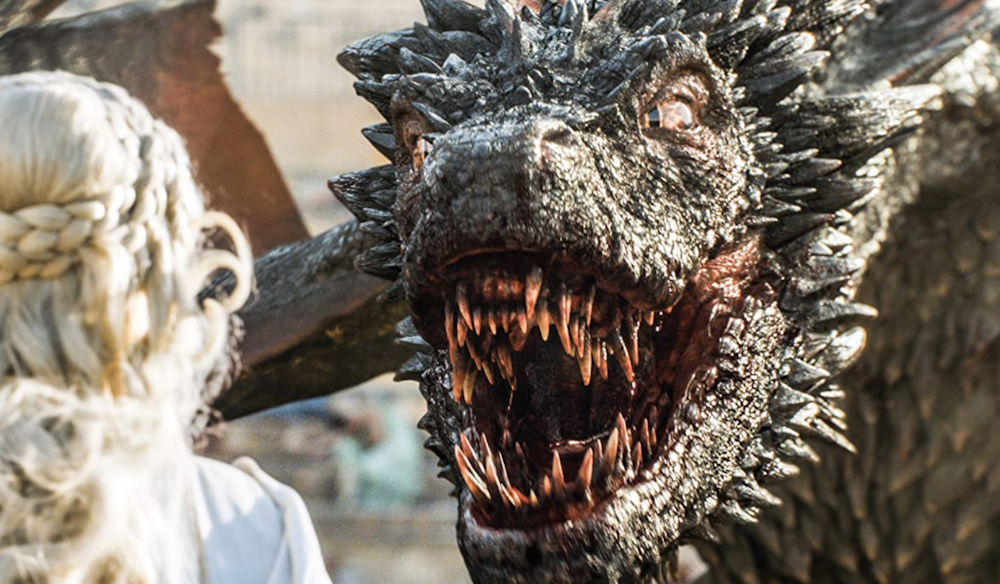 Perhaps it’s not such a bad thing we won’t ever get to inspect the teeth of a Game of Thrones dragon up close.
Game of Thrones ('The Dance of Dragons') / IMDB
Perhaps it’s not such a bad thing we won’t ever get to inspect the teeth of a Game of Thrones dragon up close.
Game of Thrones ('The Dance of Dragons') / IMDB
Moreover, many structures such as horns have evolved independently in different animals. So each time this happens in the future, it will probably follow the power cascade shape. Humans with horns remain may an unlikely reality, but at least we’ll know what this would look like.
Read more: How animals got their spots and stripes – according to maths
Authors: Alistair Evans, Associate Professor, Monash University

















