

Treating NZ’s far right groups as terrorist organisations could make monitoring extremists even harder
- Written by Hayden Crosby, PhD Candidate, University of Auckland
The government’s recently proposed changes to New Zealand’s counter-terrorism legislation are focusing attention on how best to equip law enforcement agencies with the tools to prevent the kind of atrocity witnessed in Christchurch on March 15, 2019.
The amendments to the Terrorism Suppression Act 2002 and Search and Surveillance Act 2012 are mostly reasonable responses to recommendations by the Royal Commission of Inquiry into the Christchurch terror attack.
However, by broadening the definition of a terrorist act to one intended to induce “fear” rather than “terror” in a population, there is a risk the new law may go too far.
Fear is highly subjective and the legislation seems to leave it open to interpretation. A patched gang member, for example, can induce fear at their local supermarket but it’s arguable whether this qualifies as terrorism.
Hypothetical, perhaps, but it helps illustrate a wider problem with attempts to rewrite the anti-terror and law enforcement rulebook. A recent call to expand New Zealand’s list of “designated terrorist entities” to include far right groups is a case in point.
It’s clear some foreign far right groups warrant this designation, such as the UK-based Sonnenkrieg Division, which was recently classified as terrorist by the Australian government.
But it’s questionable whether any of the currently active far right groups in New Zealand fit the criteria. While the actions of some individuals certainly warrant investigation, we don’t have any evidence local far right groups advocate or plan to engage in terrorism.
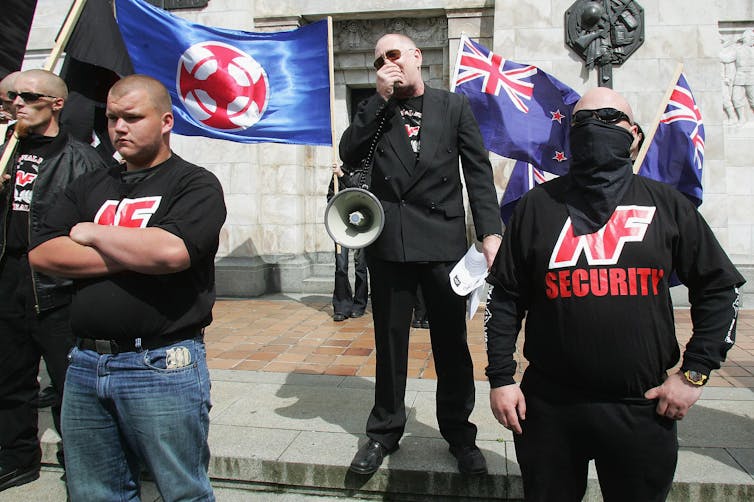 Sid Wilson, leader of the New Zealand National Front, addresses a crowd during a rally in Wellington in 2005.
GettyImages
Sid Wilson, leader of the New Zealand National Front, addresses a crowd during a rally in Wellington in 2005.
GettyImages
Far right not the only threat
Care should be taken to only add far right groups to the terror list if they legitimately present a threat, not because we dislike their politics. Banning all far right groups would be excessive, given many of them are non-violent.
Security Intelligence Service (SIS) head Rebecca Kitteridge recently announced the service has adopted new terminology to describe what it monitors — “faith motivated extremism” and “identity motivated violent extremism”, which includes violent extremism from white supremacists.
This is a vast improvement on focusing solely on Islamic extremism, and hopefully also includes monitoring the threat from the “Incel” (involuntary celibate) online subculture.
Read more: 'Incel' violence is a form of extremism. It's time we treated it as a security threat
The SIS must be careful, however, not to ignore violent extremism of other kinds coming from the far left or radical environmentalism.
Prior to the attack on Christchurch’s Muslim community, the majority of far right violence came from neo-Nazi skinheads. This included the murders of Korean backpacker Jae Hyeon Kim, Māori sportsman Hemi Hutley and gay drifter James Bambrough, all of whom were killed by members of the notorious Fourth Reich gang.
But most violence from skinheads is not ideological and is usually directed inwards at other members or rival skinhead groups and criminal gangs.
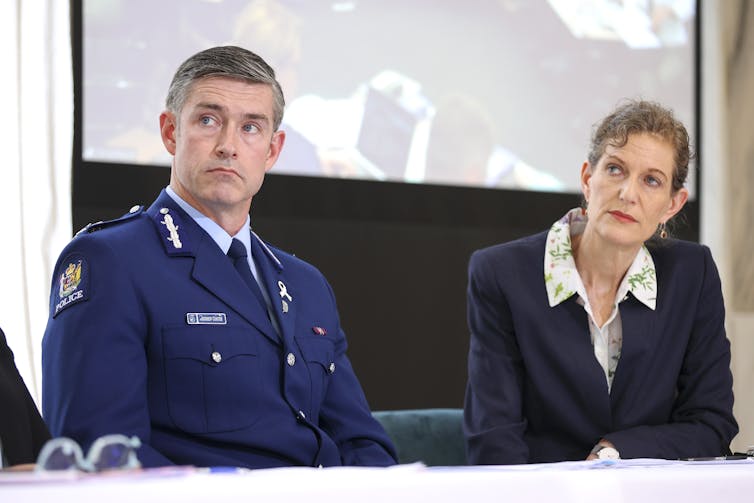 Police Commissioner Andrew Coster and Director-General of Security Rebecca Kitteridge address media before the report of the Royal Commission of Inquiry into the Christchurch terror attack.
GettyImages
Police Commissioner Andrew Coster and Director-General of Security Rebecca Kitteridge address media before the report of the Royal Commission of Inquiry into the Christchurch terror attack.
GettyImages
The law of unintended consequences
Banning far right groups or designating them terrorist entities would mean first considering the potential consequences.
Firstly, will it force them underground? This would make monitoring them much harder for police and intelligence services. It could even encourage violence by effectively taking away their ability to protest and organise peacefully.
Secondly, far right groups, particularly larger ones, often contain non-violent members who hold less extreme views. These members tend to have a pacifying effect on the more extreme individuals who join such groups.
Banning groups may result in a higher number of isolated and non-affiliated individuals with extreme far right views. Again, they can be difficult to monitor.
Thirdly, there is a risk of glamorising membership of such groups, with some relishing opportunities to defy banning orders. This is something cautioned by an independent reviewer of terrorism legislation in the UK.
And fourthly, it is questionable how effective a ban would be. As we have seen in other countries, the far right is skilled at working around such laws. Groups simply disband and members form new groups or maintain informal networks. This happened in the UK after the neo-Nazi National Action group was designated a terrorist entity.
The risk from isolated individuals
Some far right groups may indeed still present a threat of violence and terrorism. In Australia, for example, a member of the neo-Nazi National Socialist Network was recently arrested for possessing a bomb and instructions for manufacturing explosive, prohibited and dangerous weapons.
But the primary terrorist threat is from isolated “lone wolf” extremists. As Victorian police deputy commissioner Ross Guenther has admitted, before the Christchurch attack the focus was very much on Muslim extremism:
The lens we would use now would be very different to the lens we would use three years ago, to be honest.
These lone extremists are very difficult for security services to detect. They radicalise in isolation and over the internet and are not members of groups, but rather exist on the fringes of the far right community. Such was the case with the Christchurch terrorist, despite earlier speculation he was involved in local far right groups.
The far right is constantly changing and evolving, and our counter-terrorism laws and strategies need to reflect this. We shouldn’t ignore far right groups as a possible threat, but banning them would be largely ineffective and do little to protect society from the most dangerous threat – lone actor terrorists.
Read more: National Action: what I discovered about the ideology of Britain's violent neo-Nazi youth movement
Authors: Hayden Crosby, PhD Candidate, University of Auckland

















