

It may not be possible to bring all Australians with COVID home from India. But we can do better than we are now
- Written by Catherine Bennett, Chair in Epidemiology, Deakin University
A 47-year-old Sydney man has died in India after contracting COVID-19.
This news comes amid anger after the first repatriation flight from India following the controversial travel ban arrived in Darwin half empty on Saturday. Some 40 passengers tested positive for COVID-19 meaning neither they, nor their close contacts, were allowed to travel.
There’s no suggestion the Sydney man was due to board that flight, or any subsequent repatriation flight. But his case puts a spotlight on the current situation in India, where countless Australians are imploring the government to bring them home from a country in deep COVID crisis.
I would argue we can, and should, bring home at least some COVID-positive Australians — particularly those at highest risk of needing hospital-level care.
Weighing up the risks
Since Saturday’s repatriation flight, there’s also been controversy over the reliability of the tests which deemed so many passengers ineligible to travel. It’s critical the Australian government irons this out to ensure pre-flight testing is as accurate as possible.
Although, even if all passengers do test negative before flying, we still can’t guarantee a flight out of India, or any country, will have no positive cases on board. There’s a blind spot in testing between the time a person is exposed and when testing will reveal the infection. This gap could be up to ten days, but for most would be two to three days.
We know even with pre-flight screening requirements up to 1% of passengers are positive by the time they arrive in Australia.
At least if we know certain passengers are COVID positive at the time of boarding, we can manage the risk of transmission in transit.
Read more: Is Australia's India travel ban legal? A citizenship law expert explains
Flying COVID-positive Australians home safely
Despite our best efforts, we can’t rule out the risk of transmission if there are COVID-positive travellers on a flight.
However, transmission on planes appears to have been relatively infrequent. Recent reports of high positive rates on arrival and in quarantine may signal high rates of pre-flight exposure and transmission in transit — it’s hard to assess to what degree on-board transmission is a factor.
Although we know being in an enclosed space with someone with COVID-19 for a long time is high risk, the air in the cabin is filtered and turned over very regularly and therefore protects against viral spread. This could be why transmission on flights is not as common as we might expect.
That said, if we do knowingly put COVID-positive people on a flight with other passengers and crew, it would be important to take extra precautions.
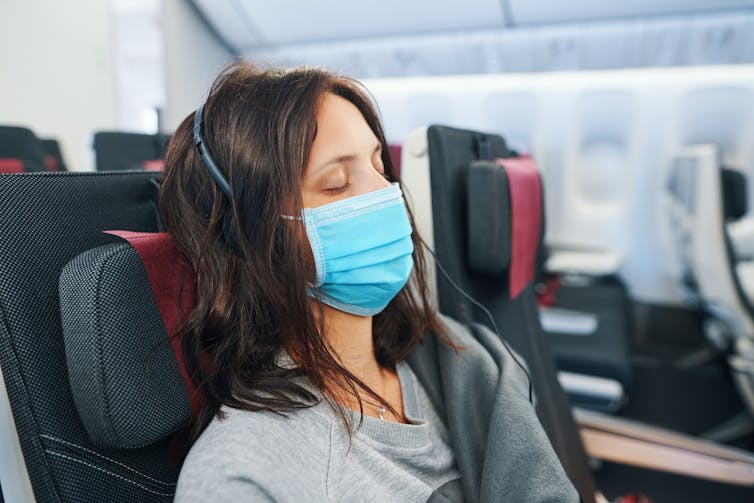 In the age of COVID, there’s always some level of risk associated with taking a flight.
Shutterstock
In the age of COVID, there’s always some level of risk associated with taking a flight.
Shutterstock
All crew on repatriation flights should be vaccinated regardless. To minimise the risk further, all crew dealing directly with COVID-positive passengers should be wearing full personal protective equipment (PPE).
COVID-positive passengers should be seated in a separate section of the plane to those who have tested COVID negative. An analysis of possible on-board transmission during a flight from London to Hanoi demonstrated most infection risk was restricted to the business class section, with attack rates dropping when people were two or more seats apart.
Commissioning large planes with more space to spread passengers out and group them according to risk would help in this regard.
It’s already a requirement that everyone on board must wear a mask unless eating or drinking. Of course, none of this eliminates the risk completely, just as negative tests might still allow someone incubating the virus on board.
It would also be important to consider end-to-end safety including using separate buses from the airport for COVID-positive patients.
Read more: How can the world help India — and where does that help need to go?
Another option would be dedicated flights for COVID-positive passengers.
Either way, it’s essential to have medical staff on board to provide care for travellers, if needed, and oversee infection control.
Accommodating COVID-positive returned travellers in quarantine
At present, Howard Springs, the Darwin quarantine facility housing returned Australians from India, is aiming to keep the number of COVID-positive residents at 50 or below.
Over time, COVID cases are increasingly likely to be asymptomatic or have mild disease if more people are vaccinated, and therefore shouldn’t need high levels of medical care. If most can stay in normal quarantine accommodation, maybe this could see the number of positive cases Howard Springs can accommodate increased.
If there’s a sound reason for this cap to remain as is, we should still use this capacity to enable evacuation of known cases at high risk of needing hospital care in India.
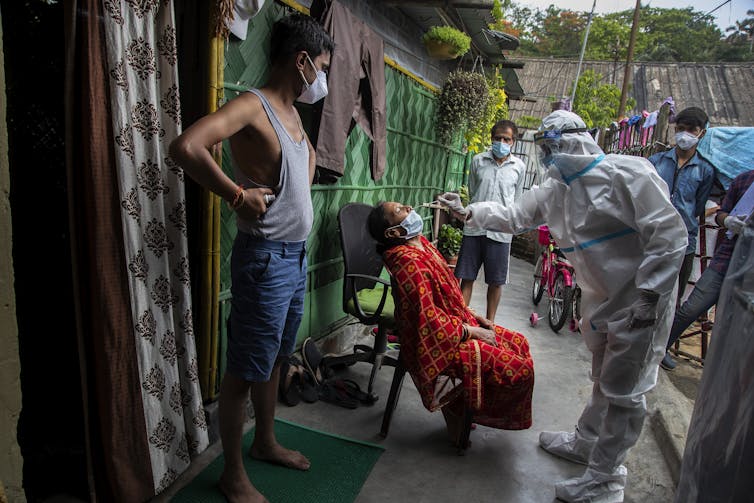 India is continuing to record thousands of new COVID cases every day.
Anupam Nath/AP
India is continuing to record thousands of new COVID cases every day.
Anupam Nath/AP
Sticking to a cap of 50 would likely mean we couldn’t accommodate every COVID-positive Australian who wanted to return home. But we could prioritise those at greatest risk of serious COVID disease, such as older people and those with underlying illnesses. Medical professionals would be on the ground to decide who qualifies as the highest priority.
We need to shift our mindset
Would we feel we had balanced the risks well if our thorough off-shore screening were to result in only a few positive cases in Howard Springs this month, while some people left in India were to die as a result of the virus and inadequate hospital care?
We pat ourselves on the back for what we achieved in containing the first wave by moving hard and fast, and rightly so. But as we’ve learnt more about the virus, we have become more determined to simply keep it out rather than use our knowledge and increased public health response capacity to control it.
We are now vulnerable and are resorting to inhumane steps to protect ourselves. Given the devastating situation in India, I believe it’s time to step back and weight up the true costs of the “zero tolerance” strategy underpinning our approach to repatriation.
Read more: Why variants are most likely to blame for India's COVID surge
Authors: Catherine Bennett, Chair in Epidemiology, Deakin University

















