

Airline policies mandating vaccines will be a turbulent test of workplace rights
- Written by: Giuseppe Carabetta, Senior Lecturer, Sydney University Business School, University of Sydney
Airlines want you vaccinated. They want as many people as possible vaccinated. The sooner that happens, the sooner borders open and they can get back to profitability.
They also have reasons to want to protect both customers and staff from COVID-19. Qantas staff, for example, have been considering legal action over workplace transmissions.
Qantas has dangled the carrot of extra frequent flyer points for fully vaccinated passengers, plus ten “mega prizes” of a year’s free travel for familes. Virgin Australia has similar plans. It also has a scheme to encourage its workers to get vaccinated. This will reportedly include the chance to win extra annual leave.
Could they go further and mandate vaccines? This is something Cathay Pacific is doing, telling its Hong Kong-based flight crews they must be vaccinated by August or their employmnet will be reviewed.
Qantas chief Alan Joyce signalled in November that once vaccines are widely available it will require international travellers to be vaccinated. This implicitly suggests it will require the same from international flight staff.
But the legal ground in Australia for employers to insist that employees be vaccinated remains murky.
Whether Qantas or Virgin – or indeed any other company – do so may depend on the case of Queensland regional carrier Alliance Airlines, the first employer in Australia to insist all employees be immunised.
Read more: The airline industry hasn't collapsed, but that's the only good news for overseas travel
A question of common law
Alliance Airlines specialises in flights to and from mining sites. It is 19.9% owned by Qantas, and collaborates with both Qantas and Virgin Australia.
It announced its mandatory policy for both influenza and COVID-19 vaccinations in late May. Its stated reason is to fulfil its duty to employees and passengers. But unions have questioned the policy’s lawfulness, arguing it is beyond the airline’s powers.
In Australia, there has been no general government guidance on whether employers can insist on employees getting COVID-19 vaccinations.
This differs to the United States, where the federal Equal Employment Opportunity Commission ruled in December 2020 that employers could (with some exemptions for medical and religious reasons) require employees to be vaccinated.
The Queensland and Western Australian governments have passed legislation mandating workers be vaccinated, but only in certain health and quarantine workplaces.
Whether Alliance Airlines’ policy is lawful therefore depends on a general common law “test” for determining the validity of workplace policies.
This test asks if a policy or direction is “lawful and reasonable” given the circumstances. These include:
the nature of the job, especially where it requires regular interactions with colleagues, clients and suppliers
if the work can be done remotely, or other reasonably practical precautions exist
the effectiveness or success rates of the vaccine
any guidance or directives from government and medical experts
the circumstances of individuals employee, such as whether they have reasonable grounds to refuse vaccination.
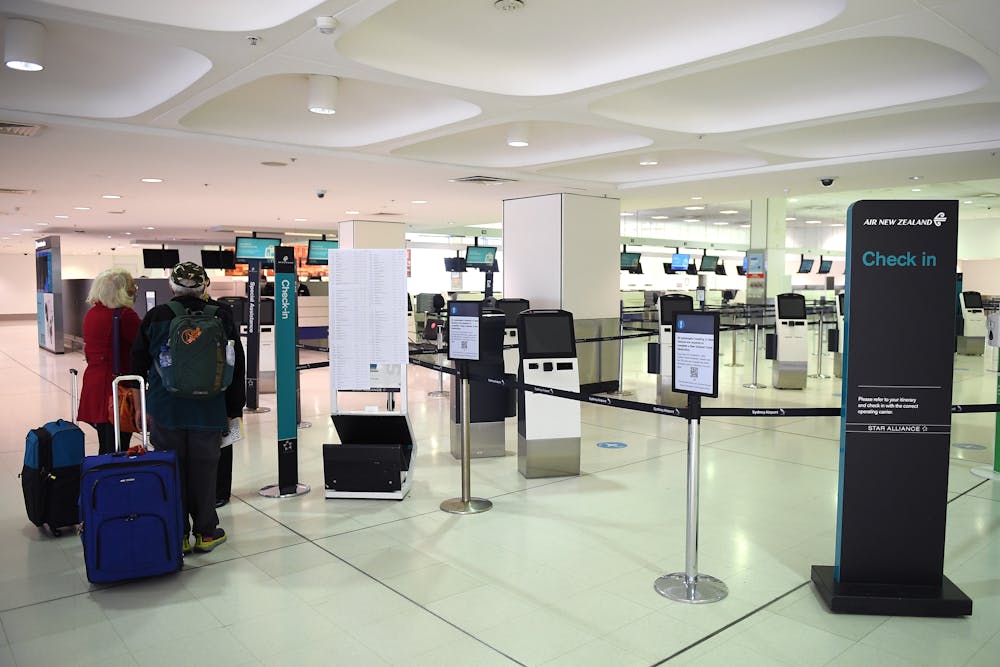 The Air New Zealand check-in counter at Sydney International Airport on June 23 2021, after New Zealand stopped quarantine-free travel with NSW for at least 72 hours.
Dan Himbrechts/AAP
The Air New Zealand check-in counter at Sydney International Airport on June 23 2021, after New Zealand stopped quarantine-free travel with NSW for at least 72 hours.
Dan Himbrechts/AAP
Unfair dismissal cases
Australia’s Fair Work Commission has demonstrated the balancing act needed to apply these factors in its most recent ruling in an unfair dismissal case involving a refusal to get an influenza vaccination.
The claim was brought by Maria Corazon Glover, a 64-year-old community care assistant, against Queensland aged and disability care provider Ozcare, her employer since 2009.
In May 2020, public health orders in Queensland required influenza vaccinations for entry into aged care facilities. Ozcare went “above and beyond” those requirements, mandating the flu vaccine for all its aged care workers, even those who did not work in facilities. Glover, a home-care provider, refused. She said she believed she would suffer an allergic reaction, based on what she understood had happened to her as a child. She was ultimately dismissed.
Commissioner Jennifer Hunt upheld her dismissal despite Ozcare’s policy exceeding the relevant public health orders and Glover’s concerns. Hunt ruled those factors were outweighed by the vulnerability of Ozcare’s clients, the frequency with which care workers visited clients’ homes (and their potential to become “super-spreaders”), and the employer’s “prerogative” to make a decision considered necessary to safeguard its clients and employees “so far is practicable to do so”.
Individual circumstances do count
Perhaps the most important takeaway from Glover v Ozcare is that it was decided on its particular facts. Employers must carefully assess employees’ situations to decide if a mandatory vaccination policy is justifiable.
An airline might reason that cabin crew interact with people in environments with a higher risk of COVID-19 transmission and where social distancing is impossible.
But an employee might counter that, unlike aged or disability care workers, they have much less close contact with high-risk, vulnerable individuals.
The case-by-case nature of the reasonableness test means any generalised “all in” vaccination policy is problematic. Even more so if there is employee resistance.
Discrimination may be valid
Employees who are dismissed for refusing to vaccinate might also argue it amounts to discrimination on prohibited grounds such as disability or pregnancy, where COVID-19 vaccination may be unsafe or pose medical risks.
Under the Fair Work Act, however, employers have a valid defence for discriminatory action if a policy or decision is based on the “inherent requirements” of the job.
In November 2020, Fair Work Deputy president Ingrid Asbury noted that vaccination against influenza was likely to be an inherent requirement for a position involving caring for young children, and so could be justified for child-care employees.
However, outside high-risk contexts such as child and health care, this defence may be limited and will turn on the employee’s role and the organisational context.
Read more: Can my boss make me get a COVID vaccination? Yes, but it depends on the job
Looking for safe ground
The Fair Work Commission’s rulings on influenza vaccines give a fair indication of the principles it will apply to any case involving COVID-19 vaccines.
But given the different circumstances, whether it will give a green light to a general policy like that of Alliance Airlines remains up in the air.
Qantas and Virgin might be on safer ground because of their international operations, if proof of vaccination becomes mandatory for other destinations. However, I think the issue of employee vaccinations for the airline industry will ultimately be resolved via government intervention.
In other sectors, owing to the complexities in determining whether mandatory policies are “legal”, many employers will likely stick with the safer route of voluntary “incentive schemes” to encourage vaccinations.
Authors: Giuseppe Carabetta, Senior Lecturer, Sydney University Business School, University of Sydney


















