

What is Barnaby Joyce's 'women' problem? And why does it matter?
- Written by: Narelle Miragliotta, Senior Lecturer in Australian Politics, Monash University
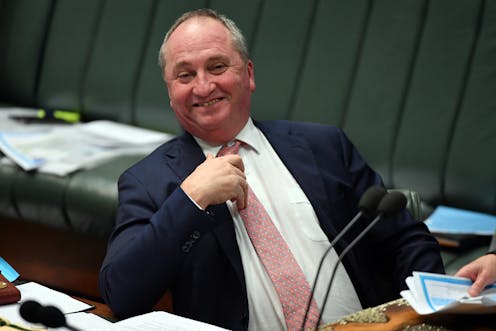
There has been a mixed reaction to Barnaby Joyce’s return to leader of the federal National Party and deputy prime minister. Even some within his own party have expressed concern at his return to centre stage.
There are multiple reasons why Joyce’s restoration has failed to garner greater enthusiasm.
One concern relates to the optics of a leadership change. These events are rarely well received by the public and often lead to in-fighting and instability. They also tend to further strain public trust in the political class, particularly when the politicians involved have issued full-throated denials that a spill is imminent.
A second reason is linked to Joyce’s populist leadership style and more strident policy rhetoric on coal and climate change. Here the concern is that Joyce’s presence will exacerbate tensions within the party room, and also scramble relations with its coalition partner, the Liberals.
The third reason is the circumstances that occasioned Joyce’s resignation from the National’s leadership in 2018.
Joyce stood down voluntarily owing to a credible, but unresolved, sexual harassment allegation (which Joyce denies), and over serious concerns about the propriety of his conduct with his now partner but then staffer, Vikki Campion.
Read more: Grattan on Friday: Blowin' in the wind with Barnaby
The male culture of politics
Joyce’s (re)ascension signals that the Nationals are somewhat inured to growing public concerns over the unhealthy gender dynamics in parliament, even when the voices raising these uncomfortable truths are from within the party.
One of the most strikingly apparent and longstanding gender inequities in politics is the under-representation of women in Australian parliaments. Despite Australia’s strong democratic credentials, it remains one of the great laggards on achieving gender parity in parliament.
In recent decades, the problem has been especially pronounced among parties of the mainstream political right. They have consistently rejected the implementation of pre-selection quotas in favour of training programs targeted at aspiring women candidates. Although these programs can be of some help, research shows they are a less effective way of redressing under-representation.
The effects of the reliance on so-called merit-based pre-selection is especially striking in relation to the Nationals. Its record on electing women to Australian parliaments is particularly poor, a situation that academic Marian Sawer – three decades ago – attributed to the greater persistence of “sex-role conservatism” in rural Australia. Sawer proposed that the National Country Party (as the Nationals was known then) reflected this conservatism.
Data compiled by Anna Hough from the Australian Parliamentary Library shows the extent to which the party’s conservatism continues to reveal itself with the under-representation of women in Australian lower houses.
Federally, only 13% of Nationals in the House of Representatives are women. This compares to 22% for the Liberals and 43% for ALP.
A similar pattern is apparent in the states where the Nationals have a legislative presence.
In the NSW lower house, only 16.7% of the party’s contingent are women, which is much lower than for the Liberals (32%) and Labor (45.5%).
In Western Australia, while the Nationals are led by a woman (Mia Davies), she is the sole National woman in the Western Australian parliament.
In Victoria, 33% of the party’s number in the Legislative Assembly are women, and it also selected a female deputy leader (Steph Ryan).
The situation in Queensland (LNP) and the Northern Territory (CLP) is complicated because these parties are affiliated to the National and Liberal parties and not strictly divisions of the Nationals. Nevertheless, both the LNP and CLP are kindred National parties.
In the case of the LNP, only 18% of its members in the Legislative Assembly are women, compared to 40% in Labor.
The situation for the CLP is healthier but is still not a record to be admired. While the CLP’s parliamentary party is led by a woman (Lia Finocchiaro), only 38% of its MPs are female.
As Jennifer Curtin and Katrine Beauregard note, women have been “active as ordinary and executive members of the party”. Notwithstanding this achievement, low levels of women in party rooms, and in lower houses particularly – which are practically and symbolically important as the chamber of government – does seriously limit the diversity of perspectives that are represented in policy and law making.
Read more: Barnaby Joyce's return, and John Anderson's loss, is symbolic of a political culture gone awry
Why Joyce’s return makes this situation worse
Joyce has not done much to instil confidence that he has learned anything in his years returned to the backbench.
While acknowledging his faults and remarking that he “hopes” he has “come back a better person”, it is not clear what new insights Joyce gained about the events that caused him to resign, especially given he has no appetite to “dwell on the personal”.
His lack of introspection is perhaps not surprising given how he managed the situation in 2018.
At the time, Joyce was quick to declare that none of the “litany of allegations” levelled against him had been “sustained”. He emphasised that he was stepping aside for the “person in the weatherboard and iron”, and not because it was warranted by his conduct.
The Nationals have calculated they will not pay much of an electoral price for their decision to return him as leader. As the federal president of the National Party, Kay Hull, reasoned:
“[s]ome women may be disappointed but […] the only women that will be voting or not voting for Barnaby Joyce will be the women of New England.
Hull may be right, but there are potentially other costs associated with the party’s actions.
As the smaller party in the coalition, the Nationals have not had to defend their record on gender in the same way as their Liberal counterpart. Joyce’s return will make it increasingly difficult for the Nationals to fly under the radar on this issue. At least, let’s hope that it does.
Authors: Narelle Miragliotta, Senior Lecturer in Australian Politics, Monash University
Read more https://theconversation.com/what-is-barnaby-joyces-women-problem-and-why-does-it-matter-163255


















