

after fictionalising Elizabeth Macarthur's life, Kate Grenville edits her letters
- Written by: Kerrie Davies, Lecturer, School of the Arts & Media, UNSW Sydney
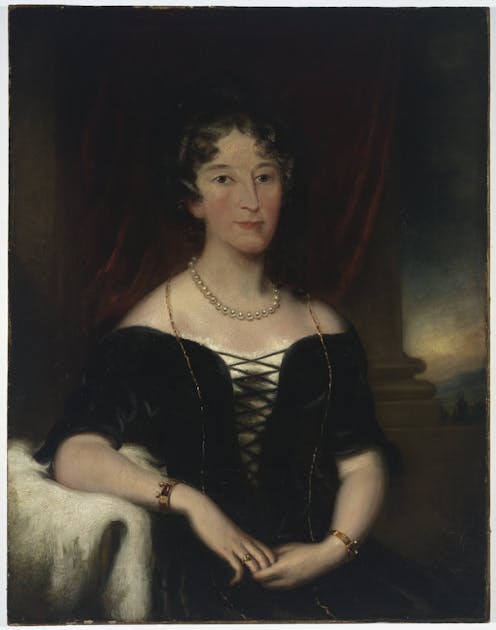
Do not believe too quickly!
This warning prologue begins Kate Grenville’s novel A Room Made of Leaves (2021), a purported long-lost secret memoir by Elizabeth Macarthur that Grenville “found” hidden in a roof cavity.
The award-winning novel reinvented Macarthur, from the dutiful colonial wife of John Macarthur to a passionate, intelligent and empathetic queen of sheep.
Review: Elizabeth Macarthur’s Letters – edited by Kate Grenville (Text Publishing)

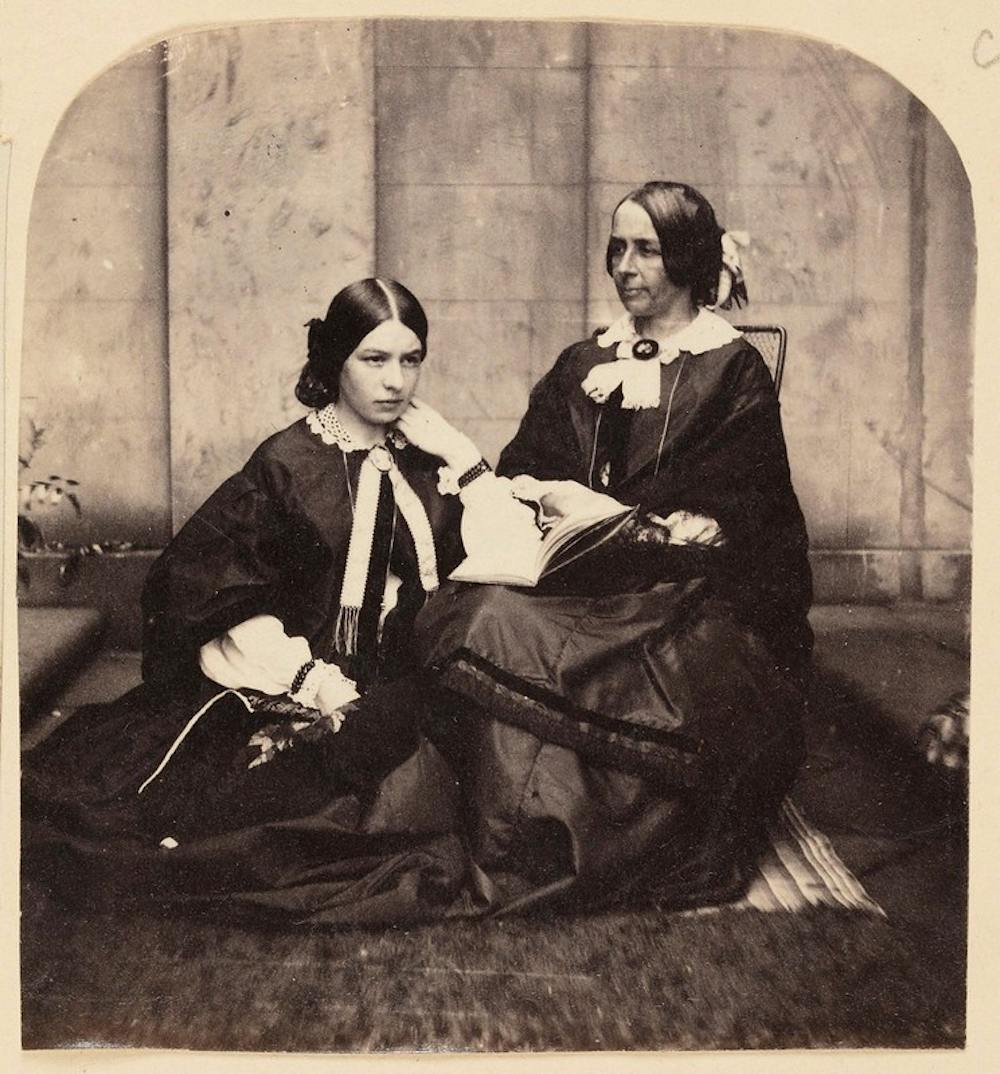 Emily and Elizabeth Macarthur. Camden, Sydney.
As per a traditional edited book of archival material, Grenville has chronologically arranged these letters, which she “pruned pretty hard”. She explains that the pruning is to remove trivial gossip and family movements, irrelevant to the core of the letters.
She begins with a letter to Elizabeth’s mother in 1789, which Grenville quoted in A Room Made of Leaves, and ends with Elizabeth’s short letter to her son, Edward, in 1849 – the year before her death.
As Grenville acknowledges, she is not the first to publish or transcribe Elizabeth’s letters. But beyond this chronology, the introduction and notes on editing, Grenville departs from convention to deliver a difficult book to a contemporary audience.
Read more:
Hidden women of history: Eliza Hamilton Dunlop — the Irish Australian poet who shone a light on colonial violence
The problem of the contemporary gaze
In commentaries that precede each letter, Grenville takes a self-searching, subjective approach that reveals the difficulty of bringing problematic historical material into the contemporary cultural gaze. Should Elizabeth be “cancelled” for her descriptions of the First Nations people whose land she and her husband enriched themselves upon? How should we interpret her careless pity for convicts who built their empire?
Author Ruby Hamad argues that white women as the “virtuous, innocent face of western civilisation”, benefited from colonialism, and enabled it.
As the face of female colonialists, should Elizabeth be exiled back to the archives? Or should her letters be published without censure to remind us of confronting truths that defy political calls to gloss the national history curriculum?
Emily and Elizabeth Macarthur. Camden, Sydney.
As per a traditional edited book of archival material, Grenville has chronologically arranged these letters, which she “pruned pretty hard”. She explains that the pruning is to remove trivial gossip and family movements, irrelevant to the core of the letters.
She begins with a letter to Elizabeth’s mother in 1789, which Grenville quoted in A Room Made of Leaves, and ends with Elizabeth’s short letter to her son, Edward, in 1849 – the year before her death.
As Grenville acknowledges, she is not the first to publish or transcribe Elizabeth’s letters. But beyond this chronology, the introduction and notes on editing, Grenville departs from convention to deliver a difficult book to a contemporary audience.
Read more:
Hidden women of history: Eliza Hamilton Dunlop — the Irish Australian poet who shone a light on colonial violence
The problem of the contemporary gaze
In commentaries that precede each letter, Grenville takes a self-searching, subjective approach that reveals the difficulty of bringing problematic historical material into the contemporary cultural gaze. Should Elizabeth be “cancelled” for her descriptions of the First Nations people whose land she and her husband enriched themselves upon? How should we interpret her careless pity for convicts who built their empire?
Author Ruby Hamad argues that white women as the “virtuous, innocent face of western civilisation”, benefited from colonialism, and enabled it.
As the face of female colonialists, should Elizabeth be exiled back to the archives? Or should her letters be published without censure to remind us of confronting truths that defy political calls to gloss the national history curriculum?
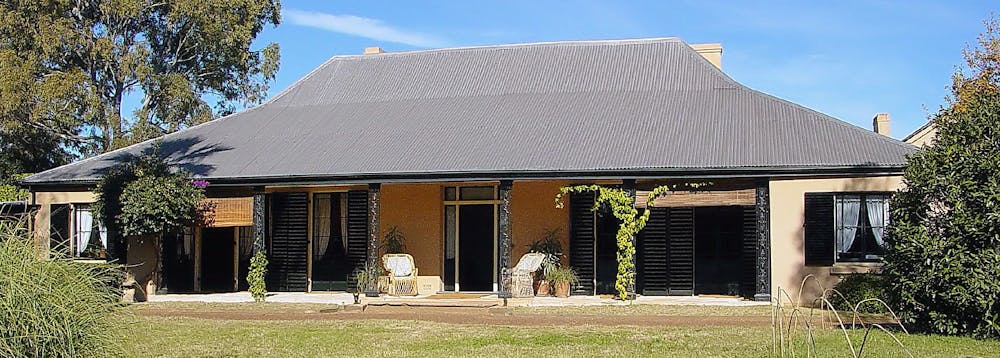 Elizabeth Farm, the home to the pastoralists John and Elizabeth Macarthur, is the oldest surviving European building in Australia.
Brian Yap/Flickr, CC BY
Grenville is obviously in the latter camp, and these questions are softened by the commentary’s disconcertingly breezy, Bridgerton, “Lady Whistledown-of-the-colonies” style, which is apt, given the hit series is set in the same era as Elizabeth’s time in Australia. It reveals Grenville’s contradictory feelings about Elizabeth, as much as the bigger questions around how we re-examine historical figures.
The commentary serves a double purpose as a meta-narrative on A Room Made of Leaves. It gives insight into Grenville’s writing process and narrative decisions.
It also reveals her wobbles as to whether she is right to read Elizabeth as an expert in irony, employed to conceal her dislike of her husband. Perhaps, dear reader, “Elizabeth really was happy with him, as she so strenuously asserts”.
In A Room Made of Leaves, Grenville took Elizabeth’s letters as starting inspiration. She could imagine the woman Elizabeth might have been and who Grenville wanted her to be. In doing so, she could bring Elizabeth into line with contemporary cultural values. But in the Letters, Grenville must instead rely on her own accompanying voice, which is witheringly clear:
Reading Elizabeth’s letters, there were times when I found her unattractive – so much that I abandoned the novel more than once … She could have had a more humane perspective, and I wish she had.
Authors: Kerrie Davies, Lecturer, School of the Arts & Media, UNSW Sydney
Elizabeth Farm, the home to the pastoralists John and Elizabeth Macarthur, is the oldest surviving European building in Australia.
Brian Yap/Flickr, CC BY
Grenville is obviously in the latter camp, and these questions are softened by the commentary’s disconcertingly breezy, Bridgerton, “Lady Whistledown-of-the-colonies” style, which is apt, given the hit series is set in the same era as Elizabeth’s time in Australia. It reveals Grenville’s contradictory feelings about Elizabeth, as much as the bigger questions around how we re-examine historical figures.
The commentary serves a double purpose as a meta-narrative on A Room Made of Leaves. It gives insight into Grenville’s writing process and narrative decisions.
It also reveals her wobbles as to whether she is right to read Elizabeth as an expert in irony, employed to conceal her dislike of her husband. Perhaps, dear reader, “Elizabeth really was happy with him, as she so strenuously asserts”.
In A Room Made of Leaves, Grenville took Elizabeth’s letters as starting inspiration. She could imagine the woman Elizabeth might have been and who Grenville wanted her to be. In doing so, she could bring Elizabeth into line with contemporary cultural values. But in the Letters, Grenville must instead rely on her own accompanying voice, which is witheringly clear:
Reading Elizabeth’s letters, there were times when I found her unattractive – so much that I abandoned the novel more than once … She could have had a more humane perspective, and I wish she had.
Authors: Kerrie Davies, Lecturer, School of the Arts & Media, UNSW Sydney 
















