

Despite the myth, deer are not an ecological substitute for moa and should be part of NZ’s predator-free plan
- Written by: Nic Rawlence, Senior Lecturer in Ancient DNA, University of Otago
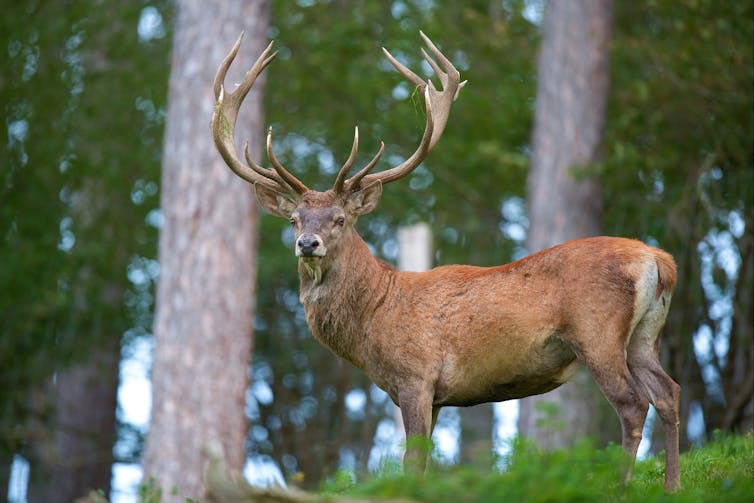
The impact of deer on Aotearoa New Zealand’s natural environment is never far from the headlines. Most recently, the Southland Conservation Board highlighted the damage the introduced species was doing to native forest on Rakiura Stewart Island.
And despite the government including NZ$30 million for deer and goat control in this year’s budget, the situation remains critical, with considerable disagreement about the best solutions.
The Department of Conservation (DOC) is key to managing deer numbers, but has been strongly criticised by the CEO of the independent Forest & Bird organisation over the climate implications of its wild game animal management framework:
When DOC publishes plans that talk about ‘improving the quality of game animals’ it’s clear they’ve lost their way. Deer, pigs and goats are wrecking native habitats and their stored carbon from the ground up.
On the other side, some hunters and anti-1080 pesticide activists are vehemently opposed to large-scale deer culling.
And central to some of their arguments has been the idea that deer are actually ecological surrogates for extinct moa – large herbivores that control plant growth and keep forests “open”.
But this outdated and false argument ignores the latest evolutionary and ecological research, and misrepresents the current state of scientific evidence. Scientists have made significant progress and now know far more than they did even ten years ago.
Are deer doing what moa did?
Deer were introduced to New Zealand from the mid-19th century as a way to make hunting for food accessible for all. Not long after that, however, conservationists became increasingly concerned about the damage the species caused.
Hunters then became worried deer were going to be controlled or eradicated, and came up with the ecological surrogate theory to justify additional releases. Some have even illegally introduced deer into areas where they had previously been eradicated or where only one species existed.
Moa had a population density of two to ten individuals per square kilometre (of about 0.5 to 2.5 million moa), broadly similar to deer (three to 15 individuals per km²). But this doesn’t mean the two had similar impacts simply because they were or are herbivores.
Read more: How did ancient moa survive the ice age – and what can they teach us about modern climate change?
The latest evidence shows unequivocally deer are nothing like moa, with completely different ecological impacts.
Moa were more ecologically friendly and unique – the product of 58 million years of evolution. While the ancestors of moa arrived in New Zealand just after the extinction of the dinosaurs, molecular dating suggests the latest evolutionary radiation of moa dates to the past six to seven million years. The nine moa species were ecologically segregated and in tune with their environment due to millions of years of co-evolution with plants.
Deer are not. They eat bare the forest “understorey” (plants beneath the canopy growing on or near the forest floor), including the insulating layer of leaf litter. Deer can eat to near extinction the plants moa browsed, which now only survive in inaccessible areas.
Deer and climate change
Deer browsing pressure also contributes to climate change through CO2 emissions from trees they kill, which release carbon as they rot, and by preventing forest regeneration that locks in carbon.
Moa had uniquely shaped beaks for cutting, minimising inter-species competition. Deer have teeth and a prehensile tongue to twist and pull plants into the mouth.
The moa digestive system was basic, whereas deer are ruminants and can extract energy from non-palatable foods like bark. Moa had a significantly more diverse diet than deer, including plants that evolved anti-browsing defences that discouraged browsing by moa. Not enough evolutionary time has elasped for New Zealand plants to evolve defences against deer browsing.
This indicates that prehistoric forest understories were more diverse and lush – not the open, sparse ones with little regeneration that deer create.
Moa played a role in the dispersal of brightly coloured fungi and the spread of native forest. Deer disperse exotic fungi that help spread wildling pines. Native fungi don’t survive passage through the deer gut.
Moa dissipated their weight through two large feet with splayed toes. Deer trample the forest floor through four small hoofed feet.
Deer have no natural predators, whereas moa had Haast’s eagle and Eyles’ harrier.
Moa bred slowly, whereas deer are boom and bust species. Female red deer reach sexual maturity at two years. Moa took up to nine years to reach adult body size, and probably longer for sexual maturity.
Solving the deer problem
Despite the misinformation, deer are pests causing irreversible damage to remaining ecosystems. But there is not yet the social licence for deer to be included in the Predator Free 2050 plan, which aims to eradicate rats, mustelids and possums.
We need to reframe the ecological damage deer are doing to taonga species and the food web those plants are part of. (This includes the danger of farmed deer escaping.)
If eradication isn’t palatable, consideration must be given to a compromise solution of confining deer to areas of least conservation concern, with drastically reduced populations.
Where those areas are, and whether hunters might pay to shoot deer there (with revenues going back into conservation), could be part of that discussion.
Read more: NZ is home to species found nowhere else but biodiversity losses match global crisis
Alternatively, deer carcasses from hunting could be left to rot, returning nutrients to the soil, despite arguments this is a waste of food. Forests are already struggling with climate resilience, not helped by the human-induced decline and extinction of seabirds that once brought nutrients in from the sea.
And the use of deer repellents in 1080 drops to control pests needs to be revisited. The pesticide can be highly effective, with up to 90% of local deer populations eradicated in some areas.
Above all, we need to ask what native forests require to be healthy and remain carbon sinks, and how this is monitored. Deer control or eradication policy needs to be timely, evidence-based and not shrouded in misinformation.
A Forest & Bird conservation manager explains the subtle differences between introduced browsers like deer and birds like the extinct moa.Authors: Nic Rawlence, Senior Lecturer in Ancient DNA, University of Otago


















