

Astronomers witness the dying flare of a star torn apart by a black hole halfway across the Universe
- Written by: James Miller-Jones, Professor, Curtin University
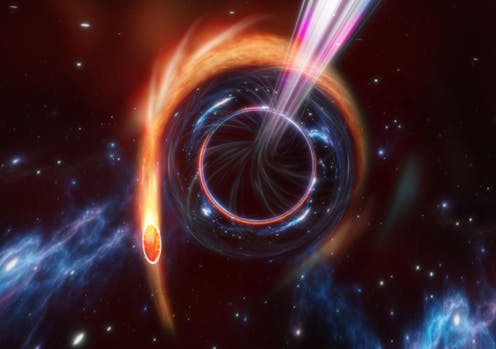
Some stars just get unlucky. There are billions of stars within a typical galaxy. Yet once every 100,000 years or so, one of those stars will wander too close to the supermassive black hole lurking at the galaxy’s centre and be torn apart. These cosmic behemoths weigh in at millions to billions of times the mass of our Sun, and their immense gravitational force can destroy an unlucky star.
The stellar debris spirals in towards the black hole, which feeds on the remains. However, black holes are messy eaters. In a small fraction of cases, this stellar destruction can power an energetic jet of material that travels outwards at almost the speed of light. If that jet is pointed directly towards us its brightness will be boosted, in much the same way that a police siren seems louder when the car is travelling towards us.
Modern astronomical surveys discover such stellar spaghettifications (known as tidal disruption events) roughly once or twice every month. However, only three of these had previously been seen to produce powerful jets, most recently in 2011.
Earlier this year we were lucky enough to spot another one of these events, more than halfway across the Universe. As we report today in Nature Astronomy, our team watched it with some of the world’s best telescopes for more than three months, getting the best view yet of the birth and development of a black hole jet.
Black holes and jets
Eating stars is an important way for black holes to grow, even more so in the early Universe. We know the supermassive black holes at the heart of today’s galaxies must have grown extremely rapidly when they were young to reach their current sizes.
These cataclysmic events also provide a unique window to the fastest-feeding black holes. We could never reproduce in a laboratory the high energies and strong gravity involved, so these rare occurrences help us to understand astrophysics at its most extreme.
In particular, they allow us to test how jets form. Jets are a natural byproduct of the infall of gas onto a central object. They transport energy from the central object to its surroundings.
The birth of a jet from a tidal disruption event. Credit: Dheeraj Pasham (MIT), Matteo Lucchini (MIT) and Margaret Trippe.The most powerful jets known are launched by the supermassive black holes at the centres of galaxies. The matter and energy in these jets can trigger or prevent the formation of stars, and affect the evolution of entire galaxies.
Being so large, supermassive black holes usually change slowly. Tidal disruption events provide an exception to this rule, as a large amount of gas is dumped very close to the black hole.
The black holes then feed rapidly, changing their behaviour over the course of days or months. Dedicated observing campaigns with state-of-the-art telescopes can provide a wealth of data on these exotic phenomena. We can use these data to test our theories for how jets form and evolve.
A burst of light
In February 2022, an optical sky survey discovered a bright burst of light from the centre of a distant galaxy. The light had been travelling to us for over 8.5 billion years – more than half the lifetime of the Universe. Telescopes around the world sprang into action to learn more about this event, which astronomers named AT2022cmc.
This event was extremely bright, particularly at X-ray wavelengths. The X-ray emission gave out more energy in 1 second than the Sun emits in 10 million years.
The X-rays were also highly variable, changing in brightness on timescales as short as 15 minutes. Notably, there was also strong emission at radio and millimetre wavelengths, which got brighter over time.
These properties indicated that AT2022cmc was a new tidal disruption event. It is the most distant found to date, and the first seen to launch a powerful jet in 11 years.
X-rays and radio waves
Over the first 100 days after discovery, our team, led by Dheeraj Pasham from MIT, observed the event with a range of telescopes. Our data covered the radio, optical, ultraviolet and X-ray emission, which arise from different parts of the inflowing and outflowing gas.
Our detailed modelling showed that the majority of the emission arose from the powerful jet launched by the rapidly feeding black hole. The unlucky star that met its demise was likely to be a low-mass dwarf star. At its peak, the black hole was devouring gas at a rate that would consume the entire Sun in just a few years.
Read more: How we captured first image of the supermassive black hole at centre of the Milky Way
We found that the jet was moving at 99.993% of the speed of light, with most of the energy carried by the particles (ions) in the jet, rather than the magnetic fields. This was unexpected, since most current theories predict that magnetic fields are critically important in jet formation and should carry much of the energy.
New telescopes, better views
With an upgraded suite of telescopes, and more sophisticated theoretical models than a decade ago, our work has provided the most detailed coverage yet of the birth and evolution of a relativistic jet. We have challenged our theoretical expectations and improved our understanding of physics at its most extreme.
Over the coming few years, new facilities such as the Vera Rubin Observatory in Chile should discover many more such events, reaching further out into the distant Universe. Powerful new radio telescopes such as the SKA will allow even more detailed follow-up and characterisation of the jets.
Our study has demonstrated the exciting science that will flow from these instruments, opening a new window to some of the most energetic events in our Universe.
Read more: Astronomers have detected one of the biggest black hole jets in the sky
Authors: James Miller-Jones, Professor, Curtin University


















