

Explainer: can you copyright furniture?
- Written by: Kylie Pappalardo, Lecturer, School of Law, Queensland University of Technology
Furniture stores are often filled with designs that look similar to others. But is copying furniture legal, and should we feel bad about buying replicas?
Recently, interior designers accused the supermarket Aldi of copying an Australian designer’s stool in the launch of a new range of “luxe” furniture. Some, including the Design Institute of Australia, noted the stool’s similarities to designer Mark Tuckey’s eggcup stool, which retails for more than $550. Aldi withdrew its stool (priced at $69) on the day of the sale, citing quarantine issues and said it was scheduled to return to stores in late August. (There is no suggestion that Aldi has broken the law here).
In general, copying furniture designs that have not been registered in Australia is likely to be legal. This means that, in most circumstances when designers have not registered their work, businesses are able to sell, and Australian consumers are able to purchase, replica furniture without breaking the law.
How designs are protected
A designer of furniture, fashion or any other product will normally start out by creating a 2D drawing of their product. The drawing might be made by hand or using a computer or machine. This initial design is automatically protected under copyright law as an “artistic work”. For most types of artistic works, copyright lasts for the lifetime of the creator plus an additional 70 years.
 Furniture designers’ drawings will be protected under copyright automatically.
Shutterstock
Furniture designers’ drawings will be protected under copyright automatically.
Shutterstock
Copyright law prevents a person from copying someone else’s work if they do not have permission or a legal excuse. Making a 3D reproduction of a 2D artistic work counts as “copying” under law. So a person who makes, for example, a physical 3D chair using a designer’s 2D design of that chair may be infringing copyright of that 2D artistic work.
However, there is an interesting feature of copyright law that applies only to designers. A designer will lose copyright protection in their 2D artistic work if it is “industrially applied”.
“Industrial application” is generally understood to mean that 50 or more copies of the 3D product deriving from the design are made and offered for sale. Any mass commercial production will therefore take the product outside of the scope of copyright law.
However, mass-designed products can be protected by Australia’s designs system. This system protects the visual appearance of a product. Unlike with copyright, designers must register their designs to be protected under law.
For a design to be registered, it must meet certain minimum requirements. Importantly, it must be new and visually distinctive. The novelty of a design is critical to protection. These requirements ensure that ordinary and unremarkable designs are not constrained by intellectual property law, but are free for people to make and sell.
How is this determined? An application for design registration is filed with and assessed by IP Australia, located in Canberra. It usually takes between three and 12 months to process an application, and costs around $300 to apply. Once registered, design protection lasts for five years, with the opportunity to renew registration for a further five years - so 10 years in total.
The designs register is searchable online. Our search did not reveal any designs registered to Mark Tuckey.
Incomplete protection is deliberate
There are important policy reasons why designers are not given complete protection under intellectual property law. For one, it is often difficult to determine what is an original design when aesthetics meets functionality - there are a limited number of ways to design a seat that people will actually want to sit on! Designs protection is limited so that consumers can affordably access practical products.
Designs law tries to balance a designer’s right to protect their product with the public’s right to access. Getting the balance right is tricky, and is likely to be under increasing pressure with the advent of 3D printing for the home.
It is now possible to print replica furniture, and this practice may become more popular as 3D printing technology becomes simultaneously more sophisticated and more widely available. This is likely to raise ongoing questions about the scope of designs protection under copyright and designs law, and whether the law is appropriately tailored to protect designers.
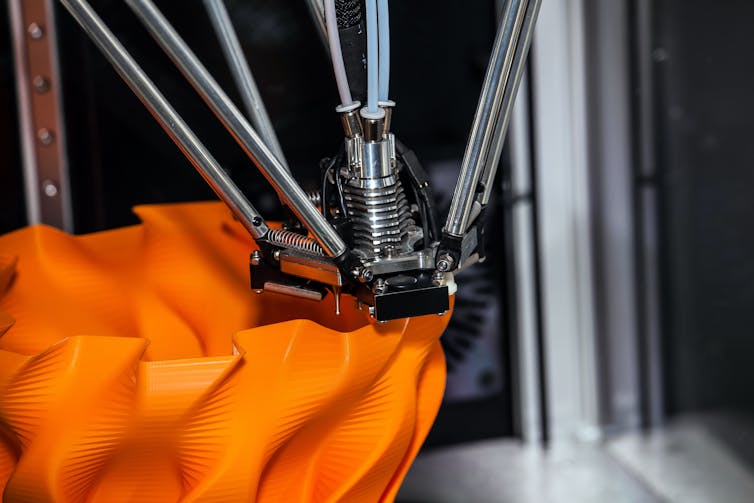 The option of 3D printing your furniture brings about new headaches for copyright.
Shutterstock
The option of 3D printing your furniture brings about new headaches for copyright.
Shutterstock
For Australian designers, the answer may not be stronger legal protection. First, we should ensure that the designs registration system is working effectively. Anecdotal reports suggest that the designs system is underused. We need to make sure that registration is affordable and accessible. Only then will we be in a position to know whether the protection offered by designs registration is enough.
For consumers, the good news is that replica furniture is likely to continue to be available in retail stores. There is certainly nothing illegal about buying replica furniture. Those with the budget to do so, however, may want to consider supporting local Australian designers of furniture and home crafts.
Authors: Kylie Pappalardo, Lecturer, School of Law, Queensland University of Technology
Read more http://theconversation.com/explainer-can-you-copyright-furniture-100336


















