

Prince Albert had nothing to do with the lyrebird bearing his name. Should our birds be named after people?
- Written by Felix Cehak, PhD Candidate, UNSW Sydney
Influential ornithologist John James Audubon’s historical ownership of slaves has spurred a debate about bird names in the United States. As a result, the American Ornithological Society will change not only birds’ common names referring to him, but all 152 eponymous bird names in North America, regardless of good or bad perceptions of their namesakes.
The cultural conversation has arrived in Australia where dozens of species are named after people. Some Australian scientists and birdwatchers (including one from the peak ornithological body Birdlife Australia) have proposed a review, particularly of names with colonial associations.
One Australian species has already been renamed. Birdlife Australia now prefers Pink Cockatoo to Major Mitchell’s Cockatoo as the common name.
Thomas Mitchell led a massacre of Aboriginal people in western New South Wales in 1836, condemned for its senselessness even at the time. Birdlife Australia provides a clear argument why the bird should not bear his name. The change has sparked a conversation in online birding communities.
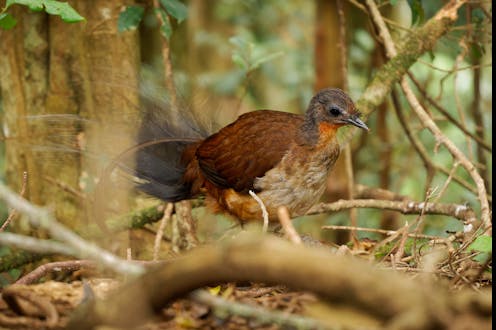
The Albert’s Lyrebird, the topic of my PhD research, also bears a name with colonial overtones, though without the direct violent connotations of Mitchell. Should it, and other Australian species named after people, be renamed? I’m not sure, but I do know this reclusive rainforest bird has a fascinating and surprisingly complex etymology.
Read more: Why dozens of North American bird species are getting new names: Every name tells a story
Why is a lyrebird named after Prince Albert?
When English ornithologist John Gould suggested the lyrebird as Australia’s bird emblem, he was recommending the Superb Lyrebird (Menura novaehollandiae) found throughout south-east Australia. Fewer people know of the Albert’s Lyrebird (Menura alberti), restricted to a tiny area on the Queensland-New South Wales border.
Fewer still know the story behind its naming. The Albert’s Lyrebird bears the moniker of Prince Albert, both in its scientific (Latin) name and current common (English) name, bestowed by Gould himself.
This species was still unknown to colonial scientists when Gould’s landmark Birds of Australia was first published in 1848. This was in part due to its remote, humid forest habitat.
Under taxonomic convention – the rules for classifying species – the credit for describing the species and assigning its scientific name would normally have gone to Gould when his 1850 supplement introduced the new species. Every listing of a species provides a scientific name, the name of the person who first described it and the date they did so. So we might have expected to see the Albert’s Lyrebird listed as Menura alberti, Gould, 1850.
Instead, next to Menura alberti we see a different surname – Bonaparte. Not Napoleon, but his nephew Charles, a naturalist who referred to Gould’s description of the new species. However, Bonaparte’s reference predated Gould’s actual publication, a technicality that means Bonaparte is listed as the scientific describer.
This quirk of taxonomy has tied this bird to two names deeply associated with empires.
Read more: Listen to the Albert’s lyrebird: the best performer you’ve never heard of
How do birds get their names?
Scientific names change only when species are reclassified. The naming is more akin to record keeping – though honouring people can be a secondary purpose. In the lyrebird’s case, Gould cited the prince’s “liberal support” and “personal virtues”.
Birdlife Australia has an English Names Committee, which deals with such changes. Prince Albert is not directly linked to historical violence in Australia, but he was Queen Victoria’s spouse during its colonisation.
If Menura alberti requires the Pink Cockatoo treatment, some other common names have been used in the past.
“Northern Lyrebird” is used in G. Matthews’ Birds of Australia. The volume is of the same name as Gould’s, by a self-funded author, who was controversial for his own taxonomic renaming.
More informally, “Small Lyrebird” has been used in relation to A.A. Leycester, the naturalist who shot the first specimen in 1844.
These are both obscure, albeit more descriptive, alternatives. “Albert’s” is much more common. Leycester himself added an even more royal connotation with “Prince Albert’s Lyrebird”, but sometimes also “Richmond River Lyrebird”.
The bird had earlier names
As for the bird being “discovered”, naturally earlier Indigenous names survive.
The bird has recently been described as a bird of the Bunjalung language area. This is true but it is also a Yugambeh and Githabul bird. Its habitat on the Great Dividing Range might include Jagera Country too.
Archibald Meston inexplicably recorded a Kabi Kabi language name from the “head of the Mary River” – no lyrebird is known to occur this far north.
The Yugambeh Museum has provided “kalbun” for national park signage in my home town, Tamborine Mountain. One Bundjalung dictionary provides “galbuny” or “galwuny” with an outlying possibility of “wonglepong”, “kalwun” or “kulwin” in the Tweed as meanings for “lyrebird” (with no clarification between the two species). Indigenous health service Kalwun uses the name in reference to the “rainforest lyrebird” but uses an image of a Superb Lyrebird as its logo.
Read more: What makes a good bird name?
If a new name is needed, who decides it?
Over many hours of conversation about this species, I have found the link to Prince Albert is always known. I have rarely heard anything more about why the lyrebird bears his name. Besides his irrelevance to Australian ornithology, I cannot gauge a specific reason the Prince Albert moniker is inappropriate, unlike Thomas Mitchell.
If a change is required to a bird’s name, the decision must be made with the relevant communities. If they wish to counter a history of imperial naming by renaming, the new name should not spring from a similar desire for ownership.
It would also be wise to maintain broadness in this conversation. In the Albert’s Lyrebird case, that includes the birdwatchers, ecologists and conservationists who have contributed to our understanding of this little-known species.
We are about to see what happens in the United States. It would be wise to watch carefully what happens next.
Authors: Felix Cehak, PhD Candidate, UNSW Sydney



















.jpg)