

Why controversial child protection reforms in NSW could lead to another Stolen Generation
- Written by Alison Whittaker, Research Fellow, University of Technology Sydney
Among the most significant powers exercised by governments is that of removing children from their families. Potential reforms before the NSW parliament this week would expand this power in frightening ways.
The reforms contained in the Children and Young Persons (Care and Protection) Amendment Bill represent a radical shift in basic child welfare principles. These changes could make removals more permanent, while dispensing with core safeguards and transparency measures. It is Aboriginal communities who stand to lose the most.
Children are already being removed from Indigenous communities at an unprecedented rate. Indigenous children make up 36.9% of children in out-of-home care in Australia, despite being just 3% of the population.
And stakeholders ranging from the Kinchela Boys Home Aboriginal Corporation to the peak body for Community Legal Centres NSW are fearful that, if passed, the NSW legislation will force adoptions and create another Stolen Generation.
What’s been proposed?
We’re especially concerned by four fundamental proposed changes:
- placing a two-year limit on creating a permanent arrangement for a child
- making guardianship orders by consent outside of courts
- amending how families can apply for restoration
- removing parental consent to adoption for children on permanent orders.
Proponents suggest the reforms are aimed at stopping children “flopping from one foster home to another”, as Pru Goward, NSW minister for family and community services, put it.
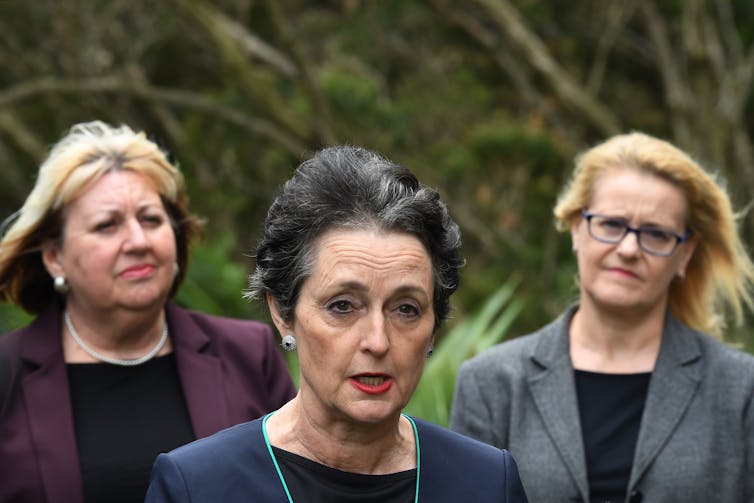 Pru Goward says the bill will bring ‘landmark reforms’ to the state’s child protection system.
Dean Lewins/AAP
Pru Goward says the bill will bring ‘landmark reforms’ to the state’s child protection system.
Dean Lewins/AAP
However, we are talking here about legally permanent care arrangements being made with arbitrary deadlines.
As Aboriginal advocates have argued, and as the evidence attests, family and kin support is key to keeping Aboriginal kids home, safe and connected with their culture. The reforms proposed in the bill will make it much harder to achieve that goal.
A permanent placement within two years
The most commonly criticised feature of the bill is the arbitrary maximum period of two years within which a decision about permanent placement has to be made.
As governments increasingly outsource their child welfare responsibilities to private agencies, there is a danger that market incentives can intrude into decision-making. The incentive to cycle children into permanent arrangements, regardless of their suitability, to meet performance indicators and targets is particularly chilling.
In Australia, the Royal Commission into Institutional Responses to Child Sex Abuse noted the vulnerability of children in care to sex abuse. Yet, once children are placed on guardianship orders or adopted, they are on their own, with no further review or oversight. They are no longer counted in the out-of-home care statistics.
And the factors that cause children to enter into care – especially Aboriginal children – aren’t usually solved within a two-year time frame. They’re often related to poverty and inter-generational trauma. These include insecure housing, drug and alcohol addiction, family violence, and mental health and behavioural problems.
Read more: Child protection report lacks crucial national detail on abuse in out-of-home care
Almost half of all children in out-of-home care in NSW in 2014-2015 had a parent who had contact with the child welfare department themselves when they were a child.
Services to address these problems (such as support for victims of domestic violence and rehabilitation facilities) are either not available or have a lengthy wait list – sometimes two years or longer.
And it’s hard to see how the frequently backlogged NSW Children’s Court could cope with the additional pressure of a looming two-year deadline.
The changes create insurmountable conditions tantamount to permanent removal with no oversight.
Guardianship orders ‘by consent’ outside of courts
Under the bill, permanent care orders can be made “by consent” in alternative dispute resolution without necessarily establishing a child is at risk. As the Law Society of NSW says in its submission to the state government:
While the child’s safety and best interests are of course paramount, these provisions would allow the court to make a guardianship order with the parents’ consent, even where there is no finding that a child is at risk of significant harm or should be subject to a care and protection order.
These decisions will be made in negotiations – without judicial oversight – between families, governments, agencies and carers with vastly different legal resources, powers and goals. Families will be assisted by lawyers who may be ill-equipped to deal with a sudden influx of new cases in an unfamiliar forum.
Read more: Why children in institutional care may be worse off now than they were in the 19th century
The legislation provides limited safeguards, but these cannot make the alternative dispute resolution suitable in cases where fundamental legal rights - such as the state breaking up a family - are at stake.
This means thousands of children who have already been transferred from foster care to private guardianship arrangements - over 894 of them Indigenous as of June 2017 - could soon be adopted without their parents’ knowledge or consent.
Once a decision has been made, the reforms narrow the criteria for reviewing them. This makes it virtually impossible for families to get permanent placement decisions changed.
In its own report on the bill, the NSW government conceded most stakeholders opposed these changes.
Rushed process leaving little time for response
Decisions such as these already take place in the context of the unconscious bias and structural racism of the out-of-home care system. And Indigenous child placement principles – which aim to keep children safe while retaining their connections to family, community, culture and country – are not being properly implemented.
Read more: FactCheck Q&A: are Indigenous children ten times more likely to be living in out-of-home care?
We do not yet know the extent of that system failure. The NSW government is not waiting for the results of an ongoing review into how it handles Aboriginal child placements. A similar review in Victoria revealed that systematic failings have contributed to the over-representation of Aboriginal children in care and that over 60% of those children had been placed with non-Aboriginal carers.
It is astonishing this bill is being rushed straight to the upper house in the last sitting days before the NSW election in March, leaving no chance for adequate debate and giving Aboriginal stakeholders just weeks’ notice to respond. A recent motion to send the bill to a short inquiry that would last mere days was voted down.
We know that NSW child protection laws need to change, but not this way. The Commonwealth government has apologised to the Stolen Generations, and the NSW government has apologised to survivors of forced adoptions. Both apologies warned us of the need to learn from past policies. If this bill passes, we will have all but forgotten them.
Authors: Alison Whittaker, Research Fellow, University of Technology Sydney

















