

Why cutting Australia's migrant intake would do more harm than good, at least for the next decade
- Written by: Peter McDonald, Professor of Demography, Centre for Health Policy, University of Melbourne
Australia’s population is among the fastest growing in the OECD with an increase of 1.7 per cent in 2016-17.
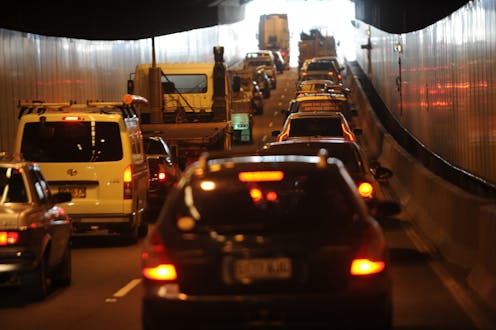
In Sydney and Melbourne traffic congestion has become so intolerable many believe a cut to migration would provide time for infrastructure such as roads and trains to catch up.
Net Overseas Migration was 262,000 in 2016-17, one of the highest levels on record.
They are all compelling reasons to cut the size of the migration program, right?
No, not right. Not at all.
Our migration program is no bigger than it was
Including the humanitarian movement, the government migration program has been set at a near-constant level of a little over 200,000 since 2011-12.
In 2017-18, although the level set in the budget remained above 200,000, the actual intake was 179,000, including an unusually large intake of refugees mainly from Syria and Iraq.
The combined Skilled and Family Streams fell short of the levels set in the budget by 28,000. The reasons for this shortfall are unclear.
‘Net overseas migration’ is different to migration
Net Overseas Migration includes the government program but also other movements in to and out of Australia which both add to and subtract from it.
New Zealand citizens are allowed to enter Australia without restriction. Many people such as international students enter Australia on temporary visas.
Permanent and temporary Australian residents are allowed to leave without restriction.
Read more: FactCheck: is Australia's population the 'highest-growing in the world'?
The net effect of all of these movements can change the recorded “net overseas migration” in ways that are inconsistent with what’s been happening to the migration program.
If, for instance, the Australian economy picked up and fewer Australians decided to leave for better prospects overseas, recorded “net overseas migration” would increase even if the migration program hadn’t.
The two have been moving increasingly independently since mid 2006 when the Australian Bureau of Statistics changed its definition of “resident”, making temporary residents more likely to be counted in the population and their movements counted in net overseas migration.
Read more: International students impaled on (illusory) population spike
Over the past five years, the number of international students arriving has increased every year but there have been few international student departures.
Inevitably, the departures of students will increase in future years and recorded net overseas migration will fall sharply again.
So, forget the near-record official net overseas migration figure of 262,000 – the underlying level of net overseas migration is more likely to be around 200,000. The underlying level of population growth is about 1.4%, and falling.
We’ll need strong migration for at least a decade
A new study by Shah and Dixon finds there will be 4.1 million new job openings in Australia over the eight years between 2017 and 2024.
Over two million of these new openings will be due to “replacement demand”, effectively replacing the retirements from the labour force of baby boomers.
There will not be enough younger workers arriving to fill the gap.
Read more: Migration helps balance our ageing population – we don't need a moratorium
In the absence of international migration and assuming constant age-specific employment rates, the number of workers under the age of 35 will fall by over half a million between 2016 and 2026, essentially because of the small number of births in the 1990s.
It means that without migration Australia would face a labour supply crunch unlike anything it has ever faced before.
Slowing or redirecting it won’t slow congestion
The mismatch of labour demand and supply makes this an extraordinarily bad time to cut migration.
The labour market is at its hottest in Sydney and Melbourne.
Investment contracts involving new employment are signed and the construction of the new transport infrastructure promised in these cities will only increase the demand.
Logic and economic theory tell us that workers move to where the jobs are, and jobs move to where the investors invest.
If, in some way, official migration into Sydney and Melbourne was restricted, the jobs in Sydney and Melbourne would still have to be filled and would go instead to workers moving from the rest of Australia or New Zealand or temporary skilled migrants.
Read more: Three charts on Australia's population shift and the big city squeeze
As a result the restriction would do little to reduce population growth in these cities. It would however, strip other states and territories of the workers they need. It would make the flow of the best and brightest from Adelaide and Perth to Melbourne even bigger.
Diverting, say, 15,000 permanent skilled immigrants away from each of Sydney and Melbourne in 2019-20 would have no impact on transport congestion.
Indeed, it might make it harder to build the required infrastructure, making congestion worse.
We’ll need it to ease a painful transition
It would also make it harder for migration to smooth the dramatic and uncomfortable changes in the age structure of our population.
Migrants don’t only do this because they are young; they also do it because, before they themselves grow old, they have had children and grandchildren.
Net overseas migration of 200,000 per annum would give us 6.8 million more people of traditional working age by 2051 than would no net migration, but only 400,000 more people aged 65 years and over.
It would place Australia in a better position to support its aged population than any other country in the OECD.
Read more: Tasmania can't only rely on a growing population for an economic boost
Official studies by the International Monetary Fund, the Productivity Commission and the Treasury find that migration significantly increases income per capita and the government’s budget position.
It does put pressure on Sydney and Melbourne, but some of it can be relieved through diversion of population and investment to the satellites of these cities.
Read more: Migration is slowing Australia's rate of ageing, but not necessarily in the regions
This has already been happening in Victoria. Geelong, Ballarat and Bendigo have each jumped into the list of Australia’s top ten urban growth centres.
The growth of Wollongong and Newcastle has been more sluggish but the NSW Premier has recently announced that NSW will be pursuing a strategy of better linkages between Sydney and its satellites.
Authors: Peter McDonald, Professor of Demography, Centre for Health Policy, University of Melbourne


















