

Airports and travel hubs can be overwhelming for Autistic people. Here’s what could help
- Written by: Chris Edwards, Adjunct Research Fellow, Inclusive Futures, Griffith University
As another Australian summer approaches, many people are planning their holidays, looking forward to the joy travel brings. Yet for Australia’s 5.5 million people with a disability, what should be an exciting journey often becomes a significant challenge.
While the aviation industry is making some progress in accessibility, many barriers remain for disabled travellers. This is true for people with hidden disabilities like autism, whose needs have historically received less attention in transport.
For Autistic travellers, airports can be challenging environments, combining sensory experiences with social and procedural demands. And while some airports are developing accessible tourism initiatives, there’s still considerable work needed to achieve truly inclusive travel.
Read more: Travellers with disability often face discrimination. What should change and how to complain
What makes airports overwhelming for Autistic travellers?
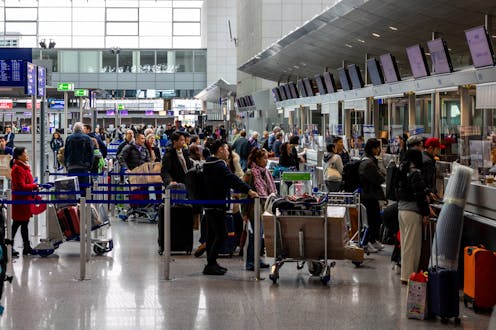
For many Autistic people, stepping into an airport feels like entering a perfect storm of sensory and social challenges.
Fluorescent lighting creates glare as it reflects off polished floors. Unpredictable announcements compete with the constant sound of crowds and rolling luggage. People are moving quickly in all directions. It creates an intensity that can rapidly become overwhelming.
Navigation presents another layer of difficulty, with unclear signage and procedures (such as getting through security) that often vary between airports. This unpredictability can amplify anxiety, especially when interacting with staff who may not understand hidden disabilities.
The result? Many Autistic people either struggle through the challenges or avoid air travel altogether, missing out on experiences others take for granted.
What do Autistic travellers say about Australian airports?
Our recently published research examined the experiences of Autistic adults and families who travelled through two Australian airports. These locations – Gold Coast and Sydney airports – have been implementing autism-friendly initiatives for more than five years. Both airports conduct staff training on hidden disabilities, participate in the Sunflower program (where people wear a sunflower symbol to voluntarily signal a hidden disability) and provide accessibility resources (such as sensory maps and visual stories).
Through our interviews with 13 Autistic travellers and family members we heard accounts of both positive experiences and ongoing challenges.
Rachel (names changed), a parent of someone with hidden disability told us it
[…] makes the trip so much harder when there are so many people, so loud, so close.
A key finding was the need for better control over sensory environments. While airports can’t eliminate all sensory stimuli, participants emphasised the importance of accessible, clearly marked quiet rooms. Autistic adult Aaron told us he felt subjected to a sensory assault almost
[…] as soon as you walk into the airport […] it’s so busy, and the lights are like that white light, and just that enough, is to be like, oh my god, what’s happening?

What these airports did well
Both airports provide sensory maps. These highlight high- and low-sensory areas within the airport. They also offer step-by-step visual guides showing what to expect at each stage of the airport journey. These resources and others help reduce anxiety by setting clear expectations.
However, many participants didn’t know these resources existed until prompted to look at them as part of the study.
The Hidden Disability Sunflower lanyard was praised by those we spoke to. When recognised, it led to more patient, supportive interactions with staff and helped ease travel anxiety. Aaron recalled an experience with an airport staff member.
She actually said to me, ‘oh, I can see you got the lanyard. Do you need any help?’ And I was like, ‘oh, thank you, but no, I’m okay.’ But that’s the first time that someone’s ever actually acknowledged it and asked me, so that was really good.
However, inconsistent awareness among staff and varying implementation across airports and airlines resulted in mixed experiences.
What could be better?
Autistic participants and family members strongly advocated for more visible signage about supports, ongoing hidden disability training for staff and proactive assistance – rather than waiting for travellers to request help.
Quiet rooms, with signs or maps to find them, could help Autistic adults and families who are currently paying for airport lounge membership to help manage travel overwhelm. Parent Rachel explained
We purposely purchase Qantas Club Lounge, which obviously costs us a fair bit of money each year, but we do that to try to get the children out of the high sensory environments [… it provides] an environment that’s a lot quieter and a space where my kids can just sit down and breathe.
Our findings suggest relatively simple changes can improve the travel experience for Autistic people. The challenge now lies in implementing these initiatives across Australia.
 Some travellers have had positive experiences when they signal hidden disability by wearing a lanyard.
vetre/Shutterstock
Some travellers have had positive experiences when they signal hidden disability by wearing a lanyard.
vetre/Shutterstock
5 tips for your next trip
A bit of planning can make the airport experience much smoother for Autistic travellers or others with hidden disabilities.
1. Plan ahead
Look up each airport’s website for resources under “hidden disability”, “Sunflower” or accessibility sections. Sensory maps, visual guides, or quiet room locations can make a big difference.
2. Signal you might need support
Self-identification, like the Sunflower lanyards, provide a way to discreetly signal to staff you may need support. If staff don’t offer help, don’t hesitate to ask for assistance if and when you need it.
3. Manage sensory input
Items like noise-cancelling headphones or sunglasses can help manage loud noises or bright lights. Packing a small “sensory toolkit” can help minimise discomfort in crowded spaces.
4. Access special services
Many airports and airlines offer special assistance services, including priority boarding and navigation help. Contact them in advance to arrange this support.
5. Allow extra time
Giving yourself extra time reduces the pressure of rushing and allows you to use any available resources at a comfortable pace.
Everyone has a right to enjoy travel and all that the world has to offer. With a bit of preparation, your airport journey can be far less overwhelming.
Authors: Chris Edwards, Adjunct Research Fellow, Inclusive Futures, Griffith University


















