

Developing nations are least responsible for climate change but cop it worst. Will the COP29 climate talks tackle this injustice?
- Written by: Imraan Valodia, Pro Vice-Chancellor, Climate, Sustainability and Inequality and Director, Southern Centre for Inequality Studies, University of the Witwatersrand
Since the Industrial Revolution, country after country has turned to fossil fuels to power their transport and industry.
Now the bill is coming due. Huge volumes of long-buried carbon are in the atmosphere, warming the planet. Climate disasters are arriving more often and getting worse.
But the pain from climate change is not distributed fairly. Developing nations are suffering the worst, despite emitting far fewer greenhouse gases. To date, two regions – Europe and North America – have contributed fully 60% of the world’s total emissions. This has made them much richer, but at a cost borne largely by those of us in the Global South.
This injustice will be in the spotlight this week, as leaders and diplomats gather in Baku, Azerbaijan, for the yearly United Nations climate talks. Climate finance is high on the agenda – specifically, the vexed question of who pays.
Who is responsible for climate change?
Historically, North America and Europe are the highest emitters.
Asia’s emissions have grown sharply in recent decades, due to its high population size, sustained economic growth in China and high emitting, oil-reliant Gulf states.
By contrast, Africa and South America are each only responsible for 3% of the world’s total emissions over time.
This is a necessarily simplistic picture. It hides, for instance, which companies and organisations emitted most in Europe and North America, as well as which income groups emit most.
But even at this level, it is increasingly clear the wealthiest people in the world are the highest emitters – including the rich who live in the Global South.
This unequal distribution of emissions gave rise to the principle of “common but differentiated responsibilities” in international environmental law in the 1990s.
This phrase speaks to the common responsibility to tackle climate change, the fact some nations have contributed less to the problem and some much more, and that some can respond more easily to the threat.
The idea was first articulated in the 1992 Rio Declaration on sustainable development. It was featured in the 1996 Kyoto Protocol on climate change and the 2015 Paris Agreement.
Pain for the poor
Until very recently, economic growth went hand in hand with using ever more fossil fuels.
The problem is the benefits were localised (an industry booms, a country gets wealthier), the environmental cost was deferred until later, and the damage would be borne more widely.
If fast-growing countries like Ethiopia, and Indonesia took the same route, climate change would get even worse and the world would blow through its shrinking carbon budget.
This is just one of many cruel twists of fate. As the damage done by climate change intensifies, developing countries have to spend more of their budgets on maintaining the status quo – repairing broken bridges, keeping farmers afloat – and less on improving the lives of their citizens.
Climate change also poses major financial risks to developing nations. To cope with more and worse disasters, governments have to borrow more. More of their budgets have to go towards servicing debt, leaving less for everything else.
Right now, millions are going hungry in southern Africa, after an unprecedented drought devastated crops. Zimbabwe has lost 80% of its crops, Zambia 70%.
In 2022, catastrophic floods in Pakistan forced almost 8 million people to leave their homes and forced another 20 million to seek immediate humanitarian aid.
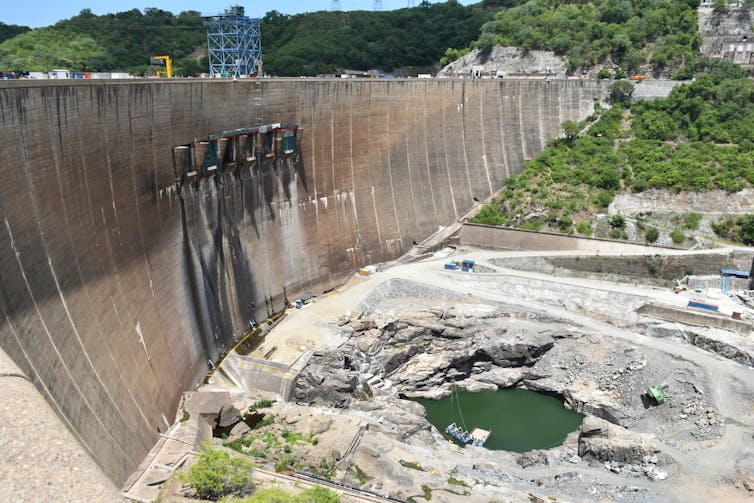
These disasters are bad enough. But they can also disrupt national climate efforts. The hydroelectric Kariba Dam has long provided low-carbon power to Zambia and Zimbabwe. But the water level has dropped sharply due to the drought. In September, the dam stopped generating electricity – and brought power cuts across both nations. In response, the governments have looked to solar and even coal.

Who pays for loss and damage?
Adapting to climate change can only go so far. In response, nations in the Global South have sought recognition of the disproportionate loss and damage they were suffering.
In 2013, the world community set up the Warsaw Mechanism for Loss and Damage in a bid to tackle this injustice.
It took a decade of negotiation, stalling and delay before agreement was reached to create the Loss and Damage Fund at last year’s COP climate talks. It will be hosted in the World Bank at first. No funds have yet flowed.
This year’s COP meeting has been dubbed the “finance COP”. On the table will be how to structure this fund. One challenge will be securing funding, given contributions are voluntary and the Green Climate Fund and Adaptation Fund are also seeking funding for mitigation and adaptation projects.
At present, pledges come to a meagre US$661 billion. Wealthier countries have consistently tried to avoid liability for climate change and have blocked the use of terms such as “compensation” or “reparation”.
Will we see progress?
In 2009, nations agreed to fund climate change adaptation and mitigation at $100 billion a year. This figure has now been reached.
The top item at this year’s climate talks will be setting a bigger goal for these climate funds. We don’t know yet whether loss and damage will be included alongside adaptation (living with it) and mitigation (preventing it). Leaders and activists in the Global South have called for a much larger sum for loss and damage, starting at $724 billion per year.
Climate change is already costing poor nations a great deal of money, estimated at $100 to $500 billion in damage each year.
If this year’s COP is to correct this injustice, funding must be in line with expected costs. Funding should flow largely as grants, rather than loans. And wealthy nations should also contribute towards the loss and damage already being suffered.
Unfortunately, we’re unlikely to see this happen if history is any guide. The COP discussions will be overshadowed by the election of Donald Trump, who has promised to give fossil fuel companies free rein.
Even so, these talks offer an important way to get wealthy nations to pay attention to the very real damage done by climate change, far from the headlines. Persistence and advocacy may still pay off.
Read more: COP29: who pays for climate action in developing nations – and how much – becomes more urgent
Authors: Imraan Valodia, Pro Vice-Chancellor, Climate, Sustainability and Inequality and Director, Southern Centre for Inequality Studies, University of the Witwatersrand


















