

Was Jesus Palestinian?
- Written by: Philip C. Almond, Emeritus Professor in the History of Religious Thought, The University of Queensland
Netflix’s upcoming biblical biopic, Mary, has been attacked on social media because the title character and her husband Joseph are being played by Israeli actors.
The criticisms are based on the argument that Mary and Joseph, and their son Jesus, a Jewish man born in Bethlehem, were, in fact, Palestinian. Some critics of the Netflix casting are concerned about the inappropriateness of Israeli actors playing historical people they believe are Palestinians, while contemporary Palestinians are being killed by Israeli bombs.
Film-maker D.J. Caruso has explained the casting of Israeli actors as a deliberate choice: “It was important to us that Mary, along with most of our primary cast, be selected from Israel to ensure authenticity.”
So, were Jesus and his parents Palestinian?
Bethlehem is now a city located in the Israeli-occupied West Bank of the Palestinian Territories, about ten kilometres south of Jerusalem. So the short answer is: yes, Jesus was a Palestinian, according to modern geopolitics at least.
But one could also argue that he was not, because, as a Jewish man, he was born at a time when Palestine did not exist as a political entity.
Paula Fredriksen, a historian of ancient Christianity, made this point in March. In the Washington Post, she called claims Jesus was Palestinian “an act of cultural and political appropriation”.

A Jewish man from Bethlehem
According to the New Testament, Jesus was born somewhere around 4-6 BCE during the reign of Herod the Great, in Bethlehem. Bethlehem’s location was in an area then known by the Romans as Judea – the land of Judah, then occupied by the Jewish people (the Judeans).
The Roman historian Tacitus was the first to mention the existence of Jesus as a Judean, outside of the New Testament, in his Annales (115-120 CE).
Tacitus told his readers the Emperor Nero had blamed the fire that destroyed Rome in 64 CE on the Christians. They were named, he wrote, after (Jesus) “Christus”, who was executed by Pontius Pilate when he was governor of “Judea, the first source of the evil”.
According to the Old Testament, the 12 tribes of Israel conquered Canaan (later to become known as Palestine, then Judea, then Palestine, and then Israel) around 1200 BCE. The tribe of Judah settled in the region to the south of Jerusalem.
This made Jesus a Judean (in Hebrew, a Yehudi), from which the English word “Jew” is derived. As a Judean, Jesus was part of the Jewish religious tradition, which was focused on the temple in Jerusalem, known as the second temple.
‘Palestine’ has a long history
The name “Palestine” for that region also had a long history, though. It first appeared in the fifth century BCE, in the writings of the Greek historian Herodotus.
He wrote of a “district of Syria, called Palaistinê”, between Egypt and Phoenicia, an ancient region that corresponds to modern Lebanon, with adjoining parts of modern Syria and Israel. So, the land (or part of it) was called “Palestine” by the Greeks before it was called “Judea” by the Romans.
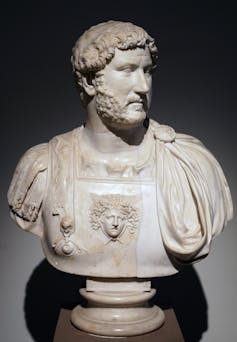
 Emperor Hadrian changed ‘Judea’ to ‘Palestinian Syria’.
Commonists/Wikipedia Commons, CC BY
Emperor Hadrian changed ‘Judea’ to ‘Palestinian Syria’.
Commonists/Wikipedia Commons, CC BY
The key moment in the creation of Palestine was shortly after a Jewish rebellion against Roman rule in Judea from 132-135 CE, known as the Bar Kokhba revolt. The Jews were killed, displaced or enslaved. They wouldn’t return to Palestine in numbers until after World War II, when the Jewish state of Israel was created.
The Emperor Hadrian changed the name of the Roman province from “Judea” to “Palestinian Syria” in c.138 CE. This name change removed the Jewish character of the region, implying it was more Syrian and Greek than Jewish.
We might say that, from this moment on, Jesus was a Palestinian.
His ethnic identity as a Jew and his religious affiliation to the religion of the Jews remained the same, but his geographical identity had changed. The Judean had become a Palestinian.
Back then, this mattered little. After all, Palestine was just another name for Judea.
Politicising ‘Palestine’ and ‘Israel’
After the fall of the Roman Empire, the boundaries of Palestine were vague and uncertain. “Palestine” did not refer to any specific political identity, so no precise geographical determination was needed.
The crusaders preferred “the Holy Land”, or “the Kingdom of Jerusalem”. The borders of Palestine remained fluid after it became part of the Ottoman Empire in 1516, until the end of the first world war ended Ottoman sovereignty in the region.
Jerusalem was captured by British and Allied forces in December 1917. By October 1918, the remaining area was occupied by the British, which would administer Palestine until a mandated end date of 1948. In May 1948, after an estimated 750,000 people who lived on 77.8% of the land in then-Palestine were displaced, the modern state of Israel was declared.
 Christian worshippers pray at the Grotto under the Church of the Nativity, traditionally believed to be the birthplace of Jesus, on Christmas Day in the West Bank city of Bethlehem.
Mahmoud Illean/AAP
Christian worshippers pray at the Grotto under the Church of the Nativity, traditionally believed to be the birthplace of Jesus, on Christmas Day in the West Bank city of Bethlehem.
Mahmoud Illean/AAP
The geographical identity of Palestine now reemerged as crucial. Palestine would now become a limited and determined geographical space, defined against the creation of the new state of Israel.
This new state built upon its original Judean, or Jewish identity. But with its new name, it created a new understanding of itself. A new kind of Jew, an “Israeli”, had arrived in the place formerly known as Judea.
The new Jewish “Israelis” established themselves against the previous inhabitants, the “Palestinians”. They limited the Palestinians to a space in the Gaza Strip and the West Bank, on what the Israelis still considered the Promised Land given to them by God, according to the Bible.
For their part, the Arabs of Palestine began to use the term “Palestinian” to assert the nationalist concept of a Palestinian people and their right to an independent state.
A common humanity
When Judaea and Palestine covered more or less the same geographical space, Jesus could be both a Judaean and a Palestinian. Back then, it didn’t matter.
But in a modern Middle East divided along binary lines (between Jew and Arab, Israeli Jew and Palestinian Muslims or Christians), it seems he can no longer be both.
Heaven only knows what Jesus would make of all this. But realising Jesus is a Palestinian and a Jew should make us question the truth and value of such binary distinctions.
After all, Jews, Muslims and Christians believe we all come from one original pair of humans: Adam and Eve.
That story leads us towards a recognition of common humanity – beyond the arbitrary and impermanent divisions of people and places thrown up by the changes and chances of history.
Authors: Philip C. Almond, Emeritus Professor in the History of Religious Thought, The University of Queensland
Read more https://theconversation.com/was-jesus-palestinian-243943



















.jpg)