

A new bill keeping 10 year olds out of jail is a good start, but it needs to go further
- Written by: Thomas Crofts, Professor, School of Law and Department of Social and Behavioural Sciences, City University of Hong Kong
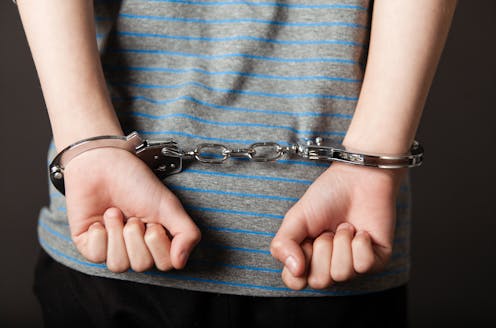
A nine-year-old boy was recently charged with arson and five counts of murder in Illinois, US. In court, the boy didn’t even understand what “arson” meant.
In Australia, a nine year old cannot be prosecuted and found guilty of an offence, but a ten year old can. From ten until 14, children can be held criminally responsible in criminal proceedings if there is proof the child understood the wrongfulness of their behaviour.
But it’s increasingly clear ten years old is too young for a child to be held criminally accountable.
There have been calls for an increase to the minimum age of criminal responsibility in Australia for many decades. The commonwealth, state and territory governments have so far been reluctant to change the age level – but that may soon change.
Read more: Young crime is often a phase, and locking kids up is counterproductive
A private member’s bill currently before the federal parliament proposes to raise the minimum age to 14 for federal offences. And a working group reviewing the issue will report to the Council of Attorneys-General at the end of November.
Australia’s minimum age is low compared to other countries. Most European countries have set their age between 14 and 16, while others such as China, Russia, Japan and Sierra Leone have it set at 14.
The increase would be in line with Australia’s obligations under the UN Convention on the Rights of the Child. Last month the UN Committee recommended all countries should adopt a minimum age of at least 14, but preferably 15 or 16.
Breaking the cycle
Raising the age would break the cycle of early entry into, and entanglement within, the criminal justice system. Children arrested before 14 years old are three times more likely than those arrested after 14, to reoffend as adults.
It would particularly help address the crisis of over-representation of young Indigenous children in the criminal justice system.
Between 2016 and 2017, an average 566 children aged ten, 11, 12 and 13 years were in detention. Of these 69% were Indigenous children.
The criminal justice system is no place for children who lack the capacity to be criminally responsible at the age of ten, or even 12 or 14.
The part of the brain responsible for abstract reasoning and the ability to control impulses is still developing in children that age. They’re less able to gauge the longer-term consequences of their behaviour, understand the impact of their actions or to comprehend criminal proceedings.
Read more: Congratulations, you’re ten! Now you can be arrested
What’s more, research shows developmental and cognitive disabilities – which result in communication difficulties, cognitive delay, learning disabilities, emotional and behavioural problems and lack of inhibition – are more prevalent in the juvenile justice sector than in the general population.
What happens if the bill passes?
Even if passed, the bill might prove of limited use because it only applies to federal offences.
Such offences, often related to national or international matters, include importing serious drugs, tax and social security fraud, counter-terrorism, money laundering, environmental offences, human trafficking, slavery and servitude, and online child sexual exploitation.
So if the bill passes, a child could still be prosecuted for a state or territory criminal offence at a younger age than they could be prosecuted for a federal offence.
Read more: We need evidence-based law reform to reduce rates of Indigenous incarceration
Still, a change to the federal age might make the states and territories consider raising theirs to avoid such a situation.
It’s also possible for the federal government to step in and increase the age in all states and territories, to ensure Australia complies with its UN obligations. But such a move would probably be unpopular with the states and territories.
Soft on crime?
We might expect the bill will face no problem getting passed in parliament – the arguments for change are compelling. But setting the age of criminal responsibility isn’t just based on research, it’s a question of policy and is influenced largely by politics.
The bill could face an uphill battle, with politicians not wanting to appear as being soft on youth crime. The Federal Attorney-General Christian Porter, in a statement to the ABC, called the bill highly controversial because it would mean there would never be any circumstances where a person aged ten to 14 could be held responsible for their actions.
It must be made clear when the bill is being debated that increasing the age does not mean children will get away with crime and nothing can be done. There are more effective ways to respond to offending by children than the criminal justice system.
In Scotland, which has recently raised its criminally responsible age to 12, children are rarely prosecuted, unless they commit a serious offence.
Children under 16 who commit an offence are generally referred to the children’s hearing system, which determines whether they are in need of support and can issue a Compulsory Supervision Order.
As Amnesty International note:
an educational, medical, psychological, social and cultural response that deals with the underlying causes is more effective and appropriate than a justice response.
Authors: Thomas Crofts, Professor, School of Law and Department of Social and Behavioural Sciences, City University of Hong Kong


















