

Modern Australian
Men's Weekly

.

Most people with disabling mental health conditions can’t access the NDIS. Here’s a better way to provide support

  • Written by Sam Bennett, Disability Program Director, Grattan Institute

The pathway to reforming the National Disability Insurance Scheme (NDIS) is littered with obstacles.

Among the biggest challenges is the federal and state governments agreeing on responsibility and funding for “foundational supports”. These are disability-specific services for people who don’t qualify for individual NDIS funding.

There has been some progress on foundational supports for children with developmental delay and autism. The federal government’s Thriving Kids initiative is due to begin mid-2026.

But there has been no progress on non-NDIS foundational supports for people with “psychosocial disability”. This is disability that can result from mental health conditions such as schizophrenia, major depression or post-traumatic stress disorder, affecting the person’s ability to function.

Our new Grattan Institute report shows how Australia can build a national system of psychosocial supports within five years without spending any more money. This will require a clear vision, smart design choices and strong commitment from all governments.

What does psychosocial support look like?

Psychosocial supports are non-clinical supports that help people with mental health challenges live meaningful, independent lives in the community.

They include programs that help people to build social connections, learn skills, or maintain stable housing.

The personal, social and economic costs of not getting this support are significant – including reduced quality of life, fewer opportunities for community participation and lost productivity.

What’s the problem?

Almost 223,000 Australians aged 25–64 had a significant psychosocial disability in 2023.

Of those, almost 58,000 received psychosocial supports from the NDIS, with the scheme providing more than A$5.8 billion to support this group in the past year.

However a majority of people with significant psychosocial disability are below the NDIS eligibility threshold. And around 130,000 adults receive no support.
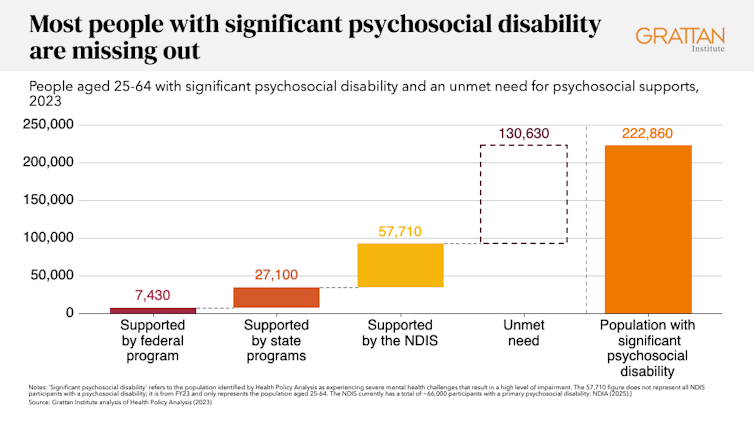
Graph showing most people with significant psychosocial disability miss out on support.
Almost 60% of adults with significant psychosocial disability have unmet needs. Grattan Institute

Access to non-NDIS supports is patchy

Federal, state and territory governments all fund small psychosocial support programs through their mental health systems. These are outside the NDIS.

Coverage is insufficient in all states and territories. The extent of support available depends far more on where you live than on your level of need.

Our analysis shows this variation is dramatic. There is a seven-fold difference in the proportion of people who receive psychosocial support outside the NDIS between Queensland (the highest) and Tasmania (the lowest).

There are also huge differences in the intensity of services offered. Queensland, for example, provides small amounts of support to relatively high numbers. In New South Wales, services reach very few people but provide more than ten times the number of hours per person.
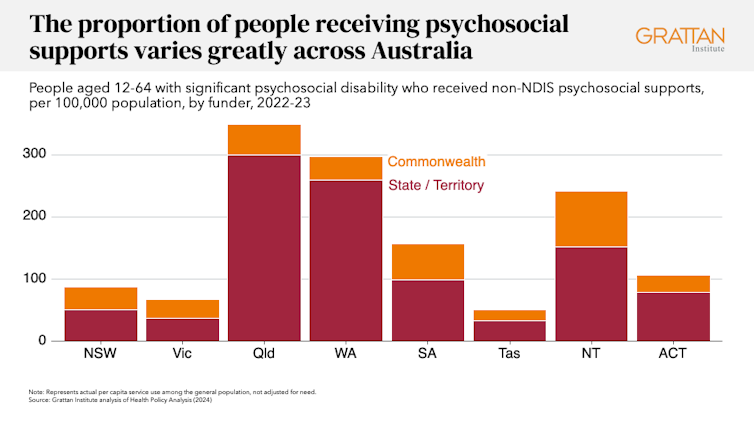
Most people with disabling mental health conditions can’t access the NDIS. Here’s a better way to provide support
A plan for more widespread support Our new report proposes a new national program of psychosocial supports, which reflects evidence of what we know works. Examples of evidence-based services include: How would the program work? Our proposal is simple: fund a tier of psychosocial supports for people outside the NDIS. Primary Health Networks (PHNs) are 31 health organisations across Australia that plan services to meet the needs of their local communities. They should be tasked with commissioning psychosocial supports, in collaboration with local providers, non-government organisations, state local hospital networks, and consumer and carer organisations. Rather than perpetuating a postcode lottery, where access to psychosocial supports depends on where you live, a PHN-led approach could provide a clearer pathway to national consistency and equity. A continuum of supports This program would not replace the NDIS, which has an important ongoing role supporting people with the most intensive support needs. A key feature of a more flexible and integrated system should also be the ability for people to “step down” from the NDIS to lower-intensity psychosocial supports outside the scheme – and to step back up again if their needs increase again. We propose the use of “zero-dollar plans”, where a person is still in the NDIS system but doesn’t receive any funding. This would enable NDIS supports to be paused without affecting a person’s ongoing NDIS eligibility status. They could resume supports at a later stage without the need to reapply. Why it doesn’t have to cost more Previously we’ve shown the problem isn’t a lack of enough money in the system, it’s how it’s distributed. Governments can fund a new program of psychosocial supports using the existing NDIS funding pool, which both the federal government and state/territory governments contribute to, rather than needing to spend more money. Delivering these supports through the NDIS budget would ensure stable funding, provide a more equitable distribution of resources, and give all governments a stake in building a more balanced system. Read more: How to reform the NDIS and better support disabled people who don't qualify for it In order to do this, governments would need to carefully redirect a small proportion of funding from NDIS supports that lack an evidence base towards the new program. Success would reduce pressure on the NDIS: if psychosocial supports outside the NDIS help people live well, they could prevent, reduce or delay the need for an individualised package in future. Governments should pivot from the current plan. This aims for federal and state/territory governments to commit to new funding for foundational supports, including psychosocial supports. Requiring new funding has led to two years of unnecessary delay. A more practical approach is to spend existing NDIS funding better to meet the needs of more Australians with significant psychosocial disability.

Authors: Sam Bennett, Disability Program Director, Grattan Institute

Read more https://theconversation.com/most-people-with-disabling-mental-health-conditions-cant-access-the-ndis-heres-a-better-way-to-provide-support-270957

The Expert's Guide to Understanding Large Bore Steel Pipe Specifications

When it comes to infrastructure, construction, and various industrial applications, the choice of materials is paramount. Among the options availabl...

Preparing for Your First Trip to San Francisco in 2026

San Francisco has long occupied a particular place in the Australian imagination. It is compact yet complex, progressive but historic, and visually st...

Modern Office Painting in Australia - It's the Real Game Changer

Walk into any modern Australian office today and you'll be struck by the fact it's a whole different beast from the ones we grew up with. Gone are t...

How to Choose the Right Suburb for Your Lifestyle

Choosing the right suburb is one of the most important decisions you’ll make when buying or renting a home. Beyond the property itself, the suburb...

Considering Cryolipolysis Fat Freezing? Here’s What You Need to Know

Body confidence can shift over time, and sometimes even good diet and training can still leave a stubborn area of fat that won’t budge. If you’r...

From Local Tradie to Digital Leader: The Strategy Behind Auto Gate Guys Sydney’s Growth

For many small trade businesses, digital marketing still feels like a buzzword, not a necessity. They rely on word-of-mouth referrals, repeat clients...

Electric Automation System: Smarter Control for Modern Electrical Infrastructure

Modern buildings and industrial facilities are increasingly dependent on intelligent control and efficiency. An electric automation system brings t...

The Damp Truth: Why Your Overflowing Gutters Are an Open Invitation for Termites

When it comes to protecting your home, most people think about visible threats — storm damage, cracked tiles, break-ins. But one of the most destruc...

Is Your Inventory a Sitting Duck? 2 Critical Upgrades to Protect Your Business Assets and Your Bottom Line

Imagine this: you finish a long day on the job, lock up your tools, materials, and work vehicle in the garage, and head home. But overnight, someone b...

Electrician in Melbourne: Reliable Electrical Solutions for Homes and Businesses

Finding a dependable electrician Melbourne is essential when safety, efficiency, and long-term performance matter. Electrical systems form the back...

Rims and Tyres for Sale in Sydney: Performance, Safety, and Style Combined

Finding the right rims and tyres for sale Sydney is about far more than appearance. Tyres and rims directly influence how a vehicle handles, brakes...

Why Access to Doctors in Bundoora Is Essential for Ongoing Community Health

Reliable access to healthcare plays a vital role in maintaining physical wellbeing and peace of mind. Having trusted doctors in Bundoora available ...

Pendant Lights: Elevating Interior Spaces With Style and Purpose

Well-chosen pendant lights have the power to transform interiors by combining focused illumination with strong visual impact. More than just a ligh...

What Sets Professional Family Lawyers in Sydney Apart from General Lawyers?

Choosing the right legal support can make a noticeable difference when dealing with family-related matters. This article will explore what separates...

Balancing Teen Academic Expectations and Wellbeing

For many teenagers, school years are shaped by increasing expectations. Academic performance, future pathways, and comparison with peers can create pr...

Why Ceiling Fans Remain One of the Most Effective Solutions for Year-Round Comfort

Creating a comfortable indoor environment without relying heavily on energy-intensive systems is a priority for many households. Installing ceiling ...

Why an Industrial Air Compressor Is Vital for Modern Manufacturing

In many industrial environments, compressed air is as essential as electricity or water. An industrial air compressor provides the power needed to ...

Why Commercial Carpet Cleaning Services Matter for Professional Spaces

Clean carpets play a major role in shaping how a commercial space looks, feels, and functions. Commercial carpet cleaning services are essential fo...















