

It may not be perfect, but history shows Australia cannot turn its back on the UN
- Written by Jon Piccini, Senior Lecturer in History, Australian Catholic University
US President Donald Trump’s invitation of selected world leaders, including Prime Minister Anthony Albanese, to join a “Board of Peace” has sparked a predictable mix of deep concern and morbid humour.
One particular point of contention is that the proposed body, which Trump suggests could be a “more nimble and effective international peace-building body”, might undermine the United Nations’ role as the preeminent global institution.
Albanese has not yet said if Australia will accept Trump’s invitation. However, history suggests it would be unwise to join the new venture. Putting aside the grave legal and ethical risks of the proposed board, Australia has long exercised a constructive influence at the UN, which has reinforced rather than undermined national interests and bilateral partnerships.
Read more: Should Australia join Trump's 'Board of Peace'? Here are 5 key points to consider
Australia at the founding of the UN
Australia was a founding member of the wartime alliance that became the “United Nations” in 1942. Labor Attorney-General H.V.“Doc” Evatt emerged as an unexpected champion of the “smaller nations” at the UN’s founding conference in San Francisco in April-June 1945.
Evatt’s success in achieving an expanded role for the General Assembly as a parliament of the world meant its “international prestige stands very high”.
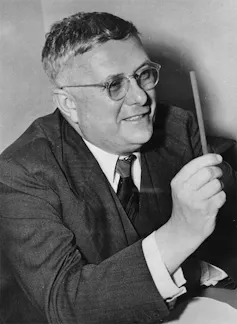
In 1946, Australia was elected to the first UN Security Council, and Evatt became president of the General Assembly in September 1948.
This was not unbridled internationalism, however. At the same time, Evatt worked assiduously to ensure Australia’s interests would be guaranteed. Under the UN Charter, Evatt happily reported to parliament on his return from the negotiations, “internal matters such as the migration policy of a state will not fall within the scope of the organisation”. Evatt had helped secure a seemingly watertight protection of “domestic jurisdiction” to protect the White Australia immigration policy.
Furthermore, Australia played an outsized role in crafting the 1948 Universal Declaration of Human Rights, one of the UN’s key documents. Australian representative in the drafting committee, ANZAC veteran William Hodgson, ensured aspects of the Labor government’s postwar agenda, including full employment and welfare, appeared in the document.
Importantly, none of this precluded Australia from strengthening bilateral and multilateral partnerships outside of, but not in conflict with, the UN. Examples of this include the ANZUS treaty (1951) and the South East Asian Treaty Organisation (1954).
Decolonisation and the UN
The UN of Evatt’s day changed radically in the era of decolonisation. New nations in Asia and Africa joined in droves, shifting the organisation’s focus to issues of anti-colonialism and racial discrimination.
On both counts, Australia was in a less than enviable position. However, it was able to use the UN as it found its place in a very new world – and eventually, as a forum to “sell” its progress.
On the one hand, Australia was empowered by the UN to bring Papua New Guinea to independence. Canberra’s lacklustre pace in achieving decolonisation saw Australia regularly targeted by both Soviet and non-aligned nations in the trusteeship council in the 1950s and 1960s.
However, by the late 1960s, and particularly under the Labor government of Gough Whitlam from 1972-5, the pace of independence accelerated. In the eyes of the UN, Australia went from colonial recalcitrant to dutiful nation builder when independence was achieved in 1975.
Whitlam’s government also brought an end to the White Australia Policy, which despite Evatt’s hopes, was indeed the subject of intense international criticism. It also signed on to numerous declarations, conventions and treaties, including the International Convention on the Elimination of all forms of Racial Discrimination.
Such engagement ensured that Australia, as Whitlam put it, “will enjoy a growing standard as a distinctive, tolerant, co-operative and well regarded nation”.
Punching above our weight
Australians have continued to play constructive and powerful roles at the UN until this day. Elizabeth Reid, Whitlam’s advisor on women, became director of the UN’s development program (1989-1998). Another Australian, James Ingram, become the first Australian head of a UN body when he assumed the role of executive director of the World Food Program (WFP) in 1983.
In the 1990s, Australia’s engagement with the UN became particularly pronounced. Australian Lieutenant-General John Sanderson led the 16,000 member United Nations Transitional Authority in Cambodia (1992-3). In 1999, after sustained protest, the Howard government agreed to head the UN’s International Force East Timor (INTERFET) operation, which brought an end to Indonesia’s bloody rule over East Timor. This in turn safeguarded the independence referendum carried out under the auspices of the UN.
The UN record on peace is less than stellar. But the record of the parties presently involved in the peace board is vastly less promising still. On a larger scale, the post-1945 international order that Australia played no small part in bringing about has been an unprecedented success in avoiding another global conflagration.
Is it perfect? Of course not. And Australia has often fallen dramatically short of its obligations to the United Nations, most recently in terms of refugee and Indigenous rights.
It was a comparative accident that Evatt found himself, and Australia, in a place to shape the UN in ways that advantaged smaller and middle powers. This board seems to offer a very different, and much less advantageous, vision of the world to a power like Australia.
Authors: Jon Piccini, Senior Lecturer in History, Australian Catholic University

















