

Modern Australian
Men's Weekly

.

New study sheds light on the threat of ‘marine darkwaves’ to ocean life

  • Written by François Thoral, Postdoctoral Research Fellow in Marine Ecology, University of Waikato

Life in the ocean runs on light. It fuels photosynthesis, shapes food webs and determines where many marine species can live.

Gradually, that light is fading. Since the early 2000s, more than one-fifth of the global ocean has darkened as sediment, nutrients and organic matter increasingly cloud coastal waters – raising concern about the future of reefs, kelp forests and seagrass meadows.

Alarming as this picture is, focusing only on gradual darkening may miss the most ecologically damaging part of the story.

Our newly published study introduces the phenomenon of “marine darkwaves”: sudden, intense episodes of underwater darkness that can last from days to months and push marine ecosystems into acute stress.

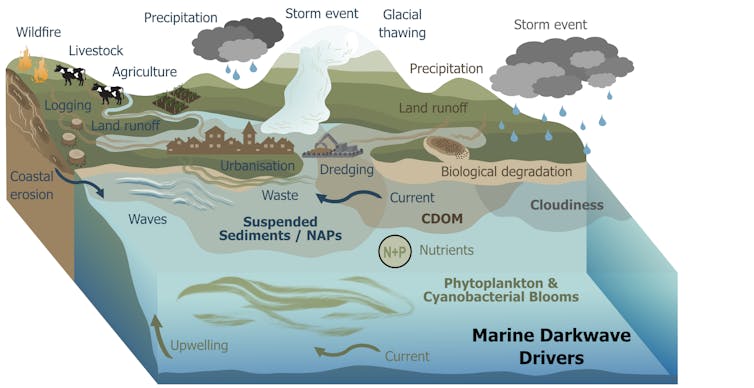
Darkness events are often triggered by storms, floods, sediment plumes or algal blooms. As with marine heatwaves, these short, intense episodes can be just as ecologically disruptive as slow, long-term trends.

Unusual underwater darkness is harmful for a range of marine ecosystems, yet the phenomenon did not have a name and definition until the marine darkwave framework was developed. Artwork of a darkened algal forest by Cassandre Villautreix, underwater picture by Leigh Tait.

Why light matters underwater

When light within the ocean drops suddenly, even for a few days, marine ecosystems can suffer. Prolonged darkness can slow growth, reduce energy reserves and in severe cases lead to dieback or mortality.

Fish, sharks and marine mammals can also change their behaviour when visibility drops, altering feeding and movement patterns.

Until now, scientists have examined ways to track long-term coastal darkening but have lacked a consistent way to identify, measure and compare extreme short-term light-loss events across regions and depths.

In other words, we have known this phenomenon exists – but we haven’t had a shared language to define and describe it. With marine darkwaves, we now have an event-based framework for extreme underwater darkness.
New study sheds light on the threat of ‘marine darkwaves’ to ocean life
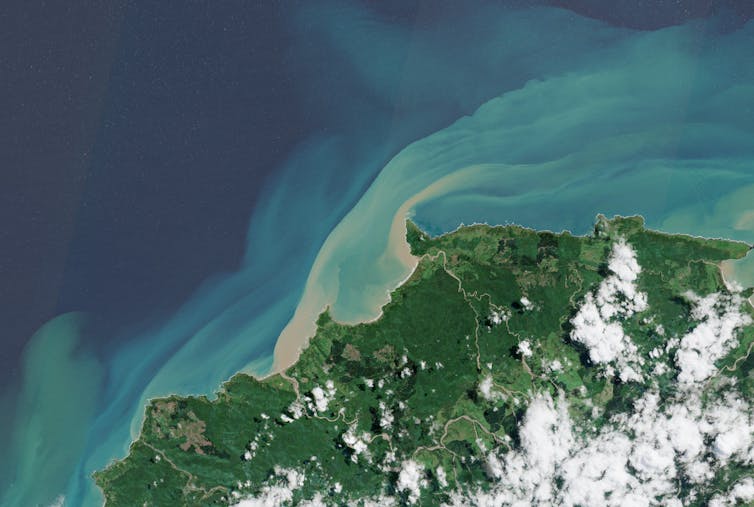
Thoral et al. (2026), CC BY-NC-SA Darkwaves occur when underwater light falls below a depth-specific threshold for a minimum duration, relative to what is normally expected at that location. This allows scientists to identify when conditions shift from merely dim to unusually dark. Importantly, this framework works across different depths, where light conditions naturally vary; across local to regional scales, from coastal reefs to entire coastlines; and across multiple data sources, including light sensors and satellite observations. Its consistency enables meaningful comparison of events that were previously difficult to place into broader contexts. What our research revealed Our study used long-term datasets from both hemispheres in markedly different coastal regions. In California, 16 years of underwater light measurements revealed repeated darkwave events, some lasting several weeks. In Aotearoa New Zealand, ten years of monitoring data from Auckland’s Hauraki Gulf showed rapid drops in underwater light during storms, at depths of seven and 20 metres. Satellite data extending back 21 years revealed a broader pattern. Along New Zealand’s East Cape coast, up to 80 marine darkwaves have occurred since 2002, most linked to storms and river-driven sediment plumes. Cyclone Gabrielle in 2023 provided a stark example. The storm delivered vast amounts of sediment to coastal waters, smothering many reefs and creating prolonged underwater darkness over large areas. In some places, the seabed received almost no light for several weeks. New study sheds light on the threat of ‘marine darkwaves’ to ocean life
Heavy sediment runoff around Waihau Bay, in New Zealand’s Eastern Bay of Plenty. This was observed following Cyclone Gabrielle on February 14, 2023 - an event that created marine darkwaves for several weeks, with continuing ecological impacts. Copernicus Sentinel data (2023), CC BY-NC-SA

Long-term averages are important, but they can smooth over the very events that cause the greatest ecological damage.

Just as a single marine heatwave can devastate kelp forests and coral reefs, a single marine darkwave can sharply reduce photosynthesis and disrupt ecosystems already stressed by warming, acidification and nutrient pollution.

Climate change is likely to increase the frequency and intensity of these events. Heavier rainfall, stronger storms and intensified land use all increase sediment and organic matter flowing into coastal waters, reducing water clarity and light availability.

Our framework allows identification of discrete periods when light thresholds critical for ecosystem function are crossed.

A new tool – and cause for hope

The marine darkwave framework complements existing tools used to track marine heatwaves, deoxygenation and ocean acidification.

By focusing on extremes, it provides clearer insights into acute stress on coastal ecosystems. In New Zealand particularly, this information is increasingly important for iwi (tribes) and hapū (sub-tribes), coastal communities, conservation groups and environmental managers making decisions about land use, restoration and marine protection.

Related monitoring work is already underway in parts of New Zealand, where expanded sensor networks aid in linking land-based processes to changes in underwater light, and linking these to ecological changes on coastal reefs.

Ultimately, marine darkwaves remind us that the ocean doesn’t always change slowly. Sometimes, it changes abruptly and quietly if we don’t pay attention.

There is also reason for cautious optimism. Many marine darkwaves are driven by land–sea connections, so their frequency and intensity are not inevitable.

Reducing sediment runoff through nature-based solutions, such as restoring wetlands, stabilising riverbanks, improving harvest techniques of exotic forests, and replanting native forests in vulnerable catchments can directly increase water clarity and underwater light.

Understanding marine darkwaves is not only about detecting change, but also about identifying practical pathways to protect coastal ecosystems before further darkness descends.

The authors acknowledge the contribution of Rahera Ohia, Ngāti Pūkenga, Jean Thoral, Leigh Tait and Cassandre Villautreix.

Authors: François Thoral, Postdoctoral Research Fellow in Marine Ecology, University of Waikato

Read more https://theconversation.com/new-study-sheds-light-on-the-threat-of-marine-darkwaves-to-ocean-life-273225

Unlock Durability And Beauty With Burnt Timber Cladding Solutions

Imagine a home or commercial space that not only stands the test of time but also tells a story through its very facade. In the world of architectur...

Offroad Caravans: Built for Adventure Beyond the Beaten Track

Australia’s vast and varied landscapes invite travellers to explore far beyond sealed roads and crowded parks. Offroad caravans are purpose-built ...

The Expert's Guide to Understanding Large Bore Steel Pipe Specifications

When it comes to infrastructure, construction, and various industrial applications, the choice of materials is paramount. Among the options availabl...

Preparing for Your First Trip to San Francisco in 2026

San Francisco has long occupied a particular place in the Australian imagination. It is compact yet complex, progressive but historic, and visually st...

Modern Office Painting in Australia - It's the Real Game Changer

Walk into any modern Australian office today and you'll be struck by the fact it's a whole different beast from the ones we grew up with. Gone are t...

How to Choose the Right Suburb for Your Lifestyle

Choosing the right suburb is one of the most important decisions you’ll make when buying or renting a home. Beyond the property itself, the suburb...

Considering Cryolipolysis Fat Freezing? Here’s What You Need to Know

Body confidence can shift over time, and sometimes even good diet and training can still leave a stubborn area of fat that won’t budge. If you’r...

From Local Tradie to Digital Leader: The Strategy Behind Auto Gate Guys Sydney’s Growth

For many small trade businesses, digital marketing still feels like a buzzword, not a necessity. They rely on word-of-mouth referrals, repeat clients...

Electric Automation System: Smarter Control for Modern Electrical Infrastructure

Modern buildings and industrial facilities are increasingly dependent on intelligent control and efficiency. An electric automation system brings t...

The Damp Truth: Why Your Overflowing Gutters Are an Open Invitation for Termites

When it comes to protecting your home, most people think about visible threats — storm damage, cracked tiles, break-ins. But one of the most destruc...

Is Your Inventory a Sitting Duck? 2 Critical Upgrades to Protect Your Business Assets and Your Bottom Line

Imagine this: you finish a long day on the job, lock up your tools, materials, and work vehicle in the garage, and head home. But overnight, someone b...

Electrician in Melbourne: Reliable Electrical Solutions for Homes and Businesses

Finding a dependable electrician Melbourne is essential when safety, efficiency, and long-term performance matter. Electrical systems form the back...

Rims and Tyres for Sale in Sydney: Performance, Safety, and Style Combined

Finding the right rims and tyres for sale Sydney is about far more than appearance. Tyres and rims directly influence how a vehicle handles, brakes...

Why Access to Doctors in Bundoora Is Essential for Ongoing Community Health

Reliable access to healthcare plays a vital role in maintaining physical wellbeing and peace of mind. Having trusted doctors in Bundoora available ...

Pendant Lights: Elevating Interior Spaces With Style and Purpose

Well-chosen pendant lights have the power to transform interiors by combining focused illumination with strong visual impact. More than just a ligh...

What Sets Professional Family Lawyers in Sydney Apart from General Lawyers?

Choosing the right legal support can make a noticeable difference when dealing with family-related matters. This article will explore what separates...

Balancing Teen Academic Expectations and Wellbeing

For many teenagers, school years are shaped by increasing expectations. Academic performance, future pathways, and comparison with peers can create pr...

Why Ceiling Fans Remain One of the Most Effective Solutions for Year-Round Comfort

Creating a comfortable indoor environment without relying heavily on energy-intensive systems is a priority for many households. Installing ceiling ...
















