

We know how to cool our cities and towns. So why aren’t we doing it?
- Written by A/Prof. Elmira Jamei, Associate professor, Victoria University
This week, Victoria recorded its hottest day in nearly six years. On Tuesday, the northwest towns of Walpeup and Hopetoun reached 48.9°C, and the temperature in parts of Melbourne soared over 45°C. Towns in South Australia also broke heat records.
This heatwave is not an outlier. It is a warning shot.
These weather conditions rival the extreme heat seen in the lead-up to the 2019–20 Black Summer, and they point to a future in which days like this are no longer rare, but routine.
What makes this summer so confronting is not just how hot it has been, but this: Australia already knows how to cool cities, yet we are failing to do it. Why?
Urban heat is not inevitable
Cities heat up faster and stay hotter than surrounding areas because of how they are built. Dense development, dark road surfaces, limited shade, and buildings that trap heat and rely heavily on air-conditioning create the “urban heat island” effect.
This means cities absorb vast amounts of heat during the day and release it slowly at night, preventing the city from cooling down even after sunset. During heatwaves, this trapped heat accumulates day after day and pushes temperatures well beyond what people can safely tolerate.
Future urbanisation is expected to amplify projected urban heat, irrespective of background climate conditions. Global climate change is making the urban heat island effect worse, but much of the heat we experience in cities has been built in through decades of planning and design choices.

Heat is a health and equity crisis
Heatwaves already kill more than 1,100 Australians each year, more than any other natural hazard. Extreme heat increases the risk of heart and respiratory disease, worsens chronic illness, disrupts sleep and overwhelms health services.
Poorly designed and inadequately insulated homes, particularly in rental and social housing can become heat traps. People on low incomes are least able to afford effective cooling, pushing many into energy debt or forcing them to endure dangerously high temperatures. Urban heat deepens existing inequalities. Those who contributed least to the problem often bear the greatest burden.
Australia has expertise, but not ambition
Here is the paradox. Australia is a major contributor to global research on urban heat. Australian researchers are developing national tools to measure and mitigate urban heat, and studies from cities such as Melbourne have quantified urban heat island intensity and investigated how urban design can influence heat stress.
Additionally, Australia already has the technologies to cool cities, from reflective coatings and heat-resilient pavements to advanced shading systems. Yet many of our cities remain dangerously hot. The issue isn’t a lack of solutions, but the failure to roll them out at scale.
Internationally, we are lagging behind countries where large-scale heat mitigation projects are already reducing urban temperatures, cutting energy demand and saving lives.
For example, Paris has adopted a city-wide strategy to create “cool islands”, transforming public spaces and schoolyards into shaded, cooler places that reduce heat stress during heatwaves.
In China, the Sponge City program, now implemented in cities such as Shenzhen and Wuhan, uses green infrastructure and water-sensitive design to cool urban areas and reduce heat stress.

Symbolic change can’t meet the challenge
Too often, urban heat policy stops at small, symbolic actions, a pocket park here, a tree-planting program there. These measures are important, but they are not sufficient for the scale of the challenge.
Greening cities is essential. Trees cool streets, improve thermal comfort and deliver multiple health and environmental benefits. But greenery has limits. If buildings remain poorly insulated, roads continue to absorb heat and cooling demand keeps rising, trees alone will not protect cities from extreme temperatures in the coming decades.
Urban heat is a complex systems problem. It emerges from how cities are built, and is largely shaped by construction materials, building codes, transport systems and planning decisions locked in over generations. Scientists know a great deal about how to reduce urban heat, but many responses remain piecemeal and intuitive rather than systemic.
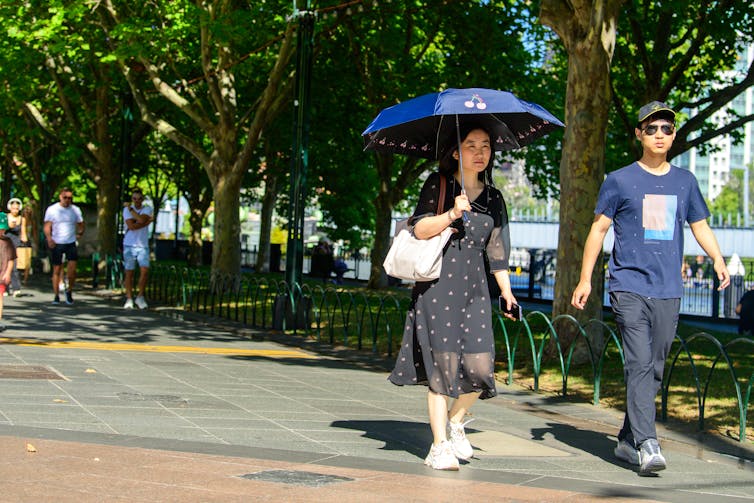
Designing an uncomfortable future
Research suggests that even if global warming is limited to below 2°C, heatwaves in major Australian cities could approach 50°C by 2040. At those temperatures, emergency responses alone will not be enough. Beyond certain temperature thresholds, behaviour change, public warnings and cooling centres cannot fully protect people.
The choices we make now about buildings, streets, materials and energy systems will determine whether Australian cities become increasingly unliveable, or remain places where people can safely live, work and age.
The battle against urban heat will be won or lost through design, technology, innovation and political will. Cities need to deploy advanced cool materials across roofs, buildings and roads, in combination with nature-based solutions. This will only work if governments use incentives to reward heat-safe design. Heat must be planned for systematically, not treated as a cosmetic problem.
With leadership and a handful of well-designed, large-scale projects, Australia could shift from laggard to leader. We have the science. We have the industry. We have the solutions. The heat is here. The only real question is whether we act, or keep absorbing it.
Authors: A/Prof. Elmira Jamei, Associate professor, Victoria University
Read more https://theconversation.com/we-know-how-to-cool-our-cities-and-towns-so-why-arent-we-doing-it-273341

















