

Is the dress green or red? Planet-friendly couture won't be for everyone but it can lead the way
- Written by: Mark Liu, Chancellors Postdoctoral Research Fellow, Fashion and Textiles Designer, University of Technology Sydney
Hollywood legend Jane Fonda hit the 92nd Academy Awards ceremony stage this week in a beaded red dress by Elie Saab – a gown she had previously worn at Cannes in 2014.
Rising star Kaitlyn Dever walked the Oscars red carpet in a deep scarlet Louis Vuitton dress she told reporters was “completely sustainable” thanks to fibre technology.
Two very different fashion approaches towards saving the planet – but how effective are they at mitigating the environmental impact of fashion? The first comes from an activist trying to be more sustainable, the second from a designer label making production changes.
Size of the problem
The fashion industry creates in excess of 85 billion tonnes of clothing a year and is responsible for 10% of global carbon emissions.
Chemical dyes in fashion create 20% of global waste water and crops such as cotton use 24% of global insecticides.
Microfibers and micro plastics from laundered garments have contaminated our beaches, bottled drinking water, and aquatic food chain.
Fast fashion promotes the reckless over-production and over-consumption of cheaply made clothing, and is reliant on exploiting inexpensive labour.
Less than 1% of fabrics can be recycled and fibre-to-fibre recycling technology is still in its infancy, without the infrastructure to address the vast amount of garments produced.
A ‘completely sustainable’ dress?
Dever’s dress was made from a material called “Tencel Luxe”, with lyocell fibre created from sustainably-grown trees. The wood is cut into tiny pieces, dissolved in a solvent and extruded into a soft cellulose fibre.
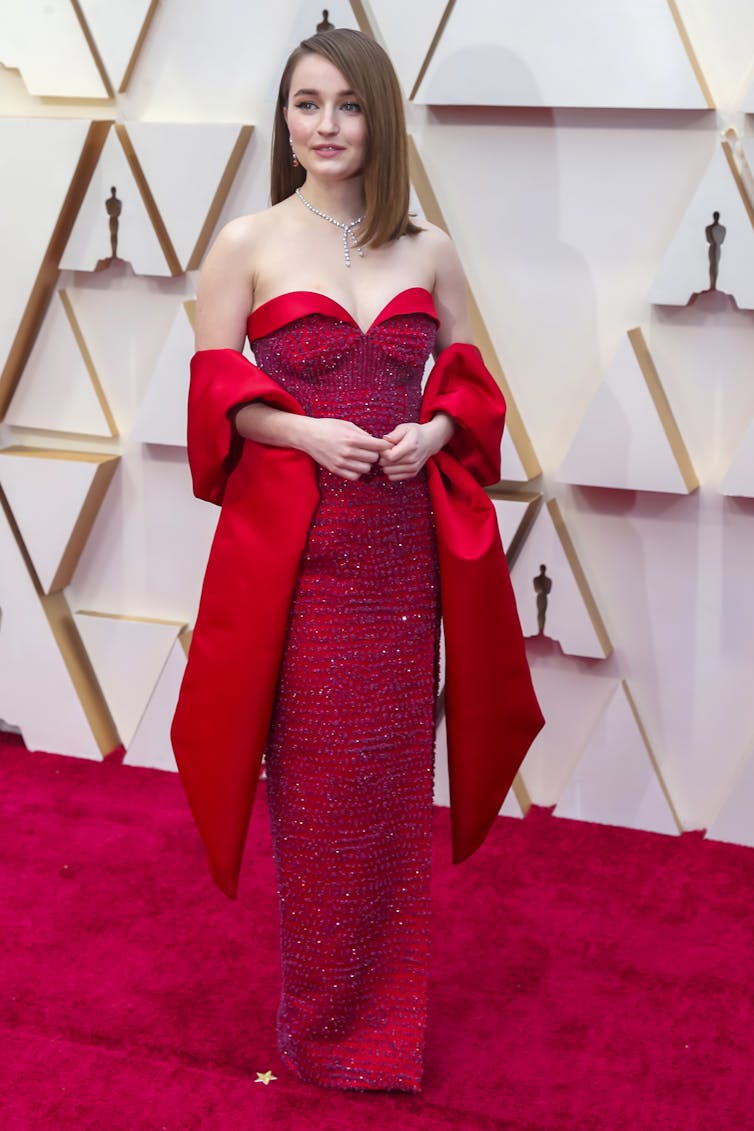 Booksmart actor Kaitlyn Dever in her Oscars dress.
DAVID SWANSON/EPA
Booksmart actor Kaitlyn Dever in her Oscars dress.
DAVID SWANSON/EPA
This process first developed in 1972 to create a cheap cotton substitute, often blended into cotton and polyester in inexpensive fabrics. Over time, lyocell improved to make a fabric more appropriate for luxurious products.
The sustainability of the fabric has also improved significantly. Today, 99% of the solvent used in the manufacturing process is recyclable. The fabric itself has the same challenges as cotton when it comes to recycling. The length of the fibres break down and shorten over time, lowering the quality when recycled into new fabrics – unless virgin material is added.
Indeed, lyocell fabric is far from perfect, and requires a large amount of energy in its production. Just substituting one material for another does not solve sustainability problems.
Read more: Time to make fast fashion a problem for its makers, not charities
Dever’s dress was made over 1,900 hours by a team of artisans with 14,400 Swarovski crystals and glass beads. A gown this opulent uses so much material, energy and labour that its carbon footprint becomes excessive.
The sustainability measure of a garment must include how it is recycled after its life. At present, some cutting edge fibre-to-fibre recycling technologies exist but Louis Vuitton is yet to offer recycling services.
The Louis Vuitton group hosts the Viva Tech Conference for exhibitors working on sustainable concepts to showcase their developments. It is encouraging that the company’s chairman and chief executive Bernard Arnault believes “sustainable, globalised growth is possible” and a priority for the company.
Read more: Five weird and wonderful ways nature is being harnessed to build a sustainable fashion industry
A second outing
With her commitment to climate change activism, Fonda has said she will no longer buy new clothing.
In a world that demands novelty, Fonda’s bold act of choosing an old gown that tastefully fits into today’s trends truly brings “vintage” clothing to the red carpet.
 Jane Fonda previously wore her dress at the 2014 Cannes Film Festival.
SEBASTIEN NOGIER/EPA
Jane Fonda previously wore her dress at the 2014 Cannes Film Festival.
SEBASTIEN NOGIER/EPA
Fonda used her celebrity influence to turn a dress on the red carpet into a political symbol.
She has vowed not to buy clothing ever again, inspired by teenage activist Greta Thunberg, who she said showed that we can’t just “go about our business” in the face of a climate emergency.
No stranger to being arrested, Fonda’s real world activism is that type needed to change government policies in ways that reign in the fashion industry.
Activists can petition governments, watch over corporations and form grassroots community groups to organise change. Celebrities who straddle the red carpet and the picket line such as Jane Fonda (or Emma Thompson for Extinction Rebellion) are key to a sustainable fashion industry.
Think before you shop
It is inspiring to see these two stars’ dresses become talking points.
It shows the public’s growing awareness of climate change and their willingness to change their behaviour to make a difference. The fashion industry will determine significant aspects of the future of our environment and the lives of over 40 million workers around the world.
From developing new green technology to changing consumer consumption behaviour and outlawing exploitative labour practices that make fast fashion possible, we are still a long way from a “completely sustainable” industry.
Corporations will need to evolve and adapt to customers who demand sustainability. They will have to offer services that recycle garments after they have been used, and embrace recycled materials. Celebrities bring these issues to the public and give them steps they can take right now.
When ask by a reporter about what people could do right now to be more sustainable, Dever said, “it’s just a matter of letting it be a part of your lifestyle”.
With fashion, I think you can think a little before you buy something brand new, and I think can also support vintage – I think that’s really, really important. And also look into the brands you’re supporting.
This is a great starting point which hopefully continues into a deeper conversation of how far we yet have to go.
Authors: Mark Liu, Chancellors Postdoctoral Research Fellow, Fashion and Textiles Designer, University of Technology Sydney


















