

Yes, the system needs to be better. But here's how to ensure your child can access the NDIS if they need it
- Written by: Karen R Fisher, Professor, Social Policy Research Centre, UNSW
Access to the National Disability Insurance Scheme (NDIS) for young children with disability is not equal across Australia. Where you live can hinder access to information about disability support, assistance to apply for it, and timely access to services.
Sadly, long-standing problems getting children into disability support were part of the reason the NDIS was introduced in the first place.
Your location can exacerbate inequity at three points: noticing your child needs support, proving they need support, and finding suitable support near you.
We interviewed families with a child who went through the NDIS process and the organisations that support them. Based on our research, we’ve collated some tips to ensure your child can access the NDIS if they need it.
1. Noticing your child might need support
Some disabilities, like physical disabilities, are visible; but many disabilities are not immediately obvious or don’t have a specific label.
Sometimes families and professionals won’t notice children need help until they get to primary school, when a teacher might suggest a child could benefit from support.
We found one common difficulty for families is wondering whether their child needs support, and what kind of support. Most families have minimal experience of disability, so this can be confusing and distressing.
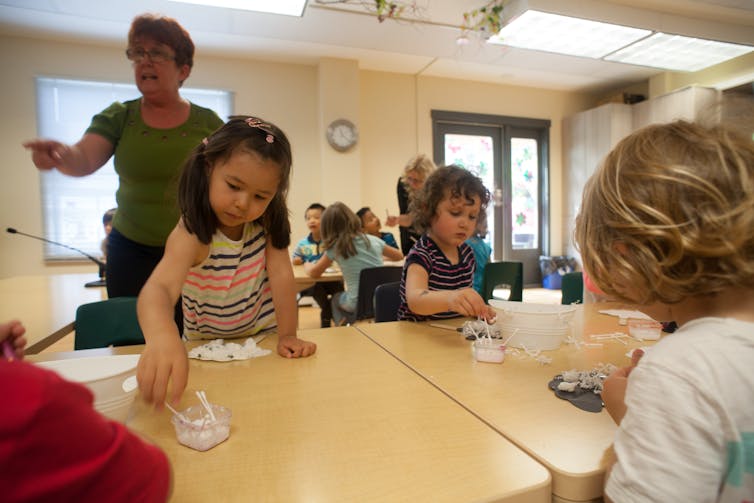 Social activities, like preschool, can be a good place to check in with other parents.
Province of British Columbia, CC BY-NC-ND
Social activities, like preschool, can be a good place to check in with other parents.
Province of British Columbia, CC BY-NC-ND
If you have any concerns, it’s a good idea to speak to health and early childhood intervention workers. Asking questions early means your child is more likely to get the support they need.
Even in regional and rural areas, most families will attend health services – whether general practitioners, community nurses or early childhood health centres. These are good places to ask if you think your child needs support.
You might also share ideas about how and where to get help with other parents and with educators at social activities like playgroup, the library, child care and preschool.
Read more: How do I know if my child is developing normally?
2. Proving your child needs support
When you know your child needs support, you must prove they are eligible.
Support is available from different parts of government, which makes it confusing – health, education, early childhood intervention services, child care and now the NDIS. Most support is free, though some families will pay for additional support.
NDIS has two support streams relevant to children.
If your child is aged up to six, contact the NDIS Early Childhood Partner (ECP) in your area.
ECPs are early childhood organisations that have partnered with the NDIS to support young children accessing the scheme. They’re free and your child doesn’t need a diagnosis to seek support.
The ECP will talk to you about what your child might need and support you to get it. Depending on your child’s needs, they will help you obtain equipment, get support from health services and education providers, and apply to the NDIS.
Read more: NDIS failing to catch children with late-onset difficulties
If your child is aged seven or above, contact your NDIS Local Area Coordinator (LAC). These services are also free. If your child is eligible for the NDIS, the LAC will explain how to get a diagnosis to prove they have “permanent and significant disability”, and how to apply for an NDIS package.
Usually getting a diagnosis relies on the health system, which can delay access to the NDIS, depending on where you live.
3. Finding suitable support for your child
Once you’ve secured an NDIS package for your child, you can choose which organisations will provide the support. The ECP or LAC can help you navigate this. Other service providers, including health professionals, educators and NDIS support coordinators can help with this too.
Once in the NDIS, our research confirmed the availability of support and range of choices varies by where you live.
Some families live in places, like rural areas, where there are not many services available. In these cases they need to find creative ways of getting support, including paying community members or using tele- or fly-in services.
 Some disabilities are visible, like physical disabilities, but many disabilities are not immediately obvious or don’t have a specific label.
Shutterstock
Some disabilities are visible, like physical disabilities, but many disabilities are not immediately obvious or don’t have a specific label.
Shutterstock
The system needs improvement
The current system relies on families or children’s services noticing the child might need support. But not all families know how to be assertive, have the capacity to ask for help or have free medical and social care in their local community.
Another difficulty is the NDIS is confusing for families, and even for support providers. First, it’s different for children aged 0-6 and older children. Second, it overlaps with education, health and other services. These factors mean families and service providers are often unsure which part of the NDIS or other services can help and how.
Every family’s experience of the NDIS is different. Some families in our research said they didn’t have enough information about the NDIS. Some families waited a long time before they could get NDIS services. Families with more education, money and information had a better experience.
Generally, families said the process worked best when their GP, early childhood educator or other service had expertise about disabilities and the NDIS, and could guide them.
Read more: Understanding the NDIS: many eligible people with disabilities are likely to miss out
The NDIS is still a relatively new system, so some difficulties are understandable. But the NDIS needs to work together with other parts of government and private services to ensure families know what supports children are entitled to and how to access them.
Any delays receiving an NDIS package or other support for a young child delays the benefit of early intervention and risks higher support needs in the long term.
Authors: Karen R Fisher, Professor, Social Policy Research Centre, UNSW


















