

Modern Australian
Men's Weekly

.

how organisations create their own red tape

  • Written by Natasha Hamilton-Hart, Professor in Management and International Business, University of Auckland, Waipapa Taumata Rau

“Dress appropriately.”

Soon after becoming General Motors’ vice president of global human resources in 2009, Mary Barra used those two words to replace a clunky employee dress code that had grown to ten pages long.

One might think that move by Barra, who now heads the company, simply signalled a return to “common sense” – meaning fewer rules and more freedom.

But in practice, “dress appropriately” actually requires something else: authority.

Employees gain more discretion, but inevitably some will get it wrong. When that happens, managers must step in and say so – a responsibility that, in General Motors’ case, some senior managers had been reportedly reluctant to exercise.

This speaks to two deeper points.

If we cede authority to people in a hierarchy – or empower them to decide what is appropriate – then we can make the rule book much shorter. And if the prospect of exercising that discretion feels uncomfortable, it suggests how unused to authority we have become.

Contemporary society, particularly in the Anglo-American world, produces rules in abundance. In this era, bosses and bossing are viewed as something of an embarrassment.

How stupid rules made for more ‘sludge’

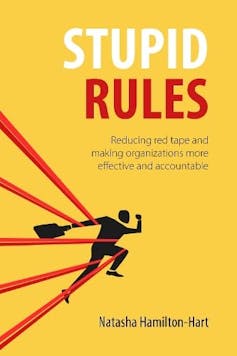
In my new book, Stupid Rules: Reducing Red Tape and Making Organisations More Effective and Accountable, I describe how a flight from authority in recent decades has stripped organisations of command capacity. This is the ability to tell others what to do without having to reference formal guidance, standards or legal rules.

I’m far from the only observer to have identified problems with the rule-heavy approach we often see taken today.

In their 2025 book Abundance, US journalists and podcasters Ezra Klein and Derek Thompson describe how land-use rules can prevent homes from being built and mire infrastructure projects in delays, rising costs and litigation.

More broadly, people struggle with red tape and pervasive “sludge” – the term used by behavioural economists for obstructive paperwork and administrative burdens.

And despite the proliferation of rules, the powerful have not been effectively restrained. Corporate lobbying has flourished and market competition has declined, as well-resourced actors have learned how to bend complex rules to their advantage.

How did we get here?

Dismantling authority was meant to make organisations more efficient and accountable. Over time, hierarchies were replaced with markets and market-like systems designed to incentivise the delivery of services such as healthcare, electricity and environmental protection.

Paradoxically, the attempt to reduce hierarchy produced more red tape. Sometimes described as neoliberal, this shift ushered in what scholars call the regulatory state.

Private markets providing services such as electricity, sewage treatment and drinking water now operate under complex rules and performance targets meant to guide their behaviour.

Yet these systems have often failed spectacularly. Each failure – whether sewage leaks, leaky buildings, healthcare scandals or other disasters – tends to trigger another round of regulation: more rules, more detailed standards and ever more elaborate performance metrics.

Is more authority the antidote?

In many cases, more detailed rules are not the answer. Organisations would often function better if they made more space for the logic of hierarchy.

Nearly a century ago, pioneering British American economist Ronald Coase explained why: firms exist because it is often more efficient to organise work through authority than through contracts and rules.

The same principle applies today. Giving decision-makers greater discretion could cut through the regulatory mire that can thwart democratically made decisions.
how organisations create their own red tape
In another American example from my book, I describe how a city government in Oregon was forced to stop construction for seven months on a water-treatment plant, even after years of planning and approvals. The city lacked authority to proceed in the face of legal objections, leading to another court hearing and increased costs. Similar problems have appeared in New Zealand. An environmental official in Christchurch described how a popular project to rewild the city’s earthquake-affected red zone ran into difficulty. He explained how situations like this are not uncommon, with planning mechanisms intended to protect the environment sometimes reducing the ecological benefits they are meant to achieve. Such “stupid rules” are not just a bureaucratic phenomenon. Many of the rules that companies work to are created by private bodies that create standards, accreditation requirements and auditing processes. Technology giant Apple’s sustainability rules, for example, set out a detailed code of conduct for its suppliers. But Apple’s own flight from authority makes these rules cumbersome and weak. Because Apple does not directly control the making of its products, its sustainability rules need to be imposed on suppliers outside the boundaries of Apple itself. Over the past 20 years, recurrent scandals saw Apple ratchet up these rules, while moving the cost of compliance onto its suppliers. Some things have improved, but the rules are in conflict with the basic structure of the supply chain set up by Apple to grind down costs. It replaced the direct control – and responsibility – of hierarchy with market exchange and contractual standards. Authority, of course, needs to be checked. But stupid rules can turn organisations into “accountability sinks” in which no one is truly responsible. Empowering decision makers – just as in that simple “dress appropriately” rule – helps restore clear lines of responsibility.

Authors: Natasha Hamilton-Hart, Professor in Management and International Business, University of Auckland, Waipapa Taumata Rau


Read more https://theconversation.com/too-many-stupid-rules-too-little-authority-how-organisations-create-their-own-red-tape-277608

Physiotherapy Strategies for Improving Independence in Daily Living

For many individuals living with permanent and significant disabilities, the concept of "independence" is not about a total absence of support, but ra...

Mobile Patrol Security vs Static Guards: What’s Best for Brisbane Businesses?

Business security is very nuanced; a cookie-cutter approach doesn’t necessarily always work in a city like Brisbane. The bigger the city, the more...

Your Home Needs Regular Maintenance — And More Than Most Think

Why Regular Home Maintenance Is More Important Than Most Homeowners Think For many Australians, the home is more than just a shelter; it is the mos...

Roof Painting Jimboomba: Protect and Transform Your Home

Your roof plays a crucial role in protecting your home from the harsh Australian climate. Over time, exposure to sun, rain, and changing weather con...

Residential Electrical Services: Reliable Solutions for Adelaide Homes

Electrical systems play a vital role in keeping your home safe, comfortable, and functional. From lighting installations to switchboard upgrades and...

Leaking Shower Repair Perth: Fix Hidden Water Damage Before It Gets Worse

A leaking shower might seem like a minor issue at first, but over time it can cause serious structural damage to your bathroom and surrounding areas...

Full Mouth Rehabilitation: A Comprehensive Dental Solution for Patients Seeking Advanced Care Abroad

Dental health plays a vital role in overall well-being, confidence, and quality of life. For individuals experiencing extensive dental issues such a...

Fertility Treatment in Australia | Expert Reproductive Care

One of the most significant journeys in life is the formation or the development of a family. To most couples and individuals, conception, however, ...

Professional Bathroom Builders Sydney: What Defines Professional Standards

Professional bathroom builders in Sydney operate within a regulated construction environment that prioritises safety, compliance, and structural durab...

Retail Cleaning Creating Welcoming and Professional Store Environments

First impressions matter in retail, and cleanliness plays a powerful role in shaping how customers perceive a store. Retail cleaning focuses on mai...

Why Year 12 Tutoring Plays A Crucial Role In Academic Success

The final year of school is one of the most demanding periods in a student’s academic journey, which is why year 12 tutoring has become an essent...

Legal Remedies Available in a Breach of Contract Case

When a contract is broken, the consequences can affect cash flow, reputation and ongoing business relationships. A breach of contract may occur when...

Long Weekend Camping in the Yarra Ranges: Three Weekends of High Country Adventure

Yarra Ranges National Park, Victoria. Image by Mattinbgn (talk · contribs), CC BY 3.0, via Wikimedia CommonsVictoria’s Yarra Ranges offer keen trav...

Why Waste Management Solutions Are Essential For Modern Businesses

Managing waste responsibly has become a critical priority for organisations of all sizes, which is why waste management solutions play such an impo...

The Importance and Varieties of Ride-On Mower Tyres

Ride-on mowers are built to manage larger lawns with consistency and control. The quality and design of ride on mower tyres play a critical role in ...

Gain Peace Of Mind: The Undeniable Benefits Of A Ready First Aid Kit

Life in our vibrant communities, whether it's the bustling city or the quiet country town, is full of unexpected moments. From a scraped knee on the...

The Most Common Conveyor System Issues in Manufacturing

In modern manufacturing, conveyor systems play a central role in keeping production lines efficient, consistent, and cost-effective. When they operate...

How to Secure a Long-Term Rental in a Competitive Market

The rental market can be unpredictable and may present challenges if you’re not prepared. Initially, you might submit numerous applications and stil...















