

What might trigger a return to 'normal'? Why our coronavirus exit strategy is ... TBC
- Written by: Katherine Gibney, NHMRC early career fellow, The Peter Doherty Institute for Infection and Immunity
The unprecedented restrictions Australians are living with are working, so far, to curb the rise in new COVID-19 cases.
Nationally, on average around 50 new COVID-19 cases were reported each day in the week leading up to April 15, compared with a peak of 460 on March 28.
Fewer people are testing positive, and these cases are infecting fewer additional people, as we close international borders, work and study from home, keep 1.5m apart and limit unnecessary travel.
New modelling indicates ten people with the virus now infect only five others.
So many people are asking when physical distancing measures can be relaxed.
When can life go back to normal?
The simple answer is, life as normal cannot resume anytime soon. Prime Minister Scott Morrison has said current restrictions will be in place for at least the next four weeks.
COVID-19 remains highly infectious, and our population is still almost entirely susceptible to catching it.
Most people won’t have been exposed to the virus and won’t have built up immunity to it. And we’re unlikely to have a vaccine for at least the next 12–18 months.
This means we need to continue to modify the way we work, socialise and travel to minimise the chance of catching the virus.
What might trigger a return to ‘normal’?
When we know who’s immune
Serosurveys survey the population for antibodies in blood that protect against COVID-19. These can indicate the proportion of the population with natural immunity after COVID-19 infection.
These studies are underway internationally, including in the United States, and are planned for Australia.
Eventually they could inform who gets vaccinated and guide decisions around lifting restrictions. But these results are still likely to be some time away.
Read more: Here's why the WHO says a coronavirus vaccine is 18 months away
Few new unexplained local cases for at least two weeks
The widespread physical distancing measures in place in Australia aim to prevent community transmission of COVID-19. This is distinct from border measures, which are designed to prevent the introduction of new cases from overseas.
As the restrictions on daily life have important health, social and economic ramifications beyond COVID-19, we will need to begin to roll them back before the Australian population is COVID-19 immune (and before we have results from serosurveys to confirm this).
These changes could begin when the number of locally acquired cases, particularly those transmitted in the community without a known source, is very low for a sustained period. This would need to be longer than the incubation period (the time from infection to symptoms showing), which for COVID-19 can be up to two weeks.
Now is an appropriate time to develop this “exit plan”, but we need to be cautious and responsive in doing so.
More testing, tracing and quarantine
First, we need an even stronger capacity to identify and isolate cases, and to trace and quarantine contacts.
As we’ve increased testing capacity in Australia, we’ve also expanded testing criteria. While initially restricted to returned travellers and contacts of a known case, some jurisdictions are now testing all people with COVID-19 symptoms – regardless of their travel or contact history – to determine the extent of community transmission.
Testing should continue to identify geographical areas or sub-populations with ongoing (or new) transmission, to pave the way for rapid and targeted public health responses.
Read more: More testing will give us a better picture of the coronavirus spread and its slowdown
Once a case is identified, a network of thousands of contact tracers work to to identify their contacts and provide advice around quarantine requirements.
Many countries have employed technological solutions such as contact tracing apps, and Australia is looking to follow suit. But such an app will be effective only if uptake is high.
Fewer than one-fifth of Singapore’s population had downloaded their TraceTogether contact tracing app by April 1, well short of their target.
When we know more about people with mild or no symptoms
Social distancing measures minimise the risk a person will transmit the virus to others when that person doesn’t know they’re infected. So before we consider relaxing them, we need to better understand the relative infectiousness of people with no or mild symptoms.
Studies currently underway are following families and close contacts of cases to see who develops typical COVID-19 symptoms, who is infected with mild or no symptoms, and who is not infected.
Likewise, understanding the role of children in transmitting infection is essential to support reopening schools, with appropriate social distancing in place. Research is similarly underway to attempt to answer this question.
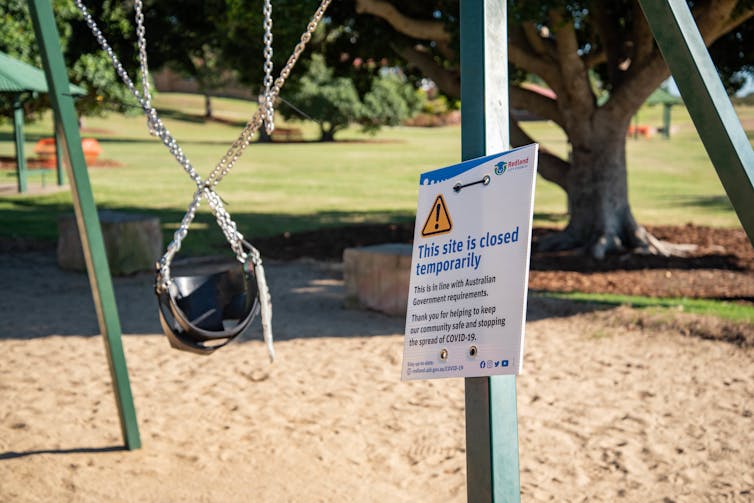 Easing restrictions comes with risks.
SOPA Images/AAP
Easing restrictions comes with risks.
SOPA Images/AAP
We will likely see restrictions lifted in stages
While returning children to classrooms and opening businesses will be a priority, restrictions around international travel are likely to be in place for many months. Isolation of cases and quarantine of contacts are likely to be ongoing.
While Australia is developing its “exit plan”, other countries have revealed theirs. Iceland has announced physical distancing restrictions will be gradually lifted starting on May 4, including increasing the limit for gatherings from 20 to 50 people, and re-opening schools and universities.
Likewise, Norway is planning to re-open kindergartens, primary schools and certain businesses from April 20.
Even the best-laid plans might not eventuate. Physical distancing measures had been relaxed in Singapore, Japan and South Korea after flattening the curve, but were recently re-introduced following a surge in cases.
No-one knows how the coming months will play out, but this is a marathon, not a sprint. We’ll need to carefully manage the risks that come with easing restrictions. But Australia is well-placed to do this, having successfully navigated the COVID-19 journey so far.
Authors: Katherine Gibney, NHMRC early career fellow, The Peter Doherty Institute for Infection and Immunity


















