

Physical distancing is here for a while – over 100 experts call for more safe walking and cycling space
- Written by: Ben Beck, Senior Research Fellow, School of Public Health and Preventive Medicine, Monash University
The coronavirus pandemic has dramatically shifted our lives and the ways we move about our cities. Despite tight restrictions on non-essential work and outings, and on social gatherings in every state and territory, governments have listed exercise as one of four essential activities. As a result, we have seen increases in the number of people walking and cycling, including children.
Physical activities such as walking and cycling are perfectly compatible with physical distancing – but only with the right infrastructure. More than 100 Australian health and transport experts have signed an open letter calling on governments to enact urgent measures to support safe walking and cycling and social distancing during the COVID-19 pandemic.
Read more: Coronavirus reminds us how liveable neighbourhoods matter for our well-being
Increased numbers lead to crowding
If you have walked or ridden around your neighbourhood, you have probably noticed more people on footpaths and shared walking and cycling paths. This increase in numbers is exposing much of our walking and cycling infrastructure as inadequate. It simply doesn’t provide enough space to follow physical distancing rules, leading to reports of overcrowding on these paths.
The pandemic has highlighted the volume of street space given to motor vehicles, at the cost of space for people to walk and cycle. Given the far lower traffic volumes on roads, cities across the globe have been reallocating road space to enable people to walk and cycle safely while adhering to physical distancing. Australian cities appear to have lagged behind.
Read more: Cycling and walking are short-changed when it comes to transport funding in Australia
The pandemic has highlighted the importance of our local neighbourhoods and the need to provide safe space locally for walking and riding, particularly for our children. As many Australians are staying home, most of our physical activity occurs on the streets and paths around our homes.
Therefore, we must focus our efforts on our neighbourhoods, local streets and shopping centres, where residents need safe and easy opportunities to be active. This includes providing safe routes to children’s schools, activity centres and other hubs.
Experts call for action
The call by more than 100 health and transport experts for infrastructure to enable safer walking and cycling has been supported by key organisations including the Heart Foundation, Public Health Association of Australia, the Australasian College for Emergency Medicine, the Australasian College of Road Safety, the Royal Australasian College of Surgeons Trauma Committee, Kidsafe, the Australasian Injury Prevention Network, Doctors for the Environment Australia, The Committee for Sydney and The Committee for Adelaide.
Across the world we see many examples of the rapid roll-out of social distancing infrastructure to support cycling and walking during the COVID-19 pandemic:
Paris is rolling out 650km of emergency bicycle lanes
Milan has announced 35km of streets will be transformed for walking and cycling
Oakland is allocating 10% of the city’s streets for walking and cycling
New Zealand has announced significant funding to help councils create more people-friendly spaces in towns and cities.
These are just a few examples. We must also consider lowering the default urban speed limit to 30km/h and reducing traffic on residential streets and around local business areas.
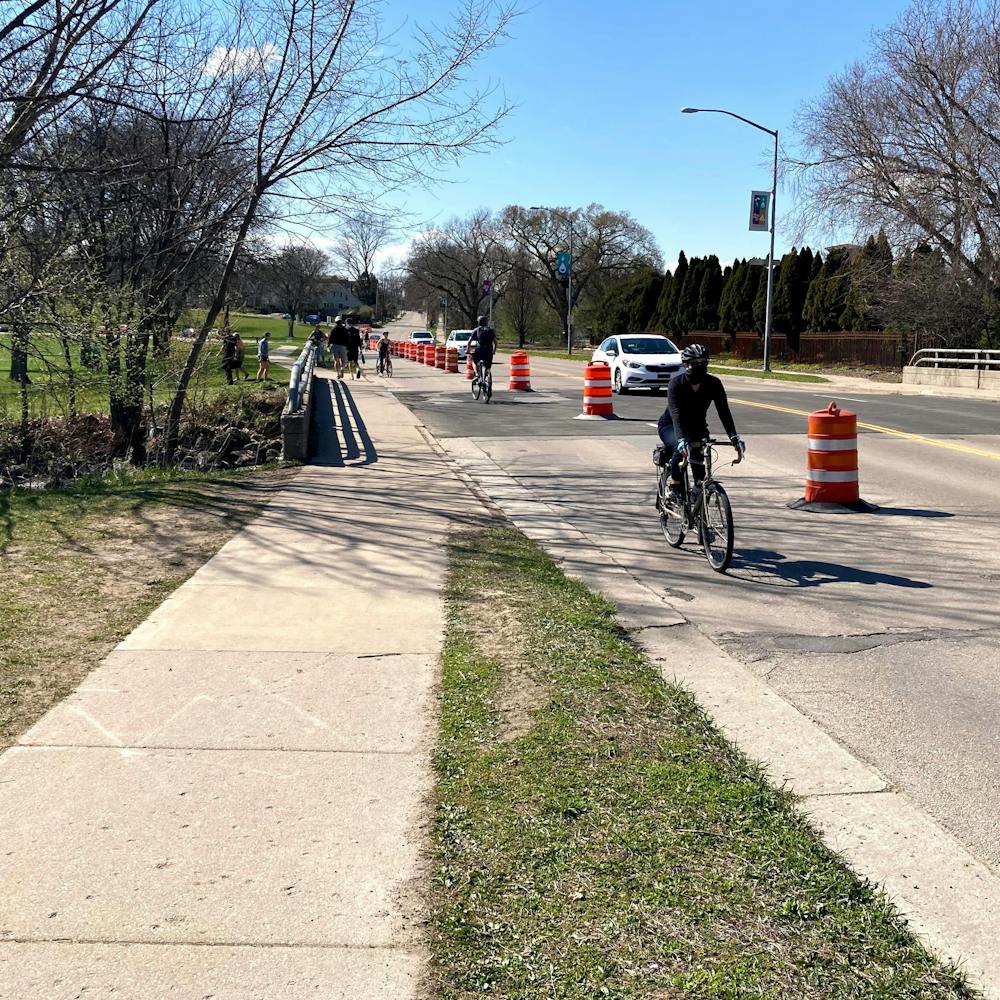 Madison, Wisconsin, has wasted no time in setting aside road space to create extra bike paths for cyclists.
Chris McCahill, used with permission, Author provided (No reuse)
Madison, Wisconsin, has wasted no time in setting aside road space to create extra bike paths for cyclists.
Chris McCahill, used with permission, Author provided (No reuse)
Read more: Cities lead the charge on the coronavirus front lines
Australia lagging behind
Despite the urgent need for connected networks of walking and cycling infrastructure in Australia, we have not seen a similar response from federal, state and territory governments.
At the moment, local councils often don’t have the authority to make changes locally or take road space without the approval of the state or territory government. We need these governments to recognise the need for rapid action and provide temporary delegation powers to local councils to enable quick infrastructure changes to support safe walking and cycling. This has happened in New Zealand and the UK.
The roll-out of this infrastructure will also be critical in reactivating the economy when physical-distancing measures are relaxed.
Financial and planning experts have recommended against investing in major road projects. Instead, they recommend smaller-scale projects that focus on sustainable modes of transport. Such projects will enable people to travel to work and school using transport modes that are both safe and healthy.
A turning point for our cities
Public transport typically moves up to half of all people travelling to work in some city centres. However, physical distancing is often a challenge on public transport. As restrictions are eased, shifting even a proportion of these passengers to walking or cycling trips will have infection-control advantages that limit transmission.
Read more: For public transport to keep running, operators must find ways to outlast coronavirus
If there is not a significant shift to cycling or walking, private car use is likely to increase. The results will be increased congestion and pollution and reduced community amenity.
Never before have we seen such a shift to active modes as our population has sought to stay healthy and active during the COVID-19 pandemic. Our immediate priority must be to tackle the inadequacies of current walking and cycling infrastructure to enable physical distancing.
Beyond this, we must look to the future. To promote active transport, we need more space that encourages these modes. We need space for health.
This is one moment in time to undo the wrongs of past transport policies that promoted the use of private cars and harmed population health and the environment. We must use this opportunity to future-proof our cities, invest in active modes of transport and ensure we provide safe and equitable mobility solutions for people today and for generations to come.
Authors: Ben Beck, Senior Research Fellow, School of Public Health and Preventive Medicine, Monash University


















