

Coronavirus 'news fatigue' starts to bite for Australians in lockdown
- Written by Caroline Fisher, Deputy Director of the News and Media Research Centre, and Assistant Professor of Journalism, University of Canberra
During social isolation, Australians have been staying at home to stop the spread of COVID-19. This has resulted in an increase in news and media consumption. After weeks of restricted movement and social distancing, Australians are restless. Not only are they tired of being in lockdown, they are also feeling worn out by news about the coronavirus.
More than two-thirds of Australians (71%) say they are avoiding news about the coronavirus and this is largely driven by news fatigue. This figure is 9% higher than our usual rate of avoidance, according to the Digital News Report Australia 2019, which showed 62% of Australians avoid the news generally.
The findings are included in a report on Australians’ news and misinformation consumption during the COVID-19 outbreak. A national representative online survey of 2,196 Australians aged 18 and older was conducted by the News and Media Research Centre at the University of Canberra in April 2020.
News fatigue is driving avoidance. About half (52%) say they are tired of hearing about COVID-19, and 46% say they find the news coverage overwhelming. Women are more likely to avoid news about the coronavirus than men because they find it upsetting. Men are more likely to avoid it because they simply feel overwhelmed by the sheer volume of news.
While news about coronavirus has provided people with an important shared topic of conversation (53%), it has also made people feel more anxious (52%).
Women were much more likely to feel an increase in anxiety because of coronavirus news (59%) than men (44%), and younger people – Gen Y in particular – have found the news coverage more anxiety-inducing than older people. This seems odd given older people are more likely to suffer serious health effects. However, job losses, isolation from friends, school closures and uncertainty about the future impact on younger people more.
The report also finds a connection between news consumption and stockpiling. People who have been consuming more news than usual were more likely to say they had stocked up on essentials (41%), compared to those whose news access had stayed the same (23%) or decreased (26%).
Overall, news consumption has been much higher during this time. More than two-thirds of Australians (71%) say their news consumption has increased since the COVID-19 outbreak, and 70% say they have been accessing news about it more than once a day. Last year, the Digital News Report Australia 2019 showed only 56% accessed news more than once a day.
Concern about COVID-19 is driving this increase in news consumption – 78% of those who say they are worried about it have started watching, reading and listening to news more often.
Read more: How some Australian media are failing us on coronavirus
On a positive note, trust in news about COVID-19 is higher (53%) than trust in news in general. Last year, overall trust in news was much lower at 44%, according to the Digital News Report. While Australians have drawn information from a range of sources during the crisis, including the government and health experts, the news media have been their main source of information.
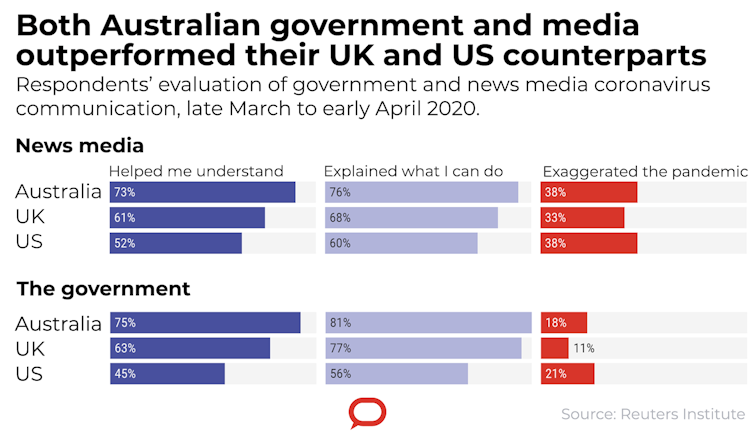
In comparison to the UK and US, the Australian news media and government have been regarded as performing better. Three-quarters (75%) of those surveyed think the government has done a good job informing them about the pandemic, compared to 63% of people in the UK and 45% in the US.
However, fewer people in the UK think the government has exaggerated this issue (11%) compared to 21% in the US and 18% here. Similarly, 33% in the UK think the news media have exaggerated the issue compared to 38% in the US and Australia.
 Reuters Institute, CC BY-ND
While there has been a lot of talk about the “infodemic” that has accompanied the health pandemic, concern about misinformation is not high. Less than a quarter (23%) of people say they have encountered a lot of misinformation about the coronavirus, and 30% say they haven’t encountered much or at all. But around one-third (36%) say they have seen it occasionally. In most cases, people have said they encounter misinformation on social media.
The post-coronavirus recovery will likely see Australia emerge into a significantly changed media landscape, marked by great uncertainty over the future of journalism. However, the question remains whether
COVID-19 will change attitudes towards news and information more permanently, or if the changes found in this survey will prove to be short-lived.
The online survey of 2,196 Australians aged 18 and older was conducted for the N&MRC by McNair yellowSquares from 18-22 April 2020. The final sample is reflective of the population that has access to the internet. We used a quota for gender, age, region and education, reflecting the Australian Bureau of Statistics 2016 Census for adults aged 18 or older. The data were weighted based on the quota. This research was supported by Deputy Vice-Chancellor Research and Innovation Strategic Funding, University of Canberra.
Reuters Institute, CC BY-ND
While there has been a lot of talk about the “infodemic” that has accompanied the health pandemic, concern about misinformation is not high. Less than a quarter (23%) of people say they have encountered a lot of misinformation about the coronavirus, and 30% say they haven’t encountered much or at all. But around one-third (36%) say they have seen it occasionally. In most cases, people have said they encounter misinformation on social media.
The post-coronavirus recovery will likely see Australia emerge into a significantly changed media landscape, marked by great uncertainty over the future of journalism. However, the question remains whether
COVID-19 will change attitudes towards news and information more permanently, or if the changes found in this survey will prove to be short-lived.
The online survey of 2,196 Australians aged 18 and older was conducted for the N&MRC by McNair yellowSquares from 18-22 April 2020. The final sample is reflective of the population that has access to the internet. We used a quota for gender, age, region and education, reflecting the Australian Bureau of Statistics 2016 Census for adults aged 18 or older. The data were weighted based on the quota. This research was supported by Deputy Vice-Chancellor Research and Innovation Strategic Funding, University of Canberra.
Authors: Caroline Fisher, Deputy Director of the News and Media Research Centre, and Assistant Professor of Journalism, University of Canberra

















