

7 ways to manage your #coronaphobia
- Written by: Jill Newby, Associate Professor and MRFF Career Development Fellow, UNSW
As we’re slowly moving out of lockdown, many Australians will be feeling anxious about going outside, away from the safety of home, and returning to normal life.
For most people, these coronavirus fears will be temporary.
But for some, being overly afraid of the coronavirus can have serious implications. People might avoid seeking medical care, isolate themselves from others unnecessarily, or be debilitated with fear.
Others have taken to social media under the hashtags #coronaphobia and #coronaparanoia to share their anxieties, some with humour.
If you’re anxious, you’re not alone. Our survey of more than 5,000 Australian adults during the peak of the COVID-19 pandemic found one in four were very or extremely worried about contracting COVID-19; about half were worried about their loved ones contracting it.
But how do you know if your fears of coronavirus are out of control? And what can you do about it?
Read more: Health Check: how do you know if you're obsessed with your health?
Here are some signs
Your anxiety may be out of control if you notice:
your fears are out of proportion to the actual danger (for instance, you’re young with no underlying health issues but wear a mask and gloves to the park for your daily exercise where it’s easy to social distance)
the fear and anxiety is intense and persistent (lasting weeks to months)
it’s hard to stop worrying about coronavirus
you’re actively avoiding situations (for instance, places, people, activities) even when they’re safe
you’re spending a lot of your time monitoring your body for signs and symptoms, or searching the internet about the virus
you’ve become overly obsessive about cleaning, washing, and decontaminating.
None of these experiences alone are a problem. But when they occur together, are persistent, and negatively impact your life, it’s time to do something about it.
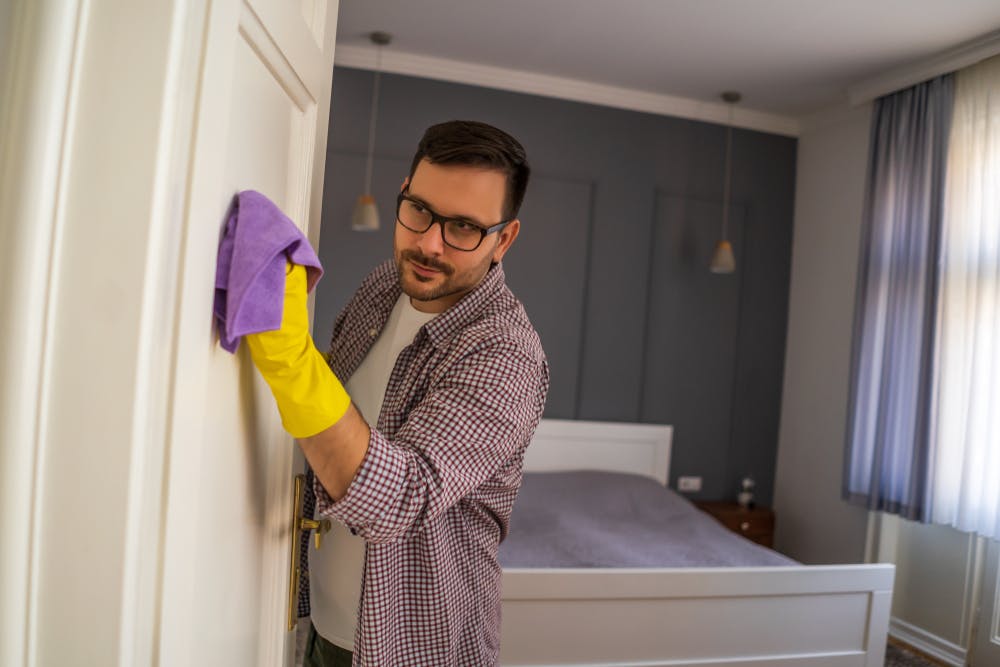 Are you cleaning the same place over and over?
Shutterstock
Are you cleaning the same place over and over?
Shutterstock
Read more: If Dr Google's making you sick with worry, there's help
These seven tips can help:
1. reassure yourself, it’ll get better: for most people, the anxiety will get better as the threat of COVID-19 passes. If anxiety doesn’t go away, it can be treated
2. change your ‘information diet’: spending time reading alarming tales of the horrors of COVID-19 will probably increase anxiety, not reduce it. Instead, try spending time focusing on positive information, stories or activities that take your mind off your fears
3. think logically about the risk: coronavirus has led to tragedy for many families, and we acknowledge the risk and consequences of contracting coronavirus differs from person to person. However, keep in mind over 90% of people infected with coronavirus in Australia have already recovered. The number of cases is also still extremely low, with 7,072 confirmed cases to date out of about 25 million people
4. reduce the focus on your body: when we pay too much attention to our bodies, it can make us notice things we wouldn’t normally notice, which then makes us more anxious. Take your mind off your body by focusing on other things, such as positive, enjoyable activities
5. take things slowly, at your own pace: it’s OK to slowly ease back into doing things you used to do. Take a step-by-step approach, doing one activity at a time, so you feel safe, while slowly building up your confidence
6. channel your anxiety into action: it can help to focus on what’s under your control. Taking active steps to look after your mental health, by sleeping well, exercising, doing fun or relaxing activities, and staying socially connected can make an enormous difference to your mental health
7. get help from professionals, not Dr Google: try an evidence-based online program for health anxiety, seek advice from your GP, or a psychologist who specialises in anxiety.
Here’s what you can do to ease your anxiety about the coronavirus (Australian Academy of Science)How about children?
Most children will be pleased to get back into their familiar routine and to re-engage with their peers and friends.
Australian research conducted with adolescents at the height of the pandemic found young people were most worried the impact of the restrictions on their education and friendships (more so than the health risk).
However, for some children, the transition back to preschool or school will be more stressful.
For younger kids, some initial separation anxiety from the family members they have been spending a lot of time with is to be expected and will typically resolve quickly.
Read more: 8 tips on what to tell your kids about coronavirus
A small proportion of children may be excessively worried about leaving the safety of home and in these cases, these tips may help:
1. have an honest and open discussion with your child: ask your child to share exactly what they are worried about. Address their concerns rationally and devise a plan with them about how they can start to face their fears in a manageable way
2. model brave behaviour: children pick up on our anxiety and fears, but also on our behaviour. Model brave behaviours to demonstrate that it is now OK to go outside, and it is safe. You can start with a walk in the park on the weekend together and then transition to attending school. Importantly, if you are feeling overly anxious about the relaxation in restrictions, it is important to address your own anxiety first, before attempting to address your child’s
3. get professional help: if your child remains overly anxious about going outside and this doesn’t resolve over a few weeks, seek professional support. The best place to start is with a GP or psychologist who specialises in anxiety.
Coronavirus mental health resources are available online. Help for adults is also available from THIS WAY UP, myCompass and MindSpot. Help for kids and adolescents is available from BRAVE-Online, ReachOut, Kids Helpline and headspace.
Authors: Jill Newby, Associate Professor and MRFF Career Development Fellow, UNSW
Read more https://theconversation.com/7-ways-to-manage-your-coronaphobia-138120


















