

How New Zealand's healthcare system is failing people with osteoarthritis
- Written by J. Haxby Abbott, Research Professor, Director of the Centre for Musculoskeletal Outcomes Research, University of Otago
Osteoarthritis is the most common form of arthritis, affecting almost 650 million people over the age of 40 worldwide.
In New Zealand, around one in eight adults have osteoarthritis, but it is a rapidly worsening problem. An ageing population and increasing rates of obesity and joint injury are contributing to the lowering of the age of onset from the early 60s to the mid to early 50s.
This will result in a 76% rise in the prevalence of osteoarthritis by 2038, including increases by 86% in health costs, 78% in joint-replacement surgery and 70% in health and productivity losses due to pain and disability.
Conventional wisdom has told us that when a person begins to suffer from the sore hips or knees of osteoarthritis, there is nothing we can do — and exercise only makes things worse and wears the joints out faster. But research has now clearly shown these assumptions to be false.
 International guidelines recommend exercise therapy as a first-line treatment.
Shutterstock/Dmytro Zinkevych
International guidelines recommend exercise therapy as a first-line treatment.
Shutterstock/Dmytro Zinkevych
Exercise therapy is now the most recommended treatment, across international guidelines. But New Zealand’s healthcare system is not delivering the most effective and inexpensive treatments, even though it is what people would want.
Instead, it delivers more costly, less effective and in some cases harmful treatments and is ill prepared to cope with increasing demand for joint-replacement surgeries.
Our research shows a comprehensive national strategy to deliver all recommended treatments, from early diagnosis and treatment through to joint-replacement surgery, would likely provide more than NZ$1 billion of value each year through cost savings and improvements in people’s quality of life and productivity.
Delivering the single most recommended treatment — a high-quality programme of specific exercise therapy — would likely save the health system around $20 million per year by reducing more expensive and ineffective treatments. It would also result in health gains worth around $450 million per year.
Read more: Exercise as therapy: its surprising potential to treat people with multiple chronic conditions
What is osteoarthritis?
Osteoarthritis mainly affects the knees and hips, and causes pain and stiffness of those joints. Many think it is simply “wear and tear” of the cartilage, but that is an unhelpful oversimplification. The condition affects the whole joint complex, including the cartilage, the bone beneath it, the capsule surrounding the joint, the lubricating fluid and the muscles around the joint.
Many people think osteoarthritis is a one-way street of inevitably worsening pain and function all the way to the surgeon’s table. This too is false.
Our joints are always in an active repair process. We can work them hard by day, and they repair by night and at rest. Osteoarthritis occurs when the stresses and strains placed on the joint, cumulatively day after day, are more than the body can keep up with repairing.
Tipping the balance just a few percent can make a big difference.
The main causes of osteoarthritis can be summed up as “mechanical factors”: stresses on the joint caused by overweight and obesity, past injuries to joint structures, weak muscles failing to protect the joint, poor alignment and excessive stresses of physical labour.
Inflammation and metabolic and nutritional factors play a role, too, but are a distant second. Heredity plays a relatively small part, and can be overcome. Recognising these underlying causes is crucial to knowing what the best treatments are.
Read more: Should I stop running if my knee hurts?
Treatment options
There has been a lot of research in the past 20-30 years about how best to treat osteoarthritis, and best-practice guidelines from around the world are unanimous in their conclusions. The most effective treatment is exercise therapy targeting the mechanical factors. Drug treatments for pain and inflammation play second fiddle, with nutritional supplements an optional extra for small additional gains.
Exercise therapy strengthens the muscles that control the joint and act like shock absorbers, attenuating stresses. Keeping the joint moving distributes forces over a wider area, lubricates the joint, reduces stiffness and stimulates repair.
Getting started can stir up some soreness, temporarily, but exercise therapy has been shown to provide better pain relief than pain killers, and reduce inflammation better than anti-inflammatory drugs.
 Exercise can trigger some temporary soreness but provides better pain relief than drugs in the long term.
Shutterstock/AstroStar
Exercise can trigger some temporary soreness but provides better pain relief than drugs in the long term.
Shutterstock/AstroStar
The second most recommended treatment is weight loss to reduce the forces acting on the joint. Walking canes and knee braces also target the mechanical causes of osteoarthritis to useful effect.
Anti-inflammatory drugs target a less potent cause of osteoarthritis, and pain-relieving drugs just mask the symptoms. Both are now second-line recommendations, to use for as short a time as possible to avoid sometimes serious adverse effects.
Joint-replacement surgery is the last resort. It is highly effective for those who need it, and provides good value for the health system, but is recommended only for people who reach end-stage disease after receiving the first and second-line treatments.
It is also in short supply, and our health system is failing to keep up with increasing demand.
Failing to deliver
There are fundamental flaws to how osteoarthritis is managed in the New Zealand healthcare system. The most recommended first-line treatments are underfunded and underrepresented.
Exercise therapy is mostly delivered by physiotherapists in the private sector, ready and willing to work within the primary healthcare system but shut out by archaic funding structures. The same applies to dieticians for weight management interventions.
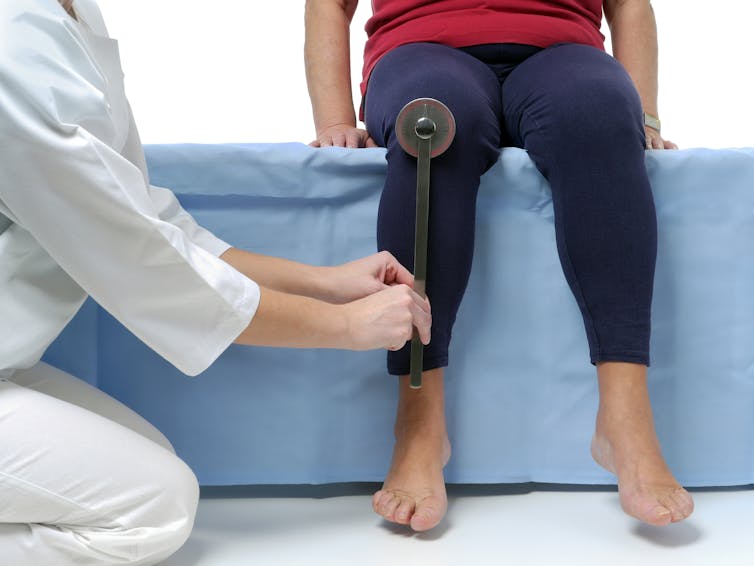 Physiotherapy is offered mostly through the private healthcare system.
Shutterstock/pryzmat
Physiotherapy is offered mostly through the private healthcare system.
Shutterstock/pryzmat
Funding barriers make GPs reluctant to refer patients to these providers for treatment, despite best-practice guidelines. By the time a patient’s osteoarthritis is severe enough to reach the priority threshold for surgery, years of increasing pain and joint damage have passed by, and the hospital system struggles to meet the growing need.
The gaps between best practice care and current reality for people with osteoarthritis are stark, but there are examples of positive initiatives. The Ministry of Health commissioned a $6 million pilot programme in 2015 to improve early access to care for musculoskeletal diseases (mainly osteoarthritis and lower back pain). It is due to report outcomes this year.
Grasping this momentum, a group of researchers, advocates and healthcare providers have presented innovative recommendations to the government and are pressing for policy progress. When all patients can access high-quality, coordinated management of osteoarthritis in primary or community care, our healthcare system will be delivering high-value care.
Authors: J. Haxby Abbott, Research Professor, Director of the Centre for Musculoskeletal Outcomes Research, University of Otago

















