

Why scrap Victoria’s ‘meaningless’ Belt and Road deal? Because it sends a powerful message to Beijing
- Written by Michael Clarke, Associate Professor, Crawford School of Public Policy, Australian National University
The Morrison government’s decision to scrap Victoria’s Belt and Road Initiative (BRI) agreement with China was based on Australia’s new Foreign Relations Act, which says the foreign minister may
ensure that arrangements entered by state or territory governments, and associated entities, are not negotiated, entered or continue in operation where they adversely affect Australia’s foreign relations or are inconsistent with Australia’s foreign policy.
In explaining her decision on Victoria’s BRI agreement, Foreign Minister Marise Payne reiterated that it was
about prioritising Australia’s national interests and ensuring there is consistency across our foreign relations.
The implication, of course, being that Victoria’s BRI agreement was not in “Australia’s national interests”.
Yet, the nature of the agreement itself, the controversy and debate surrounding it, and the overall trajectory of Australia-China relations suggests that the decision was as much performative as a practical defence of Australia’s “national interests”.
Vague agreements to ‘promote cooperation’
The nature of Victoria’s BRI “deal”, contrary to some of the breathless commentary surrounding it, was a largely a hum-drum affair.
The deal amounted to two non-legally binding memorandums of understanding (MOUs), signed in October 2018 and October 2019. These spoke vaguely of mutual commitments to “promote practical cooperation” of Chinese firms in Victorian infrastructure and Victorian firms in “China and third-party markets”.
Read more: Why is there so much furore over China's Belt and Road Initiative?
The first MOU received input from the Department of Foreign Affairs and Trade (DFAT), while the second proceeded without federal oversight.
Although Canberra was arguably right to be concerned that the second MOU proceeded without input from DFAT, the federal government’s position on the Belt and Road Initiative was not definitively settled. It was sending mixed messages.
For instance, then-Trade Minister Steve Ciobo represented Australia at China’s Belt and Road Forum in Beijing in May 2017. And several months later, the federal government signed an MOU that committed to allowing Australian companies to cooperate with Beijing on BRI-related infrastructure projects in third-party countries.
Prime Minister Scott Morrison himself also stated in an interview with a Chinese magazine in November 2018 that
Australia welcomes the contribution the Belt and Road Initiative can make in meeting the infrastructure needs of the region, and we’re keen to strengthen engagement with China in regional trade and infrastructure developments that align within the international standards of governance and transparency.
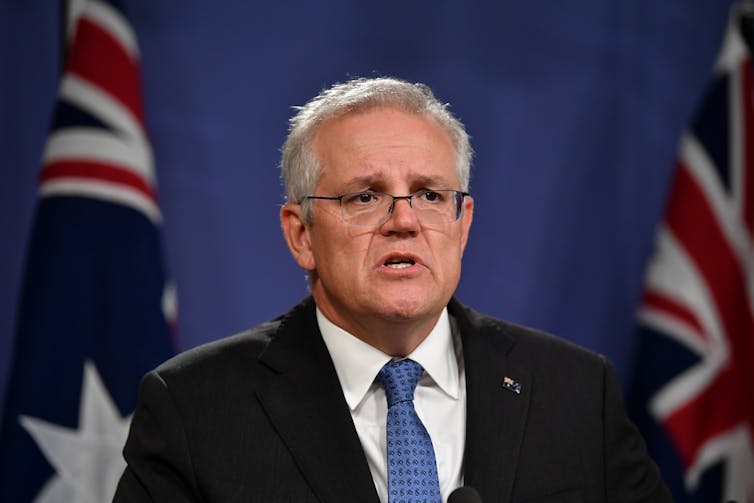 Morrison has maintained that foreign policy is the domain of the Commonwealth government and the Victorian premier should have discussed the deal with him first.
Joel Carrett/AAP
Morrison has maintained that foreign policy is the domain of the Commonwealth government and the Victorian premier should have discussed the deal with him first.
Joel Carrett/AAP
Simultaneously, however, the Morrison government resisted signing a general Belt and Road MOU with Beijing, and voiced concerns about the transparency and ultimate aims of the initiative.
DFAT Secretary Francis Adamson noted in November 2017 that Canberra would
think constructively yet clearly about the principles, rules and institutions that underpin an initiative such as Belt and Road given its scale, ambition and complexity.
What will this move mean going forward?
In the years since, Canberra’s position on BRI has clearly been informed by its concerns about its geopolitical effects.
The Morrison government also has a desire to develop alternatives to Beijing’s gambit in our immediate neighbourhood, such as signing on to the “Blue-dot Network” infrastructure investment program with the United States and Japan in November 2019.
More broadly, as relations with China have deteriorated rapidly as a result of Beijing’s “wolf warrior” diplomacy, concerns about Chinese influence and interference in Australia, and Canberra’s ill-fated pursuit of an independent inquiry into the origins of COVID-19 — among other issues — it is unsurprising the federal government has now made use of its powers under the Australian Foreign Relations Act.
Read more: China enters 2021 a stronger, more influential power — and Australia may feel the squeeze even more
The question remains as to the ultimate effect of this latest development in Australia-China relations.
Given that Victoria’s BRI agreement was almost practically meaningless, the decision appears largely symbolic in nature. It’s designed to demonstrate to the Australian public, the Chinese leadership, and Australia’s allies that Canberra is holding firm in its “push back” against Beijing.
While Payne has asserted the government remains “absolutely committed to our continuing engagement with China”, it is difficult to see how this decision contributes to that goal.
Indeed, Beijing predictably responded with anger, claiming the decision demonstrates the Morrison government has “no sincerity in improving China-Australia relations”.
 China’s embassy in Australia said the move would only ‘bring further damage to bilateral relations’ and Australia ‘will only end up hurting itself’.
Mick Tsikas/AAP
China’s embassy in Australia said the move would only ‘bring further damage to bilateral relations’ and Australia ‘will only end up hurting itself’.
Mick Tsikas/AAP
Biden reasserting US leadership in region
That, in fact, may precisely be the point as far as Canberra is concerned, given not only the current state of bilateral relations but also the emerging approach of the Biden administration.
US President Joe Biden has already asserted that US-China relations will be defined by “extreme competition”. And his secretary of state, Antony Blinken, has sparred with his Chinese counterpart on China’s “unfair” economic practices, repression in Hong Kong and Xinjiang, and Beijing’s “regional assertiveness”.
Moreover, Biden has proclaimed that “America is back”, and that it will work with allies and partners around the world
to secure the peace and defend our shared values and advance our prosperity.
These signals have been music to many ears in Canberra because they appear to demonstrate both the Biden administration’s recommitment to US leadership in the region and Biden’s acceptance that strategies of “engagement” with Beijing have failed.
All of this simply reinforces the downward trajectory of Australia-China relations.
Although Canberra may well be comfortable with this state of affairs, it should remain wary of locking itself into an adversarial relationship with its largest trading partner while its alliance partner’s ultimate strategy toward China remains a work in progress.
Two key Biden administration officials (National Security Council Indo-Pacific Coordinator Kurt M. Campbell, and National Security Advisor Jake Sullivan, for instance, have noted that American strategy toward Beijing should “seek to achieve not a definitive end state akin to the Cold War’s ultimate conclusion”, but rather “a steady state of clear-eyed coexistence on terms favourable to US interests and values”.
Canberra needs to remain alive to the possibility the Biden administration may seek to attenuate the costs of “extreme competition” through a strategy of “coexistence”. In such a scenario, performative “push back” leaves Australia vulnerable.
Authors: Michael Clarke, Associate Professor, Crawford School of Public Policy, Australian National University

















